

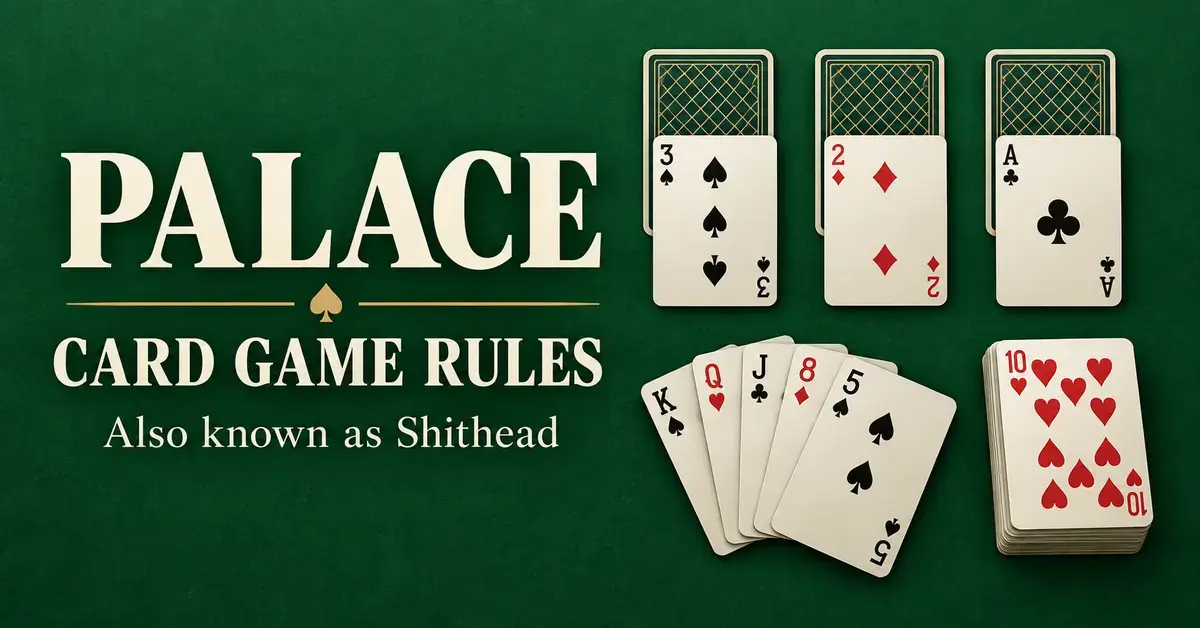
Palace is a fast, chaotic shedding game played with a standard deck of cards, loved for its sudden reversals of fortune and its blind-luck finish. If you have met it under a ruder name, you are not mistaken: Palace is the polite title for the game most people know as Shithead, and it also goes by Karma, Shed and Caboodle in different parts of the world. The aim is simple to state and surprisingly hard to pull off: be the first player to get rid of every card you hold. The last player left holding cards is the loser.
What makes Palace so moreish is that you juggle three sets of cards at once — a hand you can see, face-up cards on the table, and a row of mystery face-down cards you cannot look at until the very end. A single well-timed 10 can wipe the pile clean, and a careless turn can leave you scooping up thirty cards. This guide explains the full Palace card game rules in plain, beginner-friendly language, including the deal, the special cards, the three stages of play, popular variants, and the etiquette that keeps a game moving.
Game Snapshot
| Detail | At a Glance |
|---|---|
| Also known as | Shithead, Karma, Shed, Caboodle |
| Players | 2–5 (best with 3+) |
| Equipment | Standard 52-card deck |
| Game type | Shedding / beat-the-pile |
| Difficulty | Easy to learn, quick to play |
| Objective | Be the first to get rid of all your cards |
| You lose if | You are the last player holding cards |
What You Need to Play Palace
Palace needs only a standard 52-card deck and two to five players, though most people agree it shines with three to five. Jokers are left out of the basic game. You will also want a clear, flat surface, because each player builds a small layout of cards in front of them and everyone shares one central pile.
The game suits a mixed group. It is light enough for families and casual gatherings, yet it rewards a little cunning, which is why it sits comfortably beside other classic standard-deck games such as Crazy Eights. There is no money or betting involved in standard Palace — it is purely a social card game.
Card Ranking in Palace
Most cards rank in their natural order. From low to high the ranking is 3, 4, 5, 6, 7, 8, 9, Jack, Queen, King, Ace — so the Ace is the highest ordinary card. Two cards break this pattern because they are “magic” cards with special powers rather than fixed values:
- The 2 is a reset card that can be played on anything, and anything can be played on top of it.
- The 10 is the burn card that clears the entire pile out of the game.
Because these two ranks ignore the normal order, it helps to think of 2s and 10s as tools rather than numbers. Everything else is beaten simply by playing a card of equal or higher rank.
Setting Up: The Palace Deal
The deal is the heart of Palace, because it creates the three layers of cards each player will work through. Choose a dealer, then deal to every player, one card at a time, in this exact order:
- Three face-down cards in a row in front of each player. Nobody looks at these.
- Three face-up cards placed directly on top of the three face-down cards, so each face-down card has a visible card covering it.
- Three cards dealt face down as a hand, which each player picks up and looks at.
The remaining cards form the draw pile (also called the stock), placed face down in the centre. That pile feeds your hand during the early game.
The Swap: Setting Up a Strong Table
Before the first card is played, every player may swap any number of cards between their hand and their three face-up table cards. This is your one chance to plan ahead. Because your face-up cards are the second-to-last thing you will play, you want them to be powerful: load them with high cards, 2s and especially 10s, so that when your hand runs out you still have ammunition on the table. Move weak low cards into your hand to get rid of them early.
Special Cards Cheat Sheet
| Card | Power | Status |
|---|---|---|
| 2 | Reset — play on any card; the next player may play anything | Core rule |
| 10 | Burn — removes the whole pile from the game; same player goes again | Core rule |
| Four of a kind | Burns the pile like a 10, in one turn or completed across turns | Core rule |
| 7 | Play under — next player must play 7 or lower | Popular variant |
| 8 | Skips the next player, or is transparent | Popular variant |
| 3 | Mirror / transparent — next player beats the card beneath it | Popular variant |
Who Goes First
A common way to decide the first player is that whoever holds the lowest starting card leads — traditionally the player with a 3 begins, often the 3 of clubs. If nobody can start with a 3, the lead passes up to the next lowest available card (a 4, then a 5, and so on). A simpler house method is to let the player to the dealer’s left start. Play then proceeds clockwise.
How a Turn Works
On your turn you play one or more cards onto the central pile, trying to match or beat the card on top. The core rules are short:
- You must play a card equal to or higher than the top card of the pile.
- You may play several cards of the same rank at once — for example two 7s or three Kings together — as long as they meet the beat-or-match requirement.
- If you cannot (or choose not to) play a legal card, you must pick up the entire pile and add it to your hand. Your turn then ends.
Picking up the pile is the thing you most want to avoid, and the threat of it is what gives Palace its tension. A big pile landing in your hand can set you back enormously.
Keeping Your Hand Topped Up
While the draw pile still has cards, you must keep at least three cards in your hand. At the end of your turn, if you have fewer than three, draw from the stock until you are back to three. You always draw after playing, never before. Once the draw pile is empty, you simply play on with whatever you have and no longer refill.
The Special Cards
Two special cards are part of nearly every version of Palace, and they are what make the game swing so wildly.
The 2 — Reset
A 2 can be played on top of any card, no matter how high, and it resets the pile. The next player may then play absolutely anything, because a 2 counts as the lowest possible card to beat. Twos are handy escape hatches when the pile has climbed to Kings and Aces and you are out of high cards.
The 10 — Burn the Pile
A 10 can be played on any card at any time, and it “burns” the pile: the whole pile is removed from the game entirely (set it aside — those cards never come back). The player who played the 10 then immediately plays again, starting a fresh pile with any card they like. A well-saved 10 is one of the strongest moves in the game.
Four of a Kind — Also Burns
If four cards of the same rank end up on top of the pile, the pile is burned exactly as if a 10 had been played. This can happen in one turn (playing all four at once) or across several turns if players each add the same rank, completing the set of four. Whoever lays the fourth card clears the pile and starts again.
Popular Variants: 7s, 8s and 3s
Palace is a folk game with countless house rules, and three more “magic” cards appear in many groups. Agree on these before you start, because they change the game a lot. They are optional add-ons rather than part of the core rules.
- The 7 — play under: after a 7 is played, the next player must play a card equal to or lower than 7 instead of higher. This flips the usual direction and can trap players sitting on only high cards.
- The 8 — skip or invisible: depending on the group, an 8 either skips the next player’s turn or is “transparent,” meaning the next player must beat whatever card sat beneath the 8.
- The 3 — mirror: in some versions a 3 is transparent, so the next player must match or beat the card underneath it rather than the 3 itself.
Because these rules vary so much from table to table, it is worth a thirty-second chat before dealing so everyone plays the same game. If you enjoy games where a handful of cards carry special powers, you will recognise the same design idea in matching-and-shedding classics across the family.
The Three Stages of Play
Every player works through their cards in a fixed order, and this structure is what builds the dramatic finish.
Stage 1: Your Hand
You play from the cards in your hand, refilling from the draw pile to keep three until the stock runs out. Most of the game happens here. Your goal is to shed weak cards early and hold onto 2s, 10s and high cards for when the stock is gone.
Stage 2: Your Face-Up Cards
Once your hand is empty and the draw pile is exhausted, you start playing your three face-up table cards. These are visible to everyone, so there are no surprises — which is exactly why you stacked them with strong cards during the swap. You play them under the same beat-or-pick-up rules.
Stage 3: Your Face-Down Cards
When your face-up cards are gone, only the three mystery face-down cards remain. You cannot look at them. On your turn you flip one over blindly and it must be played as-is. If the flipped card beats or matches the pile, great; if it does not, you pick up the whole pile (plus that card) and must clear your hand all over again before you can return to your face-down cards. This blind finish is pure nerve — much like the luck-driven showdown in the classic War card game.
Winning and Losing
The first player to successfully get rid of all nine of their cards — hand, face-up and face-down — is out and safe. Play continues for everyone else until only one player is left holding cards. That final player is the loser, traditionally crowned the “shithead,” and in many groups they deal the next game (or shuffle for the rest of the night). There is usually only one loser worth naming; the real goal is simply not to be last.
How Palace Compares to Similar Card Games
Palace belongs to the shedding family, where the object is to empty your hand rather than win tricks or build melds. It is often confused with President (also called Asshole), but the two play very differently: President is a climbing game where you beat the previous play and ranks carry over between rounds, while Palace is a beat-the-pile game with table cards and burns. If you like one, the other is an easy next step — see our full guide to the President card game. For something faster and more frantic, the two-player speed game Spit scratches a similar itch.
Similar Shedding Games Compared
| Game | Type | Players | Deck | Key feature |
|---|---|---|---|---|
| Palace / Shithead | Beat-the-pile shedding | 2–5 | Standard 52 | Face-up and blind face-down cards; burn with 10s |
| President | Climbing / ranking | 4–7 | Standard 52 | Player ranks carry between rounds |
| Crazy Eights | Matching / shedding | 2–5+ | Standard 52 | Match rank or suit; 8s are wild |
| Spit | Speed shedding | 2 | Standard 52 | Simultaneous real-time play, no turns |
| War | Luck / comparison | 2 | Standard 52 | Highest card wins; no decisions |
Quick Strategy Tips for Beginners
- Hoard your 2s and 10s. They are your safety net. Playing a 10 when the pile is large denies everyone that pile and gives you a free extra turn.
- Dump low cards early while the draw pile still refills your hand, so you are not stuck with 3s and 4s in the blind stage.
- Stack strong face-up cards during the swap — ideally at least one 2 or 10 — so Stage 2 is not a liability.
- Watch the pile height. If the pile is huge and you are forced to pick up, try to burn it with a 10 or four-of-a-kind first.
- Use multiples wisely. Playing all your Kings at once feels powerful, but spreading pairs across turns can keep you flexible.
Palace rewards practice more than it first appears, and players who enjoy thinking a few moves ahead often graduate to deeper games such as those in our traditional card game guides.
Reference Sources
Frequently Asked Questions
Is Palace the same game as Shithead?
Yes. Palace is simply a family-friendly name for the game commonly called Shithead, and it is also known as Karma, Shed and Caboodle. The rules are identical; only the name changes depending on the group or region.
How many players do you need for Palace?
Palace works with two to five players using a single standard 52-card deck, and most people find it best with three or more. For larger groups you can shuffle two decks together and deal the same way, which keeps everyone involved.
What happens when you cannot play a card?
If you cannot play a card equal to or higher than the top of the pile (or a special card such as a 2 or 10), you must pick up the entire pile and add it to your hand. Your turn then ends, and play passes to the next person.
What do the 2 and the 10 do in Palace?
A 2 resets the pile: it can be played on any card, and the next player may then play anything. A 10 burns the pile, removing all of those cards from the game permanently, after which the player who played the 10 starts a fresh pile and takes another turn.
Who wins Palace?
The first player to get rid of all their cards — hand, face-up and face-down — is out and safe. The game continues until one player is left holding cards; that last player loses and, by tradition, deals the next round.