
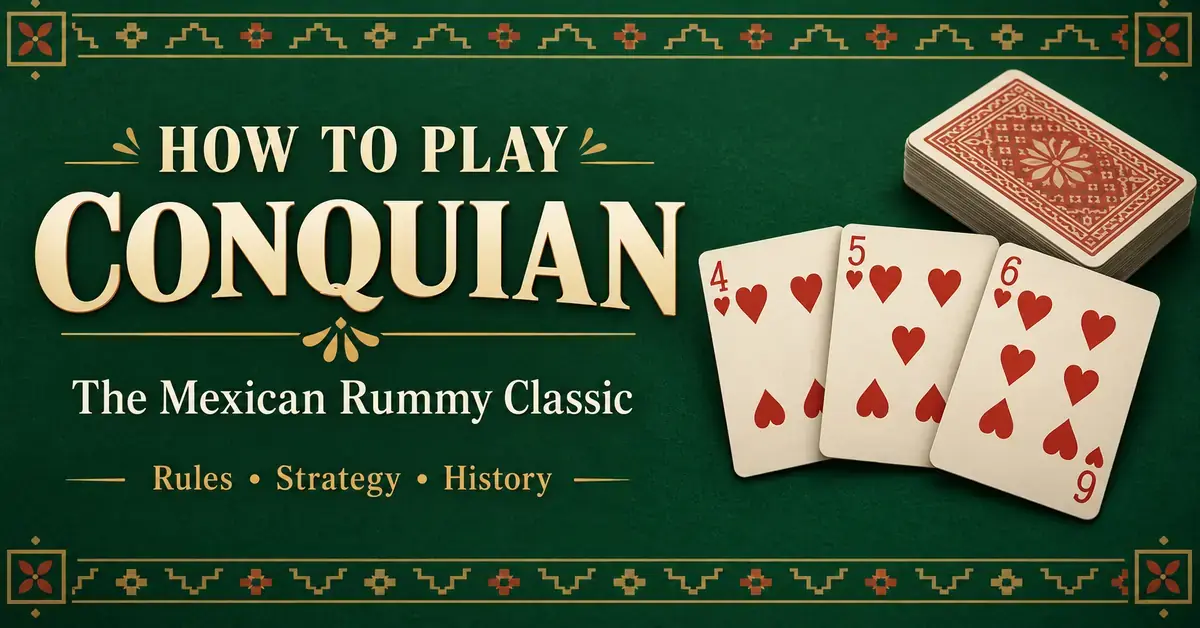
Conquian is the game that started it all. Long before anyone shuffled up for a hand of modern rummy, players in 19th-century Mexico were drawing, melding and discarding in a sharp two-player contest that card historians now recognise as the ancestor of the entire rummy family. If you enjoy the meld-building tension of today’s classic card games, learning Conquian is like meeting the great-grandparent who gave them all their best features.
This guide explains everything a beginner needs: the unusual 40-card deck, how melds work, the clever “forcing” rule that makes Conquian so cut-throat, how to win by melding exactly 11 cards, and a short strategy section to get you winning faster. We will also trace the game’s remarkable journey from Mexico City card tables to the saloons of the American Southwest.
Key Facts
- Players: 2 (classic version)
- Deck: 40 cards (remove 8s, 9s, 10s from a standard pack)
- Cards dealt: 10 each, with a 20-card stock
- Goal: be first to meld 11 cards
- Melds: sets of 3-4 same rank, or suited runs of 3+
- Key rule: every card you take must be melded at once – never held in hand
- Origin: Mexico, documented from 1852; ancestor of modern rummy
What Is Conquian?
Conquian (pronounced roughly “con-kee-AHN,” and also written Coon Can, Cooncan or Conquain) is a two-player card game in which both players race to build their entire hand into valid melds. A meld is simply a legal combination of cards: either a set of three or four cards of the same rank, or a run of three or more cards of the same suit in sequence.
What makes Conquian stand apart from every other rummy game is a single strict rule: you never pick a card up into your hand. Any card you take must be melded onto the table immediately. There are no hidden combinations building up in your fist and no generous “lay-offs” onto your opponent’s work. Every decision is made in the open, which turns a seemingly gentle card game into a tense battle of timing and card-reading.
Because the deck is small and the margins are thin, a huge share of Conquian hands end with neither player going out at all. That scarcity is the whole point: Conquian rewards patience, planning and the discipline to pass on a card you cannot yet use.
The History of Conquian: From Mexico to the Rummy Family
Origins in 19th-century Mexico
Conquian is firmly rooted in Mexico in the middle of the 1800s. The name appears in New Mexico legal documents as early as 1852, where it was listed among permitted recreational games, and an account from 1857 describes the game being played in Mexico City. Court records from 1861 suggest it was already well established in the preceding decade. The name itself is usually traced to the Spanish phrase “con quien” (“with whom”), which English speakers later reshaped into the folksy “Coon Can.”
How Conquian spread
From Mexico the game travelled north with the movement of people across the border. It had reached Texas by the 1860s, spread through the American Southwest by the 1880s, and was being played across the eastern United States by around 1900. It even crossed the Atlantic, with English references appearing by 1912. For a game played with a humble stripped deck, that is a wide and well-documented footprint, and it fits neatly into the broader story of how playing-card traditions migrated and mingled, much like the one told in the history of playing cards in Canada and North America.
Why Conquian matters: the grandfather of rummy
Conquian’s real significance is its influence. The card-game scholar David Parlett describes it as an ancestor of all modern rummy games and “a kind of proto-gin rummy.” The core loop of drawing, forming sets and runs, and discarding one card per turn is the engine behind countless later games. If you already know how to play Gin Rummy, you are essentially playing a polished descendant of the moves Conquian invented more than 170 years ago.
What You Need to Play Conquian
The 40-card Conquian deck
The standard English-language version of Conquian is played by two people with a 40-card deck. You make that deck from an ordinary 52-card pack by removing all of the 8s, 9s and 10s. The Jacks are kept, but they now act as the next card up from the 7 (effectively standing in for the 10’s old position). The traditional Mexican game uses a 40-card Spanish-suited pack (coins, cups, swords and clubs) instead, but the stripped standard pack is the easiest version for most readers to set up at home.
Card ranking and sequences
The ace is always low. Because the 8, 9 and 10 are gone, the ranking from low to high is: Ace, 2, 3, 4, 5, 6, 7, Jack, Queen, King. The single most important quirk to remember is that the 7 sits directly next to the Jack. That means 6-7-Jack is a legal run and A-2-3 is a legal run, but the sequence never wraps around, so King-Ace-2 is not allowed.
Conquian at a Glance
| Element | Detail |
|---|---|
| Card ranking (low to high) | A, 2, 3, 4, 5, 6, 7, J, Q, K |
| Valid run example | 6-7-Jack of the same suit |
| Valid set example | Three Queens of different suits |
| Sequence wrap-around | Not allowed (K-A-2 is illegal) |
| Lay-offs on opponent | Not allowed in the classic game |
| Rearranging your own melds | Allowed, if no group drops below 3 cards |
| Stock exhausted with no winner | Hand is a draw |
How to Play Conquian: Step by Step
The deal
Decide who deals (the loser of each hand usually deals the next). The dealer gives each player 10 cards, one at a time, face down. The remaining 20 cards are placed face down in the centre as the stock. There is no separate discard pile to draw from in the classic game; instead, cards are turned up from the stock one at a time, and declined cards are turned face down and set aside permanently.
Melds: sets and runs
There are only two kinds of meld in Conquian, and both are easy to learn:
- Sets: three or four cards of the same rank in different suits, for example three Queens.
- Runs: three or more cards of the same suit in unbroken sequence, for example the 5-6-7 of hearts, or 6-7-Jack of spades.
All of your melds are laid face up in front of you on the table as you build them. They are yours alone, and your opponent’s melds are entirely separate.
A turn in Conquian
Play begins with the non-dealer. On your turn, the top card of the stock is turned face up in the centre. You then make a choice:
- Take and meld it: if the face-up card lets you complete or extend one of your melds, you may take it, but you must immediately lay it down in a valid meld using cards already in your hand. You then finish your turn by discarding one unwanted card face up for your opponent to consider.
- Pass: if you cannot or do not want to use the card, you pass. The card is then offered to your opponent, who may take and meld it. If they also decline, it is turned face down and removed from play for the rest of the hand.
The crucial rule bears repeating: you can never simply draw a card into your hand to hold for later. If you take it, it must be melded on the spot. This is what gives Conquian its distinctive, high-pressure rhythm.
Forcing your opponent
Here is the rule that gives Conquian its teeth. If the current face-up card can be added to one of your opponent’s existing melds without them needing to contribute any card from their own hand, you are allowed to force them to take it. They must accept the card and meld it, then discard as normal. Skilled players use forcing to fill their opponent’s hand with cards they did not want, clogging their plans and slowing their race to 11.
Borrowing and rearranging melds (the corte)
Your tabled melds are not frozen. On your turn you may rearrange your own melds, a move sometimes called the corte or “switching.” For instance, you can pull a card out of a run to start a new set, as long as every group left on the table still contains at least three valid cards. This flexibility is a powerful tool for squeezing an extra meld out of limited material, but it must never leave an illegal, too-short group behind.
How to win
The goal is to meld a total of 11 cards. Since you are dealt only 10, the 11th card always comes from the centre of the table on the turn you go out. The moment you successfully meld that 11th card and are left with nothing to discard, the hand ends immediately and you win. Many players enjoy Conquian as a series of hands, keeping a running tally of wins to decide an overall match.
When the stock runs out
If the stock is exhausted before either player has melded 11 cards, the hand is a draw with no winner. Far from being a flaw, this is a defining feature of Conquian: tied hands are common, and the scarcity of useful cards is exactly what makes every take-or-pass decision matter so much.
Conquian Strategy and Tips
Conquian is a game of patience punished by greed. These principles will sharpen your play:
- Plan your full hand before you commit. Because every take forces an immediate meld and a discard, grabbing a card too early can lock you into a shape you later regret.
- Favour flexible cards. Middle cards such as 4s, 5s and 6s belong to more potential runs than extreme cards like aces or kings, so they keep your options open.
- Watch what your opponent cannot use. Every card passed and turned down is information. If a suit’s run cards keep getting rejected, you can read what your rival is holding and what is now dead.
- Use forcing as a weapon. When you can legally force a card onto your opponent’s meld, consider whether doing so disrupts their plan or hands them a free lay. Timing is everything.
- Discard with care. Your discard is offered to your opponent before it is lost, so never throw a card that completes an obvious meld for them. The same read-and-withhold discipline rewards players of other meld games such as Rummy 500.
- Respect the tie. Sometimes the correct play is to block rather than to chase, steering the hand toward a draw you can win next deal rather than handing your opponent the race.
Conquian vs Other Rummy Games
Conquian may be the oldest member of the rummy family, but its relatives have taken the basic idea in many directions. The table below compares it with popular descendants and cousins so you can see what makes each one distinct.
| Game | Players | Deck | Goal | Signature feature |
|---|---|---|---|---|
| Conquian | 2 | 40 cards (8s, 9s, 10s removed) | Meld 11 cards | No drawing into hand; cards must be melded at once |
| Gin Rummy | 2 | 52 cards | Knock or go gin with low deadwood | Hidden hand and knocking |
| Rummy 500 | 2-8 | 52 cards (+ jokers) | Reach 500 points | Scoring melds over many hands; lay-offs allowed |
| Continental Rummy | 2-12 | 2+ decks with jokers | Meld a set contract in one go | Must meld the whole hand at once |
| Canasta | 4 (partners) | 2 decks with jokers | Score with canastas of seven | Wild cards and seven-card melds |
| Machiavelli | 2-5 | 2 decks | Empty your hand | Rearranging all melds on the table |
If you like Conquian’s emphasis on efficient melds, the larger, more social meld games are a natural next step. The patient set-building of Canasta and the hand-in-one-shot challenge of Continental Rummy both scale the same core idea up for more players, while Machiavelli takes the table-rearranging spirit of the corte to its logical extreme.
Common Variations of Conquian
Conquian has several regional and historical forms, so it helps to agree on the rules before you deal:
- Traditional Mexican (Spanish-deck) Conquian: played with a 40-card Spanish-suited pack, often for two or three players, with eight cards dealt and only nine melded cards needed to win. Sets must use different suits.
- Anglo-American Conquian: the version detailed in this guide, using a stripped standard 52-card pack, 10 cards dealt and 11 melded cards to win.
- Lay-off variants: some house rules permit a player to add a single card to an opponent’s meld in place of a discard. The classic rules keep each player’s melds strictly separate, so confirm which version you are playing.
- Multi-deck Cooncan: later American “Coon Can” games expanded to two combined decks and more players, blurring the line between Conquian and modern rummy proper.
Reference sources
Frequently Asked Questions
Is Conquian the same game as rummy?
Not quite. Conquian is widely regarded as the ancestor of rummy, and it shares the core idea of forming sets and runs. The key difference is that in Conquian you can never draw a card into your hand to hold for later; any card you take must be melded immediately and laid on the table. That single rule makes Conquian tighter and more unforgiving than most modern rummy games.
How many cards do you need to win at Conquian?
In the standard two-player version you win by melding exactly 11 cards. Because you are dealt only 10, the winning 11th card always comes from the centre on the turn you go out. The traditional Mexican version played with a Spanish deck instead requires nine melded cards to win.
Can you really force your opponent to take a card?
Yes. If the face-up card from the stock can be added to one of your opponent’s melds without them needing to add a card from their own hand, you may force them to take and meld it. Forcing is a legitimate and important tactic, used to fill an opponent’s layout with cards they did not want and to slow their progress toward 11.
What happens if neither player melds 11 cards?
If the stock runs out before anyone goes out, the hand is a draw with no winner. Tied hands are common in Conquian and are considered a natural part of the game. Most players simply shuffle, re-deal and play another hand, often tracking wins across several deals to decide an overall match.
What deck do I need to play Conquian at home?
Take an ordinary 52-card pack and remove all four 8s, all four 9s and all four 10s. That leaves a 40-card deck in which the ranking runs Ace (low), 2, 3, 4, 5, 6, 7, Jack, Queen, King. The Jack sits next to the 7, so 6-7-Jack is a valid run, but sequences never wrap past the King back to the Ace.