

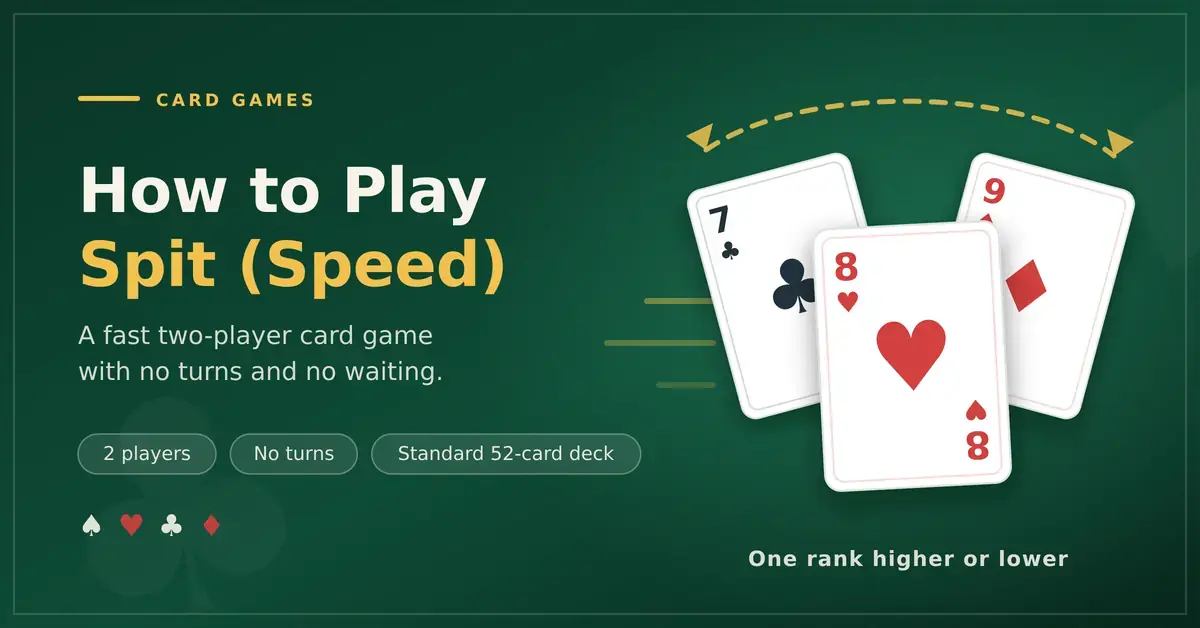
Spit is one of the fastest, most addictive two-player card games you can play with an ordinary deck. There are no turns, no waiting, and no complicated scoring — just two people racing at the same time to empty their cards before the other. Because it rewards quick eyes and quicker hands, many people also call it Speed, and the two names are often used interchangeably. This guide explains exactly how to set up Spit, how the rules work, how to win, and how it differs from the closely related game of Speed, so you can start playing in minutes.
Key Points
Spit at a glance:
- Players: 2, playing at the same time with no turns.
- Goal: Be the first to get rid of all your cards.
- Core rule: Play a card one rank higher or lower onto a central pile; suits do not matter.
- Turning the corner: Aces link Kings and 2s.
- Restart: When both players are stuck, shout “Spit!” and flip a new card each.
- Winning: Take the smaller central pile each round and shrink your deck until you have no cards left.
What Is Spit?
Spit is a real-time card game for exactly two players. Instead of taking turns, both players play simultaneously, slapping cards down as fast as they legally can. The goal is simple: be the first to get rid of all your cards. It belongs to the same lively branch of quick-reaction family card games as slap-and-match titles, but Spit adds a clever twist — you are building ascending and descending sequences on shared central piles at high speed.
The game needs almost nothing to start: one standard deck, two people, and a flat surface. It is easy enough for children to grasp in a single round, yet fast and competitive enough to stay fun for adults. That combination is why Spit has been a schoolyard, cottage and kitchen-table favourite across Canada for generations.
What You Need to Play Spit
Spit keeps its equipment list refreshingly short. Before you deal, make sure you have the following ready.
- Players: Exactly two. Spit is designed as a head-to-head duel.
- Cards: One standard 52-card deck. Remove the Jokers for the classic game.
- Space: A clear table or floor with room for two central piles between the players.
- Time: A full game usually takes 10 to 20 minutes, though a single round can end in under a minute.
How to Set Up Spit
Setup is the only slow part of Spit, and getting it right makes the fast part run smoothly. Shuffle the full deck thoroughly and deal it out so each player receives 26 cards. From your 26 cards you will build a personal layout called your tableau (or stockpiles) plus a face-down reserve called your spit cards.
Each player lays out five stock piles side by side. Working left to right, the piles hold 1, 2, 3, 4 and 5 cards — 15 cards in total. Deal every card in these piles face down, then flip the top card of each pile face up. You should now see five face-up cards in a row, with hidden cards beneath the taller piles.
The remaining 11 cards become your spit pile. Keep them in a face-down stack in your hand or beside your tableau, and do not look at them. These are the cards you will flip to kick-start play and to restart the action whenever both players get stuck.
Quick Facts
| Detail | Spit (Speed) |
|---|---|
| Number of players | 2 |
| Deck | One standard 52-card deck (no Jokers) |
| Cards per player | 26 (15 in the tableau, 11 spit cards) |
| Tableau layout | Five stock piles of 1, 2, 3, 4 and 5 cards |
| Turns | None — both players play simultaneously |
| Skills used | Speed, reflexes, pattern spotting |
| Round length | Often under a minute |
| Full game length | About 10–20 minutes |
| Difficulty | Easy to learn, fast to master |
How to Play Spit: Step by Step
Once both layouts are ready, the race begins. The following steps walk through a complete round from the opening call to the final card.
1. Start With the Call of “Spit!”
When both players confirm they are ready, they shout “Spit!” together and each flips the top card of their spit pile into the centre of the table. These two cards, placed side by side between the two tableaus, form the two central spit piles that everyone plays onto.
2. Build Up or Down by One Rank
The heart of Spit is playing your face-up tableau cards onto either central pile. A card can be played only if it is one rank higher or one rank lower than the card currently on top of that spit pile. Suit and colour do not matter in the standard game. For example, on a 7 you can play either a 6 or an 8; on a Queen you can play a Jack or a King.
3. Turn the Corner With Aces
Sequences “turn the corner,” meaning the ranks loop around through the Ace. An Ace can be played on a King or on a 2, and likewise a King or a 2 can be played on an Ace. This keeps play flowing and prevents piles from dead-ending at the top or bottom of the deck.
4. One Hand, One Card, No Turns
Both players play at the same time — there are no turns and no waiting for your opponent. The classic rule is that you may use only one hand and move only one card at a time. Whenever you move a face-up card off a stock pile, flip the next hidden card in that pile face up so it becomes playable. If you empty one of your five stock piles entirely, you may move any spare face-up card into that gap to keep your options open.
5. Say “Spit!” Again When Everyone Is Stuck
Sooner or later both players will run out of legal moves at the same time. When that happens, both players call “Spit!” once more and each flips a new card from their spit pile onto their own central pile, covering whatever was there. Play immediately resumes on these fresh top cards. If a player has no spit cards left when a restart is needed, the other player simply flips a single card to continue.
How a Round Ends and Who Takes Which Pile
A round ends the moment a player empties all five of their stock piles. As soon as someone is out of tableau cards, both players race to slap one of the two central spit piles. Because your aim across the game is to shed cards, you want the pile with fewer cards — the faster hand claims the smaller pile, and the opponent is left with the larger one.
Each player then gathers the central pile they won together with any spit cards they still have in reserve, shuffles everything, and deals a brand-new layout for the next round. If a player has fewer than 15 cards and cannot fill all five stock piles, they simply lay out as many piles as they can. This slapping-and-reshuffling cycle is what gradually shifts cards from the winner to the loser.
How to Win the Whole Game
Winning a single round is only part of the story. Because the round winner keeps taking the smaller central pile, a strong player steadily shrinks their total number of cards over several deals. Eventually one player becomes unable to lay out a full tableau and finally reaches a point where they clear every card they hold. The first player to get rid of all of their cards wins the game. A typical game runs across many quick rounds, so momentum and consistency matter as much as any single lightning-fast finish.
Spit vs. Speed: What Is the Difference?
Spit and Speed are so similar that many people treat them as the same game, and casually that is fine. Technically, though, they are two distinct games in the same family of fast, simultaneous, sequence-building card games.
- Spit gives each player five stock piles (the 1-2-3-4-5 tableau) plus a face-down spit reserve, and the round revolves around clearing those five piles.
- Speed gives each player a hand of five cards and a single face-down draw pile, and players continually refill their hand up to five cards as they play onto two central piles. Speed rounds are usually shorter and have no multi-round “slap the pile” transfer.
Both games share the same core thrill — no turns, sequence up or down by one, and a frantic race to empty your cards. If you enjoy the head-to-head duel format, you may also like the classic two-player game of War, which is even simpler and purely luck-based.
Popular Variations of Spit
Spit has been played so widely that many house rules have grown up around it. None are “official,” so agree on which you are using before the first “Spit!” Common variations include:
- Four stock piles: Deal only four piles (1-2-3-4 cards) instead of five for a shorter, faster game.
- Two-handed play: Some groups allow both hands rather than restricting players to one, which speeds things up further.
- Alternating colours: A stricter variant requires each card added to a spit pile to alternate colour as well as follow the rank sequence.
- Slap-for-choice: Instead of always taking the smaller pile, the player who finishes their stock piles first may slap either pile, and the opponent takes what is left.
- Stacking equal ranks: Some households let you place a card of the same rank on top, in addition to one higher or lower.
Tips and Strategy to Get Faster
Spit rewards preparation and awareness far more than luck. A few habits separate quick players from frantic ones.
- Scan both piles constantly. A card that is useless on one central pile is often playable on the other. Keep your eyes moving.
- Prioritise your tallest stock piles. Clearing the deeper piles first exposes the most hidden cards and gives you more choices.
- Create and use empty spaces. An empty stock pile is a parking spot for an awkward card, freeing up a pile you can actually play from.
- Do not freeze. If you cannot move, look for any legal play before calling for a restart — hesitation is where rounds are lost.
- Practise your reactions. The same reflexes that win Spit also help in reaction games like Slapjack and Snap.
Common Mistakes and Etiquette
Because Spit moves so fast, disputes are common — settle a few points up front. Agree on the one-hand rule (or that both hands are allowed) before you begin, and decide how you will handle a card played out of sequence: usually the offending player simply takes the card back and play continues. Never touch your spit reserve out of turn, and only flip a new spit card on a genuine, mutual “Spit!” call. If both players slap the smaller pile at almost the same instant, replay the slap rather than arguing. Keeping these ground rules clear turns a chaotic scramble into a fair, fun duel. For a calmer but related sequence-and-shedding challenge afterward, try the two-player classic Spite and Malice.
Reference Sources
Frequently Asked Questions
How many players can play Spit?
Spit is designed for exactly two players, since each person needs their own tableau and both players share the two central piles. There are multi-player adaptations that use more central piles, but the classic game is strictly head-to-head between two people.
Is Spit the same as Speed?
They are closely related but not identical. Both are fast, simultaneous, sequence-building games, and the names are often swapped casually. The main difference is the layout: Spit uses five stock piles plus a spit reserve and plays across multiple rounds, while Speed uses a five-card hand and a single draw pile that you refill as you go.
What happens when both players get stuck in Spit?
When neither player can make a legal move, both call “Spit!” at the same time and each flips one card from their spit reserve onto their own central pile. Play then resumes immediately on the new top cards. If a player has run out of spit cards, the other player flips a single card to keep the game going.
Can you play an Ace on a King in Spit?
Yes. Sequences in Spit “turn the corner,” so an Ace can be played on either a King or a 2, and a King or a 2 can be played on an Ace. This looping rule keeps the central piles moving instead of stalling at the top or bottom of the rank order.
How long does a game of Spit take?
A single round can end in under a minute, but a full game is played over several rounds until one player sheds all their cards. Most complete games last roughly 10 to 20 minutes, depending on how evenly matched and how quick the two players are.