

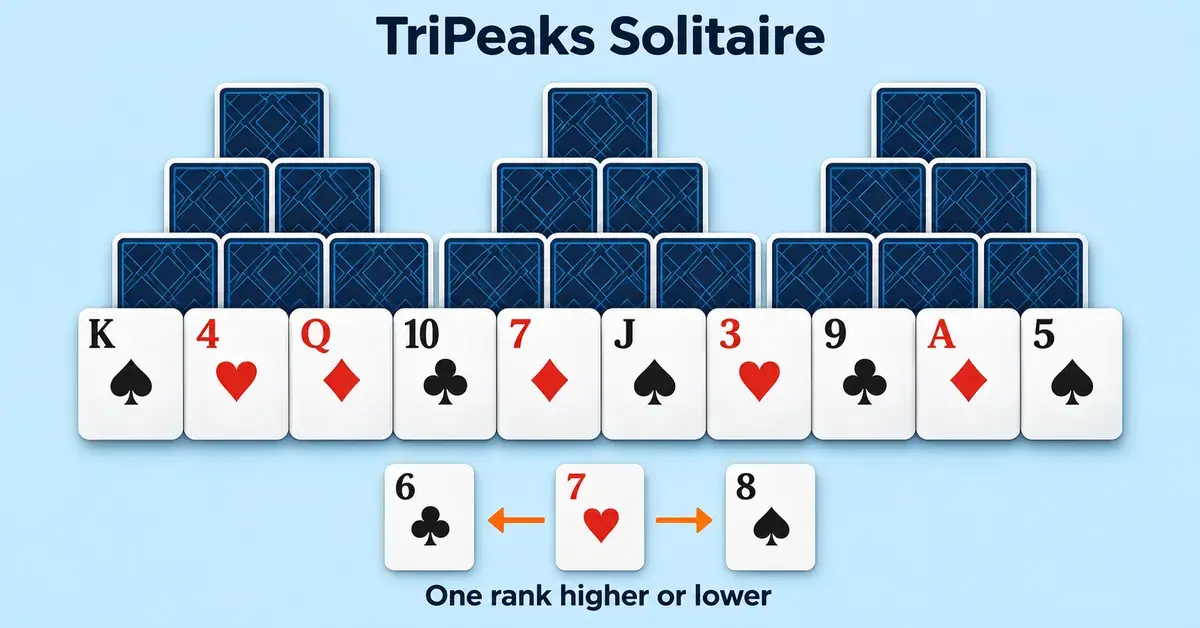
TriPeaks Solitaire is a one-player card game in which you clear three overlapping pyramids of cards by playing them, one at a time, onto a single waste pile. The only rule you really need to start is this: you may take any uncovered, face-up card from the peaks and move it to the waste pile whenever its rank is exactly one higher or one lower than the card currently on top of the waste, regardless of suit or colour. Keep stringing those cards together and the peaks melt away.
At a Glance
| Players | 1 (solitaire / patience) |
|---|---|
| Deck | One standard 52-card deck, no jokers |
| Tableau | 28 cards in three overlapping peaks |
| Stock | 24 cards |
| Objective | Clear all three peaks onto the waste pile |
| Core rule | Play an uncovered card one rank higher or lower, any suit |
| Difficulty | Easy to learn; over 90% of deals are solvable |
What Is TriPeaks Solitaire?
TriPeaks (also written Tri Peaks, and known as Three Peaks, Tri Towers or Triple Peaks) is a patience game for one player using a single standard 52-card deck. The name comes from its distinctive tableau: three card pyramids sitting side by side, their bases overlapping into one long row. Your job is to flatten all three peaks before the deck runs out.
The game was created by Robert Hogue in 1989 and reached a huge audience after Microsoft bundled it into Windows Entertainment Pack 3 and, later, the Microsoft Solitaire Collection. That history is why so many Canadians recognise TriPeaks from their phones and desktops rather than from the kitchen table — but it plays perfectly well with a physical deck too.
In card-game terms, TriPeaks belongs to the same family as Golf and Black Hole: games built around a single growing waste pile that you feed with cards of adjacent rank. If you have played Golf solitaire, the core discard mechanic will feel instantly familiar — TriPeaks simply dresses it up in a more interesting, three-peaked layout. It is a very different beast from the build-the-columns style of how to play solitaire in its classic Klondike form.
Setting Up the Game: The 28-Card Deal
Shuffle a full 52-card deck and deal the tableau in four rows that build upward into three peaks. The layout always uses the same 28 cards, arranged so that each row overlaps the one above it.
- Bottom (base) row: ten cards dealt face up in a single row along the bottom. Because the three peaks share this base, adjacent peaks overlap here rather than giving you twelve separate cards.
- Third row: nine cards dealt face down, each resting on top of two base cards.
- Second row: six cards dealt face down (two under each peak).
- Top row: three single cards, face down, forming the tip of each peak.
That is 10 + 9 + 6 + 3 = 28 cards in the tableau. The remaining 24 cards become the stock, placed face down in a pile. Turn the top stock card face up and set it beside the stock to start the waste pile (some rulebooks call this the foundation or discard pile). You are now ready to play.
Only the ten base cards start face up and playable. Every card above them is face down until the cards covering it are removed. A card counts as uncovered — and therefore playable — only when no other tableau card overlaps its lower edge.
The 28-Card Deal
| Row | Cards | Face up or down | Role |
|---|---|---|---|
| Top (peak tips) | 3 | Face down | The single card that caps each of the three peaks |
| Second row | 6 | Face down | Two cards beneath each peak |
| Third row | 9 | Face down | Widens each peak toward the base |
| Base row | 10 | Face up | Shared bottom row, ready to play from the start |
| Tableau total | 28 | — | — |
| Stock | 24 | Face down | Drawn one card at a time |
How to Play TriPeaks Solitaire, Step by Step
1. Make the core move
Look at the top card of your waste pile. You may move any uncovered tableau card onto it if that card is one rank higher or one rank lower, in any suit. If the waste shows a 7, you can play a 6 or an 8; if it shows a Jack, you can play a 10 or a Queen. Colour and suit never matter in TriPeaks — only rank.
2. Build long chains
Every card you play becomes the new top of the waste pile, so one move opens up the next. A single turn can become a long run — for example 5, 6, 7, 8, 7, 6, 5, 4 — as you zig-zag up and down the ranks. Long unbroken chains are the heart of the game: they clear the most cards and, in scored versions, earn the most points.
3. Wrap Aces and Kings around
In most online versions — for example CardGames.io, which calls it “turning the corner” — the ranks wrap around: an Ace and a King count as adjacent. That means you can play a 2 or a King on an Ace, and an Ace or a Queen on a King. Wrapping keeps chains alive far longer, so it is worth confirming before you start — check your house rules, because some versions do not allow wrapping, in which case the sequence simply stops at Ace or King.
4. Draw from the stock
When you run out of legal moves, flip the top card of the stock onto the waste pile and carry on. Each flip gives you a fresh top card and a new chance to start a chain. In the classic game you get a single pass through the stock with no re-deals, so every stock card is precious — do not flip one while you still have a useful move on the peaks.
5. Win or lose
You win the moment the last of the 28 peak cards leaves the tableau, whether that happens before or just as your stock runs out. You lose if the stock is exhausted and at least one peak card is still stranded with no legal play available. There is no partial credit on the physical board — the peaks are either cleared or they are not.
TriPeaks Scoring Explained
With a physical deck, most people simply play to clear the board. Scored play, however, is where TriPeaks gets its depth. In the original game, winning was less about clearing every peak and more about the tactics of building the best streaks and knowing when to stop.
Scoring differs sharply from app to app. Many versions add a streak bonus: each extra card you clear in a single continuous run — without drawing from the stock — is worth more than the one before it, so a long streak scores far more than the same cards played as several short chains broken up by stock flips. Others keep it simple: CardGames.io, for instance, scores only by how many cards you have left at the end and how many moves you used, with fewer cards and fewer moves counting as a better result. Treat any specific point value you see in one game as that game’s own rule rather than a universal standard.
For a sense of scale, the inventor’s own statistical analysis of the original scoring found a theoretical average of about 60 points per hand is possible with flawless play, while most players average around 12 and skilled players average over 17. The same analysis showed that more than 90% of all deals are completely solvable — which is why TriPeaks feels fair even when a board looks locked.
Strategy: How to Clear the Peaks
TriPeaks looks like luck, but a few habits dramatically raise your win rate. These tips apply whether you are playing with cards or an app.
- Plan the longest chain before you touch a card. Scan the exposed cards and trace the longest run you can make up and down the ranks. Playing cards in the right order often lets a single chain reach cards a hasty move would have stranded.
- Attack all three peaks evenly. Clearing one peak to the ground while the other two stay tall leaves you with fewer exposed cards and fewer options. Peel the peaks down together so you always have choices.
- Uncover face-down cards early. Every face-down card is a mystery and a dead end until it flips. Prioritise moves that expose new cards over moves that simply lengthen the waste pile without revealing anything.
- Hoard the stock. Because you usually get only one pass, each stock flip is a resource. Exhaust every legal move on the peaks before you draw, and keep a rough count of how many stock cards remain.
- Sometimes skip a legal move. If taking an available card breaks a chain you could extend further by playing a different card first, pause. The single most common beginner mistake is grabbing the first legal card instead of the best one.
If you enjoy this kind of forward planning, the same discipline pays off in column-building games such as Spider solitaire and in the open-information challenge of FreeCell, where every card is on show from the start and careful planning does the rest.
Popular Variations of TriPeaks
Because the inventor expected players to tinker with the format, TriPeaks has spawned several widely played variations. Agree on which one you are using before you deal, especially in a scored game.
- Wild card: one card acts as a joker that can be played on anything and accept anything on top of it. This makes a board much easier to clear and is a friendly option for beginners or younger players.
- All peaks face up: deal every tableau card face up, including the hidden rows. With no mystery cards, the game becomes a pure puzzle of planning the best order of play rather than a gamble on what will flip next.
- Empty-waste head start: instead of starting the waste pile with a stock card, leave it empty and let yourself play any one exposed card first to choose your opening. This gives a small head start on building that first long chain.
How TriPeaks Compares to Golf and Pyramid Solitaire
TriPeaks is often confused with two close cousins. It shares the single-waste-pile discard mechanic with Golf, and it shares its pyramid-shaped layout with Pyramid — but the way you remove cards is different in each. One point worth clearing up: TriPeaks does not use the “cards adding up to 13” rule. That pairing mechanic belongs to Pyramid solitaire, where you remove two cards that total thirteen. In TriPeaks you only ever match adjacent ranks against the waste pile.
| Feature | TriPeaks | Golf Solitaire | Pyramid Solitaire |
|---|---|---|---|
| Tableau shape | Three overlapping peaks | Seven columns | One large pyramid |
| Tableau cards | 28 | 35 | 28 |
| How you remove cards | Play a card one rank up or down onto the waste | Play a card one rank up or down onto the waste | Pair two cards that add up to 13 |
| Wrap-around (K–A) | Usually yes (digital) | Often no | Not applicable |
| Stock passes | One, no re-deals | One, no re-deals | Varies (often limited passes) |
| Game family | Adjacent-rank discard | Adjacent-rank discard | Addition / pairing |
If the pairing idea appeals to you more than chaining, it is worth reading the full Pyramid solitaire rules next — it is the same triangular shape with a completely different brain to it.
Reference Sources
Frequently Asked Questions
What is TriPeaks Solitaire?
TriPeaks Solitaire is a single-player card game played with one standard 52-card deck. You deal 28 cards into three overlapping peaks and keep 24 as a stock. The goal is to clear all three peaks by playing uncovered cards onto a waste pile, each one ranked one higher or lower than the current top card. It is a fast, relaxing game that most people learn in a couple of minutes.
Can you always win TriPeaks Solitaire?
No, but your odds are good. The inventor’s statistical analysis of the original game found that over 90% of deals are completely solvable with perfect play. In practice you will lose some games to unlucky layouts and to your own missed chains, but careful play — especially saving your stock and planning long runs — pushes your real-world win rate well up.