
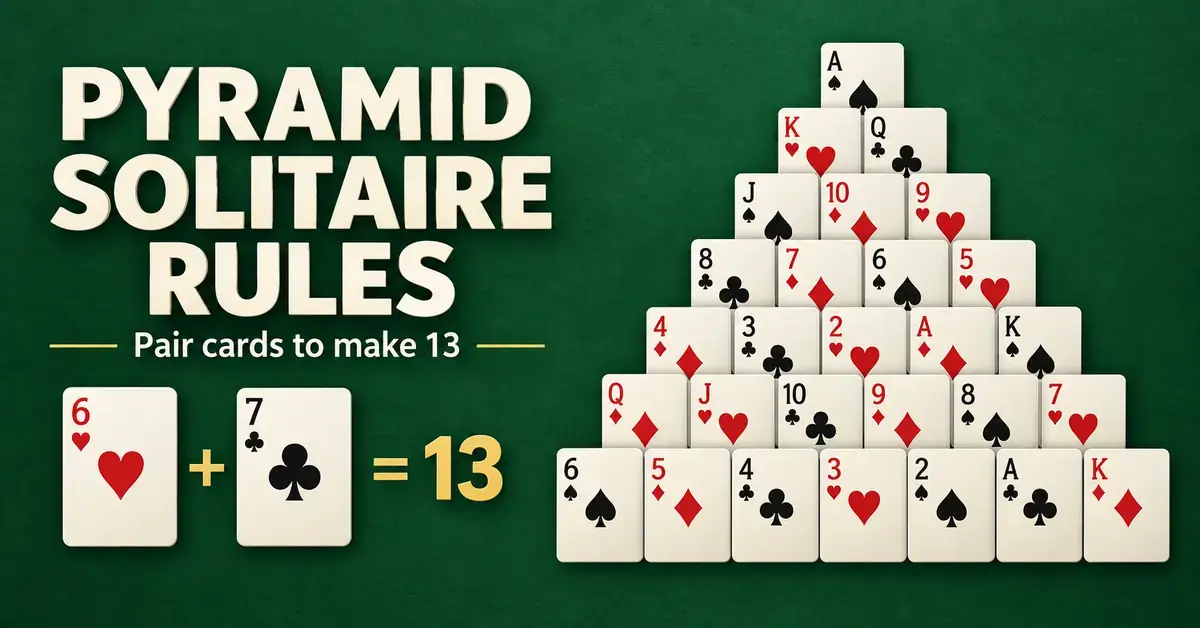
Pyramid Solitaire is one of the most recognizable single-player card games in the world: a tidy triangle of cards that you dismantle by pairing numbers that add up to 13. It looks simple, and the rules genuinely are easy to learn in a couple of minutes, but clearing the whole pyramid is a real test of planning and patience. This guide walks through everything you need, from dealing the layout to the exact pairing math, the stock and waste rules, scoring, the most popular variations, and strategy that will help you win more often.
If you are brand new to patience games in general, it helps to first understand how to play Solitaire in its classic Klondike form, because Pyramid borrows the same idea of a stock and a waste pile while using a completely different layout and goal. One quick note before we start: this article is about the single-player card game. The multiplayer party game sometimes called the same name is the Pyramid drinking game, which is unrelated.
What Is Pyramid Solitaire?
Pyramid Solitaire is a patience game for one person played with a standard 52-card deck. Twenty-eight cards are dealt face up in the shape of a pyramid, and your job is to remove them in pairs that total 13. Because many cards are blocked by the ones in front of them, the order in which you clear pairs matters a great deal, which is what gives this friendly-looking game its surprising difficulty.
The modern version likely originated in North America. It appears as “Elizabeth’s Solitaire” in Dean Bryden’s 1927 book Fun With Cards, and was published under the name “Pyramid” by Johnson and Pope in 1928. The game became a household staple after Albert Morehead and Geoffrey Mott-Smith featured it in their influential 1949 collection, The Complete Book of Solitaire and Patience Games. Today it is bundled with almost every digital solitaire app, which is why so many players know the triangle on sight.
Like all patience games, Pyramid is played alone and against the deck rather than against another person. Its appeal is the quick, self-contained puzzle it creates: a fresh shuffle produces a new layout every time, each game lasts only a few minutes, and there is a satisfying sense of progress as the triangle shrinks row by row. It works just as well with a physical deck at the kitchen table as it does on a phone during a commute.
Pyramid Solitaire at a Glance
- Players: 1
- Deck: One standard 52-card deck, no jokers
- Pyramid: 28 cards in 7 overlapping rows
- Stock: The 24 remaining cards
- Goal: Remove pairs that add up to 13 and clear the pyramid
- Kings: Worth 13, removed on their own
- Difficulty: Hard (about 1 in 50 single pass; much higher with redeals)
- Playing time: 5 to 15 minutes
What You Need to Set Up Pyramid Solitaire
All you need is a single standard 52-card deck (no jokers) and a flat surface. Shuffle thoroughly, because the shuffle alone decides a large share of whether a given game is even winnable. Deal the cards slowly and leave a little room to the side for the stock and waste piles, since you will be returning to them constantly.
Building the Pyramid
Deal 28 cards face up in seven overlapping rows that form a triangle:
- Row 1 (top): 1 card
- Row 2: 2 cards
- Row 3: 3 cards
- Row 4: 4 cards
- Row 5: 5 cards
- Row 6: 6 cards
- Row 7 (bottom): 7 cards
Each card should overlap and partly cover the two cards in the row below it, so every card except those in the bottom row is blocked by two others. This overlap is the heart of the puzzle: a card cannot be played until both cards resting on top of it have been removed.
The Stock and the Waste
The 24 cards left over after building the pyramid become the stock, placed face down to one side. When you turn stock cards over, they go face up onto a waste pile next to it. Only the top card of the stock and the top card of the waste are available to play at any moment, so the stock gives you a steady stream of fresh cards to help break open the pyramid.
The Goal: Pairs That Add Up to 13
The entire game runs on one rule: you remove cards in pairs whose values add up to exactly 13. Clear every card off the pyramid and you win.
Card Values
Each card has a fixed point value, and suits are ignored completely:
- Ace = 1
- Cards 2 through 10 = their face value
- Jack = 11
- Queen = 12
- King = 13
Because a King is already worth 13 on its own, it is removed by itself without needing a partner. Every other card must be matched with one that completes the sum of 13.
Pairs That Add to 13
| Card | Value | Pairs with |
|---|---|---|
| Ace | 1 | Queen (12) |
| 2 | 2 | Jack (11) |
| 3 | 3 | 10 |
| 4 | 4 | 9 |
| 5 | 5 | 8 |
| 6 | 6 | 7 |
| King | 13 | Removed alone |
How to Play Pyramid Solitaire Step by Step
Once the layout is dealt, play unfolds as a series of pairings. Here is the full sequence.
1. Identify the Cards You Can Play
A card is “available” or “exposed” only when nothing is lying on top of it. At the start that means the entire bottom row of seven cards, plus the top card of the stock once you begin dealing. As you clear bottom-row cards, the cards behind them become exposed and join the pool of playable cards.
2. Make Pairs and Remove Kings
Scan the exposed cards for any two that add up to 13 and remove them together: Ace with Queen, 2 with Jack, 3 with 10, 4 with 9, 5 with 8, 6 with 7. Any exposed King is simply discarded on its own. A pair can combine any two available cards, which means you can match a pyramid card with another pyramid card, a pyramid card with the top of the stock or waste, or the top of the stock with the top of the waste.
3. Work the Stock and Waste
When you run out of useful pairs on the pyramid, turn the top card of the stock face up onto the waste. If it pairs with an exposed card, remove the pair; if not, leave it on the waste and turn another. In the traditional single-pass game you go through the stock only once. The common “Par Pyramid” rules let you gather the waste back into a new stock (without reshuffling) and deal through it twice more, for three passes in total.
4. Win or Lose
You win the moment the last pyramid card is removed. You lose if you run out of legal pairs and still have pyramid cards left with no passes through the stock remaining. Many digital versions declare the win as soon as the 28 pyramid cards are gone, while the strictest version asks you to clear all 52 cards including the stock and waste.
Pyramid Solitaire Scoring
Casual players often just aim to clear the pyramid, but the classic Par Pyramid scoring system rewards finishing quickly. You earn points based on which pass you clear the pyramid on:
- Clear the pyramid on the first pass through the stock: 50 points
- Clear it on the second pass: 35 points
- Clear it on the third pass: 20 points
Digital apps frequently add their own layers on top of this, such as timed bonuses, combo streaks for chained removals, or penalties for redeals, so always check the scoring panel in whichever version you are playing.
Popular Variations of Pyramid Solitaire
Pyramid has spawned a family of variants that mostly adjust how hard it is to reach the buried cards. The most common are summarized below.
| Variation | Key difference | Effect on difficulty |
|---|---|---|
| Standard (single pass) | One pass through the stock; a card is freed only when both covering cards are gone | Very hard |
| Par Pyramid | Three passes through the stock with pass-based scoring | Hard |
| Relaxed Pyramid | Half-open rule: removing just one of the two covering cards frees the card beneath | Much easier |
| Giza | Open layout with three extra rows of eight cards and no hidden information | Moderate |
| Tut’s Tomb / Triangle | App variants that tweak stock passes or extra free cells | Varies |
The Relaxed version is the most forgiving everyday variant: because a card becomes playable as soon as one of its two covers is removed, you get roughly twice as many legal moves per turn, turning a near-impossible puzzle into a beatable one. Giza goes further by dealing every card face up, so success depends purely on planning rather than luck of the draw.
Strategy Tips to Clear the Pyramid More Often
Pyramid is a hard game by nature, so even small improvements in technique noticeably raise your win rate. A few principles make the biggest difference:
- Think before you pair. The first matching pair you spot is not always the best. Favour pairs that expose new cards or unblock a card you will need soon.
- Work both sides of the pyramid evenly. Clearing one side quickly tends to strand cards on the other side with no partners left. Peel the triangle down in balance.
- Do not burn the stock carelessly. Each stock card you flip is a limited resource. Hold a flip until it can complete a pair or free a needed card, especially in single-pass games.
- Prioritize the bottlenecks. Identify which buried card is blocking the most progress and plan the two removals that will expose it.
- Remove Kings when convenient, not reflexively. Kings leave on their own, but clearing a King that is not blocking anything can wait while you set up more valuable pairs.
Be realistic about the odds. In the original single-pass game, Morehead and Mott-Smith estimated a win rate of about 1 in 50 to clear all 52 cards. Computer solvers show that with “overlap” discards allowed and no redeal you can clear the pyramid around 23% of the time, and with unlimited passes through the stock that rises to roughly 83%. In other words, the rule set you choose matters far more than any single clever move.
How Pyramid Solitaire Compares to Other Solitaire Games
Pyramid sits at the harder, more mathematical end of the solitaire spectrum. If you enjoy the quick, additive style of play, you will likely also enjoy Golf Solitaire, which is similarly fast and sequence-based. For a bigger building challenge, Forty Thieves Solitaire uses two decks and rewards long-term planning, while Scorpion Solitaire focuses on untangling columns rather than hitting a target number. The table below compares them at a glance.
| Game | Decks | Core goal | Relative difficulty |
|---|---|---|---|
| Pyramid | 1 | Pair cards that add up to 13 | Hard |
| Golf | 1 | Clear columns by rank sequence | Moderate |
| Forty Thieves | 2 | Build four suits up to the foundations | Hard |
| Scorpion | 1 | Build four in-suit King-to-Ace columns | Moderate to hard |
Reference Sources
Frequently Asked Questions
How many cards are in the Pyramid Solitaire layout?
The pyramid itself is built from 28 cards arranged in seven overlapping rows, from a single card at the top down to seven cards along the bottom. The remaining 24 cards of the standard 52-card deck form the face-down stock, which you turn over onto the waste pile during play.
What cards pair together in Pyramid Solitaire?
You remove two exposed cards whenever their values add up to 13. The pairs are Ace with Queen, 2 with Jack, 3 with 10, 4 with 9, 5 with 8, and 6 with 7. Kings are worth 13 on their own, so they are removed singly without a partner.
Can you win every game of Pyramid Solitaire?
No. Many deals are simply unwinnable because needed partners end up blocking each other inside the pyramid. The traditional single-pass game is won only about one time in fifty, though relaxed rules and multiple passes through the stock push the win rate much higher, in some solver studies past 80 percent.
How many times can you go through the stock?
It depends on the rules you are using. The original version allows a single pass through the stock, while the widely used Par Pyramid rules let you turn the waste back into a stock and deal through it twice more, for three passes in total. Some digital versions allow unlimited redeals, which makes the game far easier.
Is Pyramid Solitaire a game of luck or skill?
It is both. The shuffle decides whether a deal is theoretically winnable, which is the luck element, but within a winnable deal your choices about which pairs to make and when to use the stock strongly affect whether you actually clear the pyramid. Careful, balanced play measurably improves your results.