
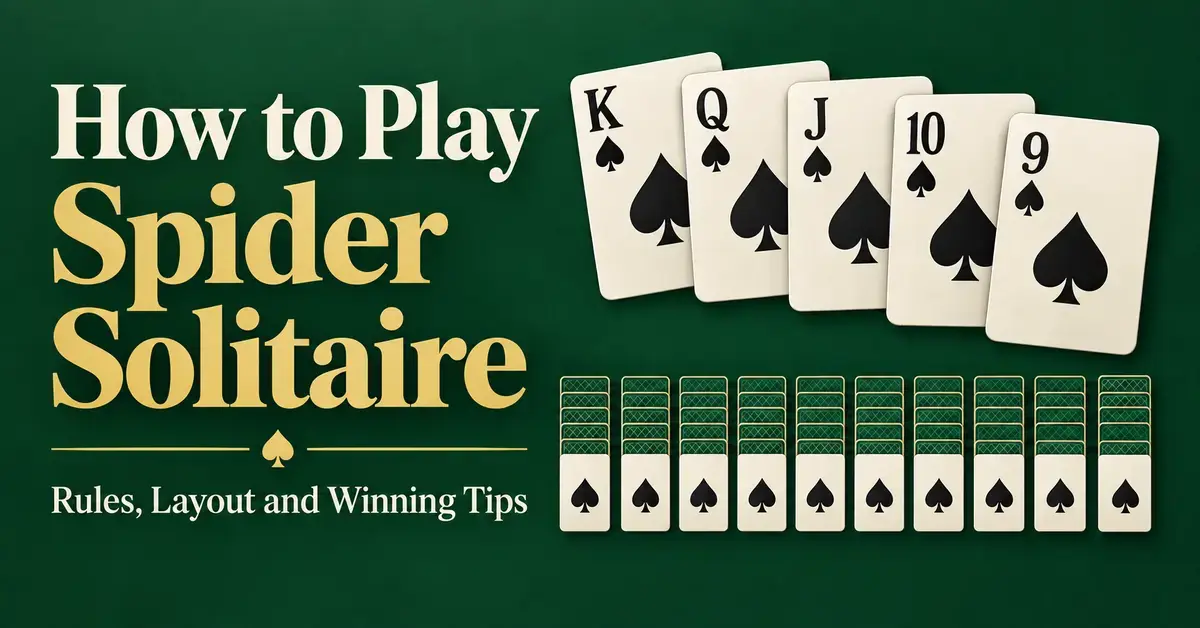
Spider Solitaire is one of the most popular patience (solitaire) games in the world, largely because it has been bundled with Microsoft Windows for decades. It is played with two decks of cards and challenges you to build eight long sequences in the tableau rather than racing a few cards up to foundation piles. The result is a slower, more strategic game that rewards planning and patience. This guide explains exactly how to play Spider Solitaire: the two-deck setup, the ten-column layout, how to build and remove sequences, the three difficulty levels, how scoring works, and the practical tips that lift your win rate.
Spider Solitaire at a Glance
- Players: 1 (single-player patience game)
- Cards: Two 52-card decks, jokers removed (104 cards)
- Layout: 10 tableau columns; first 4 get 6 cards, other 6 get 5 cards (54 dealt)
- Stock: 50 cards, dealt 10 at a time (one per column) across 5 deals
- Build: Downward by rank, any suit; move same-suit runs as a group
- Goal: Build and remove 8 complete King-to-Ace same-suit sequences
- Difficulty: 1 suit (easy), 2 suits (medium), 4 suits (hard)
What Is Spider Solitaire?
Spider Solitaire is a single-player card game in the “patience” family, meaning you play alone and win by sorting a shuffled pack into order. Unlike the classic game many people simply call solitaire, Spider uses two full decks and asks you to assemble all of your sequences directly in the playing area — the tableau — before the game clears them away. There are no separate foundation piles to drag cards onto one at a time.
The name comes from a spider’s eight legs: you must complete eight full suit sequences, from King down to Ace, to win. Each finished sequence is like one leg of the spider. Because you are juggling 104 cards across ten columns, Spider feels more like a puzzle than a quick time-filler, and skilled players treat it as a game of planning several moves ahead.
If you are brand new to patience games in general, it helps to first understand the standard version. Our guide on how to play solitaire covers the single-deck Klondike rules, after which Spider’s two-deck structure is much easier to grasp.
A Quick History of Spider Solitaire
Spider Solitaire is widely dated to 1949, and it was an established favourite long before computers existed. It is often described as an American creation, and it was reportedly enjoyed by notable figures of its era, which helped spread its popularity through magazines and game collections. For most of the twentieth century it was played with two physical decks on a tabletop.
The game reached a global audience when Microsoft began including it with its Windows operating systems. For millions of players, Spider Solitaire — along with its on-screen difficulty settings — was their first introduction to a two-deck patience game, and it remains a staple of free online card-game sites today.
What You Need to Play
Spider Solitaire has a simple kit but a specific setup. Getting the deal right is the foundation of every game.
The Two-Deck Setup
You need two standard 52-card decks shuffled together, with the jokers removed, for a total of 104 cards. Suits and colours do not need to match between the decks; what matters is rank and, for completing sequences, suit. Because you are shuffling two packs together, a large, clear playing surface (or a screen) makes the game far easier to manage.
The Spider Solitaire Layout
At the start, 54 cards are dealt into ten tableau columns. The first four columns receive six cards each, and the remaining six columns receive five cards each. Every card is dealt face down except the top card of each column, which is turned face up and is the only card you can see and play at first.
That leaves 50 cards in the stock (the undealt pile). These are dealt out later in the game, ten at a time — one card to each column — giving you five more deals over the course of a game. The stock is your lifeline when the tableau stalls, but as you will see, there is an important rule about when you are allowed to use it.
Spider Solitaire Setup Explained
| Element | Details |
|---|---|
| Columns 1–4 | 6 cards each (24 cards), top card face up |
| Columns 5–10 | 5 cards each (30 cards), top card face up |
| Total dealt to tableau | 54 cards |
| Stock pile | 50 cards remaining |
| Stock deals | 5 deals of 10 cards (one card per column) |
| Deal restriction | Cannot deal while any column is empty |
The Goal of the Game
Your objective is to build eight complete sequences, each running from King down to Ace in a single suit, within the tableau. The moment a full King-to-Ace same-suit run is assembled on top of a column, the game removes it from play. When all eight sequences have been built and removed, the tableau is empty and you win.
Crucially, you build sequences downward only (King, Queen, Jack, 10… down to Ace), and Aces are low — there is no wrapping around from Ace back to King. Winning therefore means steadily converting a messy tableau into eight clean, suited runs while using the stock sparingly.
How to Play Spider Solitaire Step by Step
Once the cards are dealt, play proceeds by moving cards between columns, exposing face-down cards, and dealing from the stock when you get stuck. Here is the full sequence of play.
Building Sequences in the Tableau
You may place any face-up card onto a card that is exactly one rank higher, regardless of suit or colour. For example, a 9 of any suit can go on any 10, and a Jack can go on any Queen. This loose rule lets you tidy the tableau quickly, but only same-suit runs count toward winning and can be moved as a unit, so mixing suits is a short-term convenience with a long-term cost.
Moving Groups of Cards
When several cards already form a descending run in the same suit — say the 8, 7 and 6 of spades sitting in order — you can move all of them together as a single packed unit onto a 9 of any suit. If the run is not all one suit, most versions only let you move the portion that is correctly ordered from the top. Building same-suit runs is therefore the heart of good Spider play, because only those can be relocated freely and eventually cleared.
Dealing from the Stock
When you run out of useful moves, click or deal the stock to place one new face-up card on every column. There is one firm rule: you cannot deal from the stock if any column is completely empty. You must fill every empty column first. This prevents players from “parking” the board and forces you to keep the tableau populated — which is why experienced players are cautious about emptying columns right before they want to deal.
Completing and Removing a Suit
As soon as a column shows a complete King-to-Ace sequence in one suit, that sequence is automatically lifted off the tableau. This reveals whatever was beneath it (turning a face-down card face up) and frees space. Clearing sequences is how you make room, expose hidden cards, and march toward the eight-sequence finish.
Spider Solitaire Difficulty Levels
Spider’s difficulty is controlled entirely by how many suits are in play. The cards and layout stay the same; only the number of suits you must track changes, and that has a dramatic effect on how winnable a game is.
One suit uses two decks of the same suit (for example, all spades). It is the friendliest version and the best place to learn, because any descending run is automatically same-suit and movable. Two suits introduces a second suit, so you must start separating runs by suit — a solid middle ground. Four suits is the full game and is genuinely difficult, demanding careful planning to avoid trapping cards under the wrong suit.
Difficulty Levels Compared
| Level | Suits in Play | Approx. Win Rate | Best For |
|---|---|---|---|
| One Suit | 1 suit (e.g. all spades) | ~50–60% | Beginners learning the flow |
| Two Suits | 2 suits | ~20–25% | Intermediate players |
| Four Suits | All 4 suits | ~7–10% | Experienced players seeking a challenge |
Reported win rates vary by source and by how well you play, but the pattern is consistent: the one-suit game is won roughly half the time or more, the two-suit game around one in five, and the four-suit game often under one in ten. With strong play across difficulties, a win rate near one in three is a reasonable benchmark. If you enjoy this kind of staged difficulty, you will find a similar skill curve in two-deck patience games like Forty Thieves Solitaire.
Scoring in Spider Solitaire
Many digital versions, including the familiar Microsoft and Arkadium editions, use a simple points system. You begin with 500 points. Every move you make subtracts one point, which rewards efficiency, and every completed sequence adds 100 points. Finish all eight sequences in as few moves as possible and your score stays high; fumble through hundreds of moves and your total erodes.
For example, completing a game in 100 moves leaves you 400 points from the move count (500 minus 100), plus 800 points for the eight finished sequences, for a final score of 1,200. Because moves cost points, this scoring quietly encourages the same habit that helps you win: think before you shuffle cards around.
Winning Tips and Strategy
Spider is beatable with method rather than luck, especially at one and two suits. These principles make the biggest difference.
Prioritise Same-Suit Sequences
Whenever you have a choice, build runs in a single suit. A mixed-suit stack looks tidy but cannot be moved as a group and will not clear, so it eventually becomes a logjam. Same-suit building is slower but it is the only path to removing cards.
Expose Face-Down Cards Early
Face-down cards are hidden information. The sooner you flip them, the more options you unlock. Favour moves that turn over a new card over moves that merely rearrange cards you can already see.
Create and Protect Empty Columns
An empty column is the most flexible asset in the game because any card — or any movable run — can be placed there. Use empty columns to unpack mixed stacks and reorder cards by suit. But use them deliberately: remember you cannot deal from the stock while a column is empty, so time your emptying around when you still have moves to make.
Be Careful with Kings
Kings are the top of every sequence, so nothing can be stacked on them. A King dropped into an empty column will sit there blocking that space until you manage to complete its full suit run beneath it. Place Kings thoughtfully rather than parking them to free up a different column.
Don’t Rush the Stock
Each deal from the stock drops a card onto every column, often burying carefully arranged runs and adding clutter. Squeeze out every sensible tableau move before you deal. Dealing early is one of the fastest ways to turn a winnable game into a dead end.
Common Mistakes to Avoid
Beginners tend to lose for a handful of repeatable reasons. Watch for mixing suits too freely, which creates immovable piles; dealing from the stock the moment play slows, before exhausting real moves; and emptying a column at the wrong time so you cannot deal when you need to. Another frequent error is chasing a quick, pretty arrangement of mixed cards instead of the slower same-suit runs that actually clear the board. Avoiding these alone will noticeably raise your results.
How Spider Solitaire Compares to Other Solitaire Games
Spider sits in the same family as other build-down tableau games, but its two-deck scale and eight-sequence goal set it apart. Games such as Scorpion Solitaire and Yukon Solitaire share Spider’s emphasis on moving blocks of cards and freeing buried cards, yet they use a single deck and different winning conditions. For a lighter, faster patience game with simpler rules, Golf Solitaire is a good contrast. Trying several variants is the quickest way to appreciate what makes Spider’s strategy distinctive.
Reference Sources
Frequently Asked Questions
How many decks do you need for Spider Solitaire?
Spider Solitaire uses two standard 52-card decks shuffled together, with the jokers removed, for 104 cards in total. This is one of the main differences from classic single-deck solitaire and is what makes room for the game’s eight separate sequences.
What is the goal of Spider Solitaire?
The goal is to build eight complete sequences in the tableau, each running from King down to Ace in a single suit. As soon as a full same-suit run is assembled it is removed from play, and when all eight have been removed the tableau is empty and you win.
Can you build sequences with mixed suits in Spider Solitaire?
You can temporarily place any card on a card one rank higher regardless of suit, which helps you organise the board. However, only runs that are all the same suit can be moved together as a group and counted toward the eight winning sequences, so mixed-suit stacks must eventually be unpacked.
Why can’t I deal cards from the stock?
Spider Solitaire does not let you deal from the stock while any column is empty. You must place a card in every empty column first. This rule keeps the tableau full and stops players from stalling the game, so plan your empty columns around the deals you intend to make.
Is Spider Solitaire a game of skill or luck?
It is both, but skill dominates at the easier settings. The one-suit game is won by most players with careful play, while the four-suit game is hard even for experts and can be lost to an unlucky deal. Good habits — building by suit, exposing hidden cards and using the stock sparingly — reliably improve your win rate.