

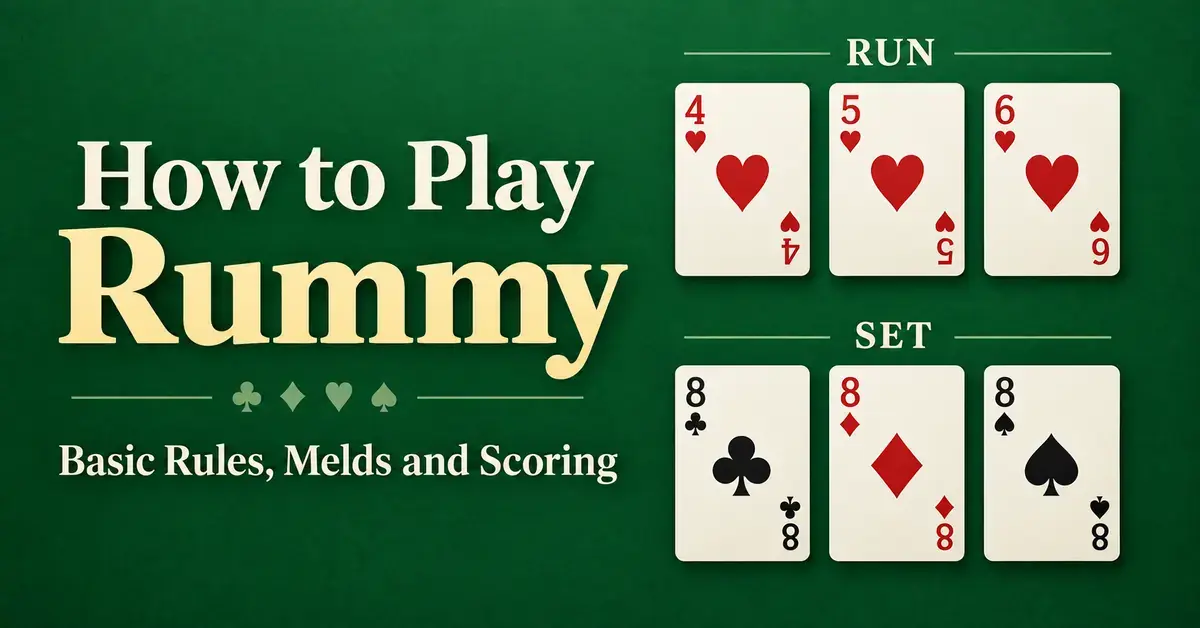
Rummy is one of the most popular family card games in the world, and it is the foundation for a whole family of related games you may already know, from Gin Rummy to Canasta. If you can shuffle a standard deck and recognise a run of numbers, you can learn the basics in a single sitting. This guide explains how to play Rummy from scratch: what you need, how to deal, how to build the two types of melds, how a turn works, how to win a hand, and how to keep score. It is written for complete beginners, so every term is explained in plain language.
The game described here is often called Basic Rummy, Straight Rummy or simply Rum. It is the plain, no-frills version that most other rummy games are built on. Once you understand it, picking up variants becomes far easier.
What Is Rummy?
Rummy is a “matching” card game. The goal is to collect your cards into valid combinations, called melds, and get rid of every card in your hand before your opponents do. Unlike trick-taking games such as Euchre or Hearts, there are no trumps and no tricks to win. You simply draw a card, improve your hand, and discard a card, over and over, until someone empties their hand.
The family is thought to descend from older matching games such as the Mexican game of rummy, and today it includes dozens of relatives. The version below is the standard English-language game played across Canada and the United States, and it works beautifully as a gentle introduction before you try the deeper variants.
Key Facts
| Players | 2-6 (best with 3-4; use two decks for 6+) |
|---|---|
| Deck | Standard 52 cards, no jokers |
| Cards dealt | 10 (2 players), 7 (3-4 players), 6 (5-6 players) |
| Objective | Be first to meld all cards into sets and runs, then discard your last card |
| Meld types | Sets (3-4 of a rank) and runs (3+ of a suit in sequence) |
| Typical target | First player to 100 or 500 points |
| Difficulty | Easy to learn, beginner-friendly |
What You Need to Play
Rummy requires very little equipment, which is part of its charm:
- A standard 52-card deck. Jokers are not used in basic Rummy (some variants add them as wild cards).
- Two to six players. The game is at its sharpest with three or four. If you want to seat more than six players, simply shuffle two decks together.
- Paper and pen for keeping score across several hands.
Card ranking runs from the Ace (low) up through 2, 3, 4 and so on to the 10, then Jack, Queen and King. In basic Rummy the Ace is normally low, but as you will see below it can also sit at the top of a run next to the King.
The Objective of Rummy
Your aim is to be the first player to “go out” by melding all of your cards into valid sets and runs and discarding your last card. Every card you cannot meld counts against you (or in your opponents’ favour) when the hand ends, so there is constant tension between holding cards that might complete a meld and dumping cards before they cost you points.
How to Set Up a Game of Rummy
Choose a dealer (the player who cuts the lowest card is a common method). The dealer shuffles, offers the deck to the player on their right to cut, then deals the cards one at a time, face down, clockwise. The number of cards each player receives depends on how many people are playing.
After dealing, the dealer places the rest of the deck face down in the centre of the table to form the stock. The top card of the stock is turned face up and placed beside it to begin the discard pile. Play then begins with the player to the dealer’s left and moves clockwise.
How Many Cards Do You Deal in Rummy?
The deal changes with the number of players so that the game stays balanced. The table below shows the standard counts.
| Number of players | Cards dealt to each player | Decks needed |
|---|---|---|
| 2 players | 10 cards each | 1 deck |
| 3 players | 7 cards each | 1 deck |
| 4 players | 7 cards each | 1 deck |
| 5 players | 6 cards each | 1 deck |
| 6 players | 6 cards each | 1 deck (2 decks recommended) |
Melds Explained: Sets and Runs
A meld is simply a valid combination of cards that you can lay face up on the table. There are only two kinds of meld in Rummy, and learning to spot both is the heart of the game.
Sets (Also Called Groups or Books)
A set is three or four cards of the same rank but different suits. For example, 7♠ 7♥ 7♦ is a valid set of three sevens, and you could extend it with the 7♣ to make a set of four. You cannot use two cards of the same suit in one set, because they would be identical in rank and suit duplication is not allowed within a single meld.
Runs (Also Called Sequences)
A run is three or more consecutive cards of the same suit. For example, 4♥ 5♥ 6♥ is a valid run, and you could lengthen it at either end with the 3♥ or the 7♥. All cards in a run must share one suit; a mixed-suit sequence does not count.
Where the Ace Sits in a Run
The Ace can be used either as the lowest card (A-2-3) or the highest card (Q-K-A), but it cannot “wrap around” the corner. That means K-A-2 is not a legal run. Decide before you play whether your table allows the Ace high, low, or both; the most common rule is that the Ace can be either, but never both in the same run.
Card Point Values
| Card | Point value |
|---|---|
| Number cards (2-10) | Face value (a 7 is worth 7 points) |
| Jack, Queen, King | 10 points each |
| Ace (used low) | 1 point |
| Going rummy | The winner’s score for the hand is doubled |
How a Turn Works in Rummy
Every turn follows the same simple three-step rhythm: draw, then (optionally) meld or lay off, then discard. You always end your turn with exactly one card fewer unless you have gone out.
Step 1: Draw a Card
Begin your turn by taking one card. You may draw the top card of the face-down stock, or you may take the top card of the discard pile if it helps your hand. Picking from the discard pile tells your opponents something about what you are collecting, so use it thoughtfully. Note that if you draw from the discard pile, you cannot immediately discard that same card on the same turn.
Step 2: Meld and Lay Off
After drawing, you may lay down any valid sets or runs from your hand onto the table, face up. This is called melding. You may also lay off: adding one or more cards from your hand to a meld already on the table, whether it is your own meld or an opponent’s. For instance, if someone has melded 4♥ 5♥ 6♥, you can lay off the 7♥ to extend it. Laying off is optional, and you may lay off as many fitting cards as you like on your turn.
Step 3: Discard
End your turn by placing one card from your hand face up on the discard pile. The only time you do not discard is when you use your final card to meld or lay off and go out. If the stock pile runs out before anyone wins, set aside the top discard, shuffle the rest of the discard pile to form a new stock, and carry on.
How to Win a Hand: Going Out
A hand ends the moment one player “goes out” by getting rid of every card in their hand. You go out by melding and/or laying off all of your remaining cards, finishing with a final discard (or, in some house rules, with no discard needed on the last card). As soon as a player goes out, the hand stops immediately and scoring begins.
Going Rummy for Double Points
There is a special, more daring way to win called going rummy (sometimes written “going rummy” or “going out concealed”). A player goes rummy when they meld their entire hand in a single turn, having laid down no cards at all earlier in that hand. Pulling this off doubles the score the winner collects, which rewards players who are patient enough to keep their cards hidden and strike all at once. It is risky, because holding a full hand of unmelded cards is costly if someone else goes out first.
Rummy Scoring
Scoring in Rummy is based on the pip (point) value of the cards. Number cards are worth their face value, the face cards are worth 10 each, and Aces are usually worth 1 point when the Ace is used low. The element above lays out the full table of values. There are two widely used ways to apply those values.
Method 1: The Winner Scores Opponents’ Cards
This is the most common casual method. When a player goes out, every other player counts the pip value of the cards still left in their hand, and the winner scores the combined total of everyone else’s leftover cards. If the winner went rummy, that total is doubled. Play continues hand after hand until one player reaches an agreed target, commonly 100 or 500 points.
Method 2: Each Player Scores Their Own Melds
In some circles, each player instead scores the value of the cards they personally melded and laid off during the hand, and then subtracts the value of the cards still trapped in their hand. This can produce negative scores for players caught with heavy hands, and it rewards melding steadily rather than hoarding for a single big play. Agree on which method you are using before the first deal.
Reaching the Target Score
Rummy is played over as many hands as it takes for someone to reach the target. A quick two-player game might run to 100 points, while a longer session often uses 500. If you prefer, you can simply play a fixed number of deals and declare the highest score the winner. The scoring style you choose does not change how the cards are played, only how the hands add up.
Popular Rummy Variations to Try Next
Once the basic game feels natural, the wider rummy family opens up. Each variant keeps the sets-and-runs core but adds its own twist, such as wild cards, contracts you must fulfil, or a bigger deck. The table below compares some of the most popular relatives, with guides on this site for each.
| Variant | Players | What makes it different | Best for |
|---|---|---|---|
| Gin Rummy | 2 | Two-player duel where you can “knock” with low unmatched cards instead of melding everything | Head-to-head play |
| Rummy 500 | 2-8 | You score the value of cards you meld; play races to 500 points | Point chasers |
| Continental Rummy | 2-12 | Larger deals and a focus on long sequences, using multiple decks and jokers | Big groups |
| Canasta | 4 (partners) | Partnership game built around melding seven-card “canastas” with wild cards | Team play |
| Liverpool Rummy | 3-8 | A contract rummy where each deal demands a specific set of melds | Structured challenges |
| Conquian | 2 | The 40-card ancestor of rummy; you must meld 11 cards to win | History lovers |
If you want a two-player challenge, how to play Gin Rummy is the natural next step, while Rummy 500 suits players who enjoy chasing points. Fans of bigger games can explore Canasta or the long-sequence world of Continental Rummy. For a contract-style twist, try Liverpool Rummy, and for the historic root of it all, read about Conquian, the Mexican rummy classic.
Beginner Tips and Strategy
Rummy rewards a little forward planning. These habits will sharpen your play quickly:
- Watch the discard pile. The cards opponents pick up and throw away reveal what they are collecting. Avoid feeding them the ranks they clearly want.
- Shed high cards early. Kings, Queens, Jacks and Tens are worth 10 points each if you are caught with them. If they are not part of a near-complete meld, let them go.
- Keep flexible cards. A card such as the 6♥ can join both a set of sixes and a heart run, so it is worth holding while you decide which meld to chase.
- Do not reveal too soon. Melding early tells opponents what you hold and lets them lay off onto your melds. Sometimes keeping cards hidden and going rummy is worth the risk.
- Count the odds. If two of the cards you need are already discarded, that meld is unlikely; switch plans rather than clinging to it.
Common Mistakes to Avoid
New players often trip over the same handful of rules. Remember that you draw exactly one card and discard exactly one card each turn; you cannot skip the discard unless you are going out. A set must use different suits, and a run must use a single suit, so double-check your melds before laying them down. Finally, agree on the Ace rule, the scoring method and the target score before the first deal so there are no arguments halfway through.
Reference Sources
Frequently Asked Questions
How many cards do you need to start a run in Rummy?
A run needs a minimum of three consecutive cards of the same suit, such as 5♣ 6♣ 7♣. You can always extend an existing run at either end on later turns by laying off matching cards.
Can you pick up more than one card from the discard pile?
In basic Rummy you may only take the single top card of the discard pile on your turn. Taking several cards at once from the discard pile is a feature of certain variants, such as Rummy 500, not of the standard game.
Is the Ace high or low in Rummy?
The Ace is usually low, worth one point, and it can anchor a run as A-2-3. Many tables also allow it high, next to the King as Q-K-A. What it cannot do is wrap around the corner, so K-A-2 is never a legal run.
What does it mean to go rummy?
Going rummy means melding your entire hand in one turn without having laid down any cards earlier in that hand. It is harder to achieve because you hold your cards until the end, but it doubles the points the winner collects for the hand.
How do you win the whole game of Rummy rather than a single hand?
You win individual hands by going out first, but the overall game is won by reaching an agreed target, commonly 100 or 500 points, across several hands. Alternatively, you can play a fixed number of deals and let the highest total take the match.