

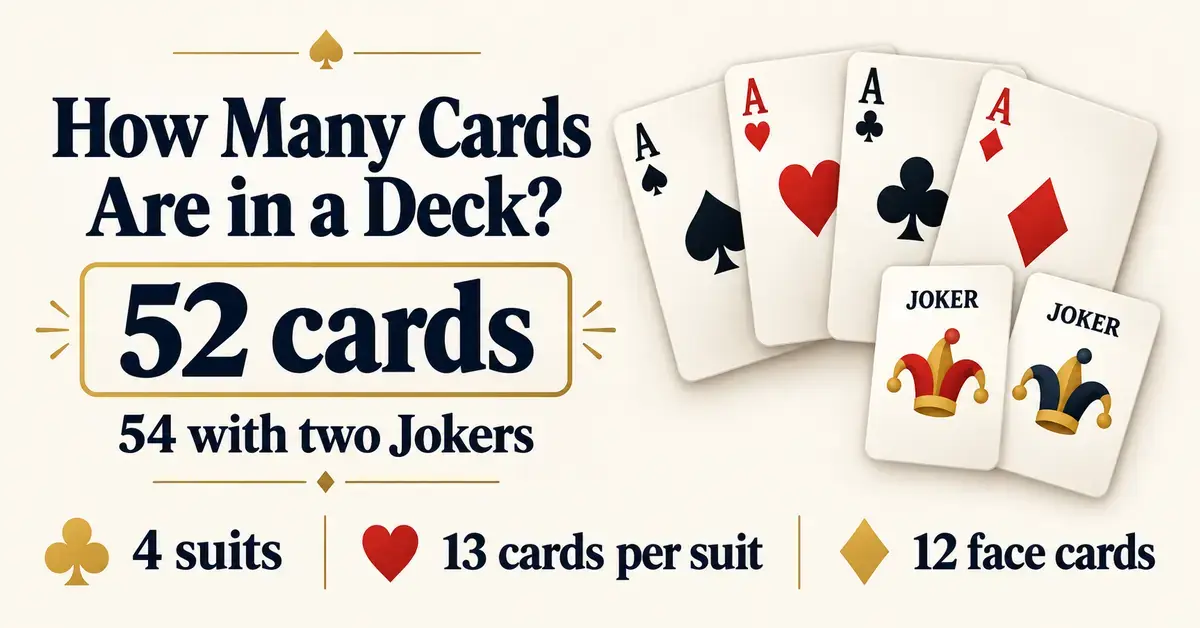
If you have ever opened a fresh pack of cards and wondered exactly what is inside, the short answer is simple: a standard deck holds 52 playing cards, or 54 cards once you count the two Jokers that usually come in the box. Those 52 cards are organised into a tidy, logical system of suits, ranks and court cards that has barely changed in centuries. Understanding that system is the first step to picking up almost any card game, from a quiet evening of Solitaire to a lively table of poker.
This guide breaks a deck down piece by piece. We will count the suits, explain the 13 ranks, clarify exactly how many face cards there are, look at where the Joker came from, and compare the other deck sizes you will run into — such as the 24-card Euchre pack or the 48-card Pinochle pack. By the end you will know not just the numbers, but why the deck is built the way it is.
Quick Answer
Quick answer: A standard deck has 52 cards, or 54 cards including the two Jokers in most boxes.
- 4 suits: spades, hearts, diamonds, clubs
- 13 ranks per suit: Ace, 2–10, Jack, Queen, King
- 12 face cards (4 Jacks, 4 Queens, 4 Kings)
- 26 red + 26 black cards
- 4 of each rank across the deck
How Many Cards Are in a Standard Deck?
A standard deck of playing cards contains 52 cards. This is the familiar French-suited pack used across Canada, the United States, the United Kingdom and most of the world, and it is the deck pictured on nearly every card table and casino felt.
Most retail decks also add two Jokers, which brings the physical pack in the box to 54 cards. The Jokers, however, are not part of the official 52 and are only used in games that specifically call for them. So the answer depends slightly on what you mean: 52 cards make up the playing deck itself, while 54 is the total count of cards you typically find inside a new box.
The 52 cards are split evenly into four suits of 13 cards each. Four suits multiplied by 13 ranks gives you exactly 52 (4 x 13 = 52), a clean mathematical structure that makes the deck equally suited to games of chance, skill and strategy.
The Four Suits Explained
Every standard deck is divided into four suits, each marked with its own symbol:
- Spades (♠) – a black suit
- Hearts (♥) – a red suit
- Diamonds (♦) – a red suit
- Clubs (♣) – a black suit
Each suit contains the same 13 cards, so the four suits are perfectly balanced. This symmetry is what lets games deal fair, repeatable hands and is the reason the deck has survived in the same form for so long.
Red and Black Suits
The four suits divide into two colours. Hearts and diamonds are red, while spades and clubs are black. Because each colour covers two suits of 13 cards, a deck holds 26 red cards and 26 black cards. This even red-and-black split is central to games like Solitaire, where cards must be stacked in alternating colours, and to many betting games that pay out on red or black.
Why Suits Matter in Games
Suits are far more than decoration. In trick-taking games such as Euchre, players must “follow suit” by playing a card of the same suit as the one led, and one suit is often named trump to outrank the others. In poker, suits determine whether five cards form a flush. Knowing the four suits and their colours is the groundwork for understanding the poker hand rankings and the rules of almost every other card game.
The 13 Ranks in Each Suit
Within each suit the 13 cards run in a fixed order of ranks. From lowest to highest they are usually counted as:
- Ace (A) – often the highest card, but low in some games
- Number (pip) cards 2 through 10 – nine cards whose value matches the number of suit symbols printed on them
- Jack (J), Queen (Q) and King (K) – the three court cards, also called face cards
That gives each suit one Ace, nine numbered cards and three court cards, for 13 cards in total. Multiply by four suits and you reach the full 52. Because every rank appears once per suit, a deck contains exactly four of each rank – four Aces, four Kings, four 7s, and so on.
The Ace is the deck’s great chameleon. In War and many poker hands it is the most powerful card, yet in games such as cribbage it counts as a single point, and in some sequences it sits below the 2. Its value always depends on the rules of the game being played.
Deck Breakdown
| Group | Cards included | Count |
|---|---|---|
| Suits | Spades, hearts, diamonds, clubs | 4 |
| Cards per suit | Ace, 2–10, Jack, Queen, King | 13 |
| Number (pip) cards | 2–10 in every suit | 36 |
| Aces | One per suit | 4 |
| Face (court) cards | Jacks, Queens, Kings | 12 |
| Standard deck total | All suits combined | 52 |
| With Jokers | 52 cards plus 2 Jokers | 54 |
Face Cards (Court Cards) Explained
The Jack, Queen and King are known as face cards or court cards because they show illustrated human figures rather than simple pips. Some players also treat the Ace as a face card in casual conversation, but in the strict sense only the Jack, Queen and King qualify.
How Many Face Cards Are in a Deck?
A standard deck contains 12 face cards. There are three court cards in each suit – one Jack, one Queen and one King – and with four suits that works out to 3 x 4 = 12. Split by colour, that is six red face cards (in hearts and diamonds) and six black face cards (in spades and clubs). If you choose to count the four Aces as well, you would arrive at 16 “high” cards, but the accepted figure for face cards alone is 12.
One-Eyed Jacks and the Suicide King
Look closely at the court cards and you will notice some quirks of the traditional English pattern that have earned their own nicknames. The Jack of spades and Jack of hearts are drawn in profile so that only one eye shows, which is why they are nicknamed the one-eyed Jacks. The King of hearts appears to hold a sword behind his head, giving him the grim nickname of the suicide King, while the one-eyed King of diamonds is typically shown with an axe. These artwork details sometimes become wild cards in home games, but they have no effect on the standard rules.
Jokers: The 53rd and 54th Cards
The Joker is the odd one out. Most modern packs include two Jokers, which is why a new box usually holds 54 cards rather than 52, though some decks ship with one, three or more. Jokers are not assigned to any suit or rank and are left out of most traditional games entirely.
When they are used, Jokers most often act as wild cards that can stand in for any other card, or as the highest trump. Rummy-family games such as Canasta make heavy use of Jokers as wild cards, and many family games invent their own roles for them. If a game does not mention the Joker, the safe assumption is to remove it before you deal.
Where the Joker Came From
Unlike the rest of the deck, the Joker is an American invention. It grew out of the trick-taking game Euchre, in which the highest trump was called the “Best Bower” (from the German Bauer, meaning farmer or Jack). In the 1860s, American card makers added a special high card to serve this role, and over the following decades it evolved into the jester-like Joker we know today – the only card the United States added to the European deck.
How Many Red and Black Cards Are in a Deck?
Because the suits divide neatly into two colours, the maths is straightforward. A standard 52-card deck holds 26 red cards (13 hearts plus 13 diamonds) and 26 black cards (13 spades plus 13 clubs). Within each colour you will find two Aces, eighteen number cards and six face cards. This balance keeps colour-based games fair and is one more example of the deck’s elegant 50/50 symmetry.
Other Deck Sizes You Will Encounter
The 52-card pack is the standard, but plenty of popular games use trimmed-down or expanded decks. Often these are simply a standard deck with certain ranks removed, while others are specialist packs sold on their own. Here are the sizes you are most likely to meet:
| Deck | Number of cards | How it is built |
|---|---|---|
| Standard deck | 52 (54 with Jokers) | Four suits of 13 ranks |
| Euchre deck | 24 | Standard deck stripped to 9, 10, J, Q, K, A in each suit |
| Piquet deck | 32 | Standard deck with the 2s through 6s removed |
| Spanish / Italian deck | 40 | Four suits with no 8s, 9s and 10s (used in games such as Conquian) |
| Pinochle deck | 48 | Two copies each of 9, 10, J, Q, K, A in four suits |
| Tarot deck | 78 | A specialist pack with 22 trumps plus four 14-card suits |
| Canasta setup | 108 | Two full standard decks plus four Jokers |
These variations show how flexible the basic system is. The 40-card Spanish pack used for Conquian simply drops three ranks from every suit, while a Pinochle pack doubles up on the high cards. Whatever the size, each is really just a thoughtful edit of the same familiar 52-card foundation.
A Brief History of the 52-Card Deck
Playing cards are thought to have originated in China around the 10th century and spread westward along trade routes. They reached Europe in the late 1300s, most likely by way of the Mamluk Sultanate of Egypt, whose cards featured four suits and ranked court cards much like the ones we use now. European card makers adapted these designs, and by the 15th century the French had simplified the suit symbols into the hearts, diamonds, clubs and spades we recognise today – shapes that were cheap to print and easy to tell apart.
The French pattern eventually became the global standard, carried around the world through trade and travel, and the English pattern pack is the version familiar across Canada. Playing cards have a long story in this country too, as explored in our look at the history of playing cards in Canada. The 52-card deck we shuffle today is the result of centuries of refinement into one compact, universal tool for play.
Reference sources
Frequently Asked Questions
How many cards are in a deck without Jokers?
A standard deck without Jokers contains 52 cards. These are divided into four suits – spades, hearts, diamonds and clubs – with 13 cards in each suit. The two Jokers that come in most boxes are extra cards and are not counted as part of the official 52.
How many face cards are in a deck of 52?
There are 12 face cards in a standard 52-card deck: a Jack, Queen and King in each of the four suits. That is three court cards per suit multiplied by four suits. If you also counted the four Aces, you would reach 16 high cards, but the standard count of face cards is 12.
How many red cards and black cards are in a deck?
A standard deck has 26 red cards and 26 black cards. Hearts and diamonds make up the 26 red cards, while spades and clubs make up the 26 black cards. The split is always even because each colour covers two full suits of 13 cards.
Why do decks come with two Jokers?
Decks usually include two Jokers so that games which use them as wild cards have enough to go around, and so there is a spare if one is lost or damaged. The Joker is an American addition that grew out of the game Euchre. Because it belongs to no suit, it is removed for most traditional games.
How many cards are in a Euchre or Pinochle deck?
A Euchre deck has 24 cards, made by stripping a standard deck down to the 9, 10, Jack, Queen, King and Ace in each suit. A Pinochle deck has 48 cards, which is effectively two Euchre decks combined so that each of those six ranks appears twice in every suit.