

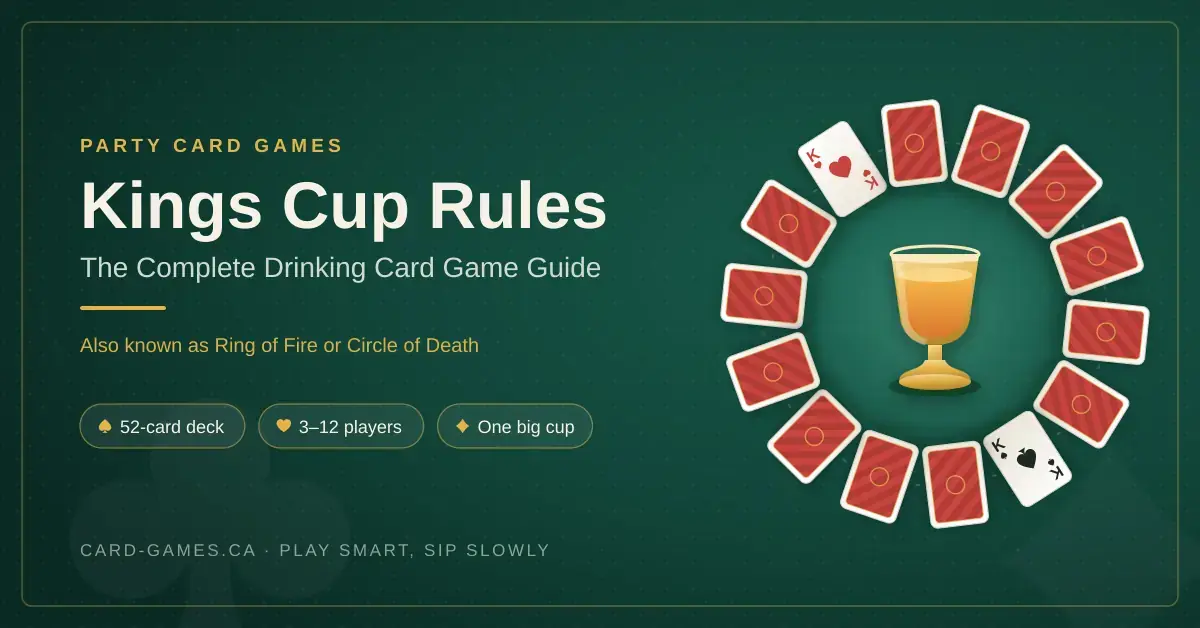
Few games capture the spirit of a house party quite like Kings Cup. Also known as Ring of Fire, Circle of Death or simply “Kings,” it turns an ordinary deck of playing cards into an evening of dares, mini-games and good-natured chaos. Because every card triggers a different action, no two rounds ever play out the same way — which is exactly why the game has stayed popular at student houses, cottages and backyard gatherings across Canada for decades. This complete guide walks you through the Kings Cup rules, what each card means, how to build the classic Ring of Fire, the most popular variations, and how to keep the night fun and safe.
What Is Kings Cup?
Kings Cup is a social drinking game played with a standard 52-card deck and one large communal cup placed in the middle of the table. Players take turns drawing cards from a ring spread around that cup, and each card value carries a rule — some make you drink, some make other players drink, and several launch quick mini-games or let you invent new rules on the spot.
Unlike trick-taking or rummy games, Kings Cup has no real “winner.” The goal is purely social: keep the group laughing and interacting until the deck runs out or the central King’s Cup is finally emptied. It sits firmly in the world of party and drinking card games, where the cards are really just a framework for the group’s own humour and house rules.
The game is known by many names depending on where you grew up — Ring of Fire, Circle of Death, Donut, or just Kings — but the core structure is almost always the same: a ring of cards, a central cup, and a shared set of rules everyone agrees on before the first draw.
A Short History of Kings Cup
Kings Cup has no single documented inventor. Like most drinking games, it grew and spread informally — passed from one group of friends to the next, mostly at universities and house parties, long before the internet helped standardise the rules. That word-of-mouth history is exactly why the card meanings differ so much from town to town: each group added, dropped or renamed rules to suit its own sense of humour, and those local versions stuck.
What all versions share is the same clever design. A regular deck already contains 13 ranks and 52 cards, which gives the game a built-in structure of 13 different rules and a natural sense of escalation as the Kings are slowly drawn. That simplicity — no board, no app, no special deck required — is a big part of why the game has endured and why it remains a fixture at Canadian gatherings from campus residences to cottage weekends.
What You Need to Play
One of the reasons Kings Cup is so popular is that the setup costs nothing beyond a deck of cards and something to drink. Here is everything you need:
- A standard 52-card deck — jokers removed.
- One large empty cup or glass placed in the centre of the table — this becomes the “King’s Cup.”
- A drink for every player. Beer, cider, a mixed drink or, just as validly, a soft drink, sparkling water or mocktail for anyone not drinking alcohol.
- 3 to 12 players. The game works best with about 4 to 8 people gathered around a single table.
- A flat surface — a table, floor or coffee table large enough to lay the cards in a ring.
Quick Facts
| Players | 3–12 (best with 4–8) |
|---|---|
| Deck | Standard 52-card deck (no jokers) |
| Also known as | Ring of Fire, Circle of Death, Kings, Donut |
| Type | Social party / drinking game |
| Setup time | About 2 minutes |
| Game length | Roughly 20–45 minutes |
| Skill needed | None — luck, quick reactions and humour |
| Equipment | Deck of cards, one central cup, a drink per player |
How to Set Up the Ring of Fire
Setting up takes less than two minutes. Follow these steps:
- Place the empty King’s Cup upright in the middle of the table.
- Shuffle the full 52-card deck.
- Spread the cards face down in an unbroken circle (the “ring”) around the cup, slightly overlapping so they form one continuous loop.
- Make sure every player can comfortably reach the ring and has their own drink in front of them.
- Agree on which card meanings you are using before you start — this avoids arguments once the game is underway.
Players then take turns, moving clockwise, drawing one card at a time from the ring, flipping it face up, and immediately carrying out that card’s rule. In some versions the ring must stay unbroken and a penalty applies to whoever breaks the circle when drawing — one of many optional house rules covered below.
Kings Cup Rules: What Every Card Means
Each card rank triggers a specific action. The table below is the most widely recognised, “standard” set of Kings Cup rules — but remember that this game is famous for regional variation, so treat it as a reliable starting point rather than gospel.
Card Meanings
| Card | Name | What happens |
|---|---|---|
| Ace | Waterfall | Everyone drinks at once; you cannot stop until the player to your right stops. |
| 2 | You | The drawer chooses another player who must take a drink. |
| 3 | Me | The player who drew the card drinks. |
| 4 | Floor | Everyone touches the floor; the last person to do so drinks. |
| 5 | Guys | All the guys drink (many groups use a gender-neutral rule instead). |
| 6 | Chicks | All the women drink (again, often swapped for an inclusive rule). |
| 7 | Heaven | Everyone points to the ceiling; the last person to react drinks. |
| 8 | Mate | Pick a partner who must drink every time you drink for the rest of the game. |
| 9 | Rhyme | Say a word; players go around rhyming until someone fails and drinks. |
| 10 | Categories | Name a category; players list items until someone stalls and drinks. |
| Jack | Make a Rule | The drawer invents a rule that lasts the whole game; breaking it means a drink. |
| Queen | Question Master | The drawer can ask questions; anyone who answers must drink until the next Queen. |
| King | King’s Cup | The first three Kings pour a splash into the central cup; the fourth King drinks it all. |
The action cards (Ace, 4 and 7)
These cards get everyone moving at once. On an Ace (Waterfall), all players begin drinking at the same time; you cannot stop until the person to your right stops, so the player who drew the card controls how long the “waterfall” lasts. Four (Floor) and Seven (Heaven) are mirror-image reaction games: the last player to touch the floor — or to point at the ceiling — has to drink. They are simple, fast, and reward paying attention.
The social cards (2, 3, 5, 6 and 8)
These decide who drinks. Two (You) lets the drawer assign drinks to someone else, Three (Me) means the drawer drinks, and Eight (Mate) pairs you with a chosen partner who must drink whenever you do for the rest of the game. The classic Five (Guys) and Six (Chicks) split the table by gender — though many modern groups swap these for gender-neutral rules, which we cover in the variations section.
The mini-game cards (9, 10, Jack and Queen)
These are where the personality of the game really shows. Nine (Rhyme) and Ten (Categories) send a word or theme around the circle until someone stumbles and drinks. Jack (Make a Rule) lets the drawer invent a rule that lasts the entire game — anything from “no first names” to “you must drink with your left hand.” Queen (Question Master) makes the drawer the Question Master: anyone who answers one of their questions has to drink, until the next Queen is pulled.
The Kings and the King’s Cup
The Kings are the heart of the game and the reason for that cup in the middle. When the first three Kings are drawn, the player who drew each one pours some of their own drink into the central King’s Cup. Whoever draws the fourth and final King must drink the entire contents of that cup — a mix of everything that has been poured in — which usually ends the round. Because of this, drawing Kings early is safe, but the later the game goes with Kings still in the ring, the more nervous everyone becomes.
Popular Kings Cup Variations and House Rules
No two groups play Kings Cup exactly the same way — the “rule card” is one of the most passionately debated items in drinking-game folklore. Here are some of the most common variations you will run into:
- Thumb Master (often the Jack or a chosen card): the drawer can place their thumb on the table at any time; the last player to copy them drinks.
- Never Have I Ever: some groups assign this to a card, with the drawer making an “I’ve never…” statement and anyone who has done it drinking.
- Question Master upgrades: the Queen holder keeps their card face up and can trap anyone who replies to a direct question.
- Snake Eyes / Categories twists: harder themed rounds for experienced groups.
- Gender-neutral rules: replacing “Guys” and “Chicks” (5 and 6) with rules like “left of the dealer drinks” or “anyone wearing a certain colour drinks,” so everyone is included.
- The unbroken ring penalty: if you break the circle of cards while drawing, you drink.
- Non-alcoholic version: play exactly the same rules using soft drinks, water or mocktails — the mini-games are just as fun sober.
If you enjoy putting a party spin on familiar decks, you will also like our look at Drunk Uno and other hilarious card-game variations, which applies the same social-rules idea to Uno.
Kings Cup vs Other Party Card Games
Kings Cup is one option among many for a lively night in. The comparison below shows how it stacks up against other popular adult party card games so you can pick the right one for your group.
| Game | Best player count | Deck used | Style | Best for |
|---|---|---|---|---|
| Kings Cup | 4–8 | Standard 52-card | Social / drinking, mini-games | Spontaneous, rules-light parties |
| Cards Against Humanity | 4–10+ | Dedicated card set | Fill-in-the-blank humour | Groups that love dark comedy |
| Uno | 2–10 | Dedicated Uno deck | Shedding / matching | All ages, fast rounds |
| Never Have I Ever | 3–10 | Cards or no cards | Confession / party | Icebreakers and getting to know people |
| Waterfall | 4–8 | Standard 52-card | Social / drinking | Fans who want a Kings Cup cousin |
For more ideas beyond Kings Cup, browse our roundup of the best party card games for adults in Canada.
Tips for a Better (and Safer) Game
- Agree on the rules first. Settle every card meaning and house rule before the first draw to avoid mid-game disputes.
- Keep the pours small. Because so many cards trigger drinking, small sips keep the game going longer and everyone in better shape.
- Offer non-alcoholic options. The mini-games work exactly the same with soft drinks or water, so no one is left out.
- Pace yourselves. Have water and snacks on the table, and never pressure anyone to drink.
- Plan a safe ride home. Arrange a designated driver, taxi or rideshare before the night starts.
Responsible-play disclaimer: This article is provided for informational and entertainment purposes only and is intended for adults of legal drinking age in their province or territory (18 in Alberta, Manitoba and Quebec; 19 elsewhere in Canada). Kings Cup can encourage rapid or heavy drinking, so please play in moderation, never drink and drive, and never pressure anyone to consume alcohol. For guidance on lower-risk drinking see Canada’s Guidance on Alcohol and Health from the Canadian Centre on Substance Use and Addiction, and if you or someone you know needs support with alcohol use, free and confidential help is available through ConnexOntario (1-866-531-2600) or your provincial health line.
Reference Sources
Frequently Asked Questions
How many players do you need for Kings Cup?
You can play with as few as three people, but Kings Cup is at its best with roughly four to eight players seated around one table. Larger groups still work; you may just want to speed up the mini-game cards so everyone stays involved.
What is the difference between Kings Cup and Ring of Fire?
They are essentially the same game, and most people use the names interchangeably along with Circle of Death and simply “Kings.” Some groups reserve “Ring of Fire” for a version where a can of drink sits in the centre and cards are tucked under the tab, but the ring of cards, the central cup and the card-by-card rules are the same core game.
What happens when you draw the last King?
The first three Kings each add a splash of the drawer’s drink to the central King’s Cup. Whoever draws the fourth and final King must drink whatever has collected in that cup, which traditionally ends the round. It is the game’s built-in finale and the source of most of the suspense.
Can you play Kings Cup without alcohol?
Absolutely. The rules work identically with soft drinks, juice, sparkling water or mocktails. Because the fun comes from the mini-games, dares and made-up rules rather than the alcohol itself, a fully non-alcoholic game is just as entertaining and lets everyone take part.
Why do the card meanings sometimes differ?
Kings Cup has spread almost entirely through word of mouth, so card meanings vary widely from one region and friend group to the next. There is no single official rulebook. The set in this guide is the most commonly recognised version; the important thing is that your group agrees on one consistent set of rules before you begin.