

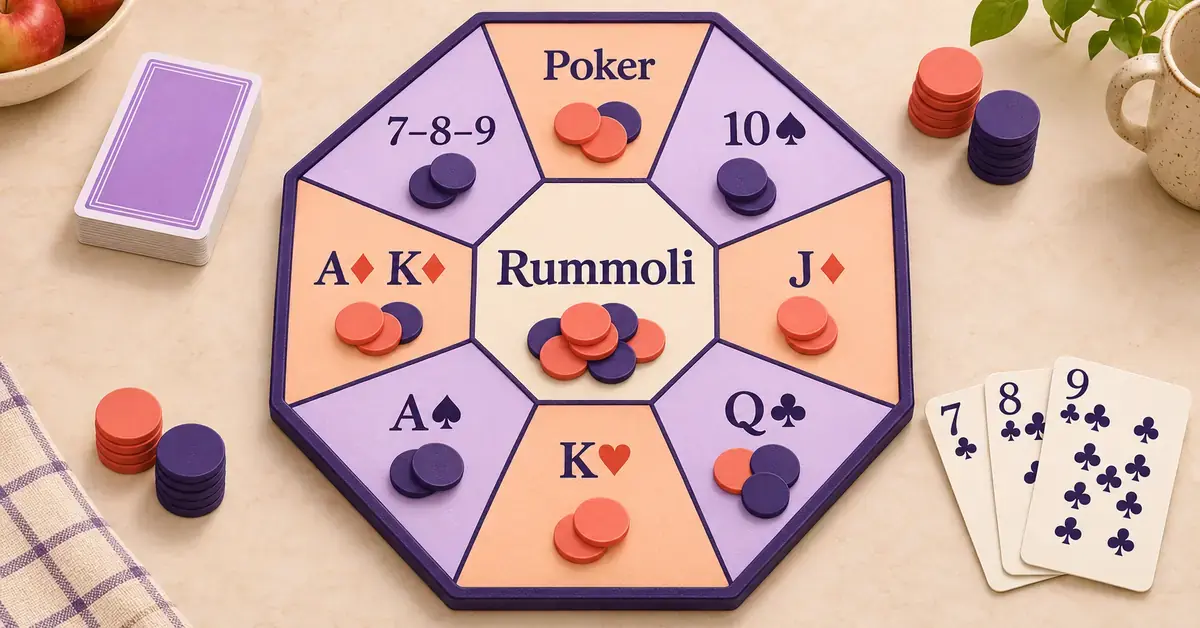
Rummoli is a classic Canadian chip-and-board game that blends a short round of poker with a sequence-matching “stops” game on a single octagonal board. To play, two to eight players each take a stack of chips, pay one chip into every pot printed on the board, and then compete to claim those pots — first through a quick poker round, then by laying their cards down in sequence and racing to be the first to empty their hand. This guide walks you through the board layout, each pot, the setup, step-by-step play and exactly how to win, so you can run a full game at your next kitchen-table night.
Despite the “-oli” ending, Rummoli is not a form of traditional rummy — there are no melds or runs to collect in your hand the way there are when you learn how to play Rummy. Instead, Rummoli belongs to the “stops” family of matching games, and much of the fun comes from the chips, the pots and the gentle gambling that builds across several rounds.
What Is Rummoli?
Rummoli is a Canadian family game first marketed in 1940 by the Copp Clark Publishing Company of Toronto. It is one of the most popular members of the “stops” group of matching card games — a family that descends from the old German game Poch and includes relatives such as the French Nain Jaune (Yellow Dwarf) and the Victorian Pope Joan. Rummoli is most similar to the American game Tripoley (generically called Michigan Rummy), which debuted in Chicago in 1932, eight years before Rummoli reached Canadian stores.
The game is designed to be social and easy to learn. It is usually played for fun or for very small stakes — traditionally a jar of coins such as Canadian dimes — and a single hand takes only a few minutes once everyone knows the flow. Because luck plays a large role, children and adults can play together on fairly even terms, which is why Rummoli has stayed a holiday favourite in many Canadian households for decades.
Quick Facts
| Feature | Detail |
|---|---|
| Players | 2–8 |
| Deck | Standard 52 cards, no jokers |
| Equipment | Rummoli octagon board plus chips or counters |
| Game type | “Stops” matching game with a poker round |
| Origin | Canada — Toronto, 1940 (Copp Clark Publishing) |
| Playing time | About 30–60 minutes over several hands |
| Goal | Win the most chips |
What You Need to Play
Rummoli needs very little equipment, and most of it is probably already in your home:
- The Rummoli board. This is a large, octagon-shaped playing surface printed with the pots. Commercial sets include a jumbo board, but the layout is simple enough that you can draw it on a sheet of paper or a felt mat if you have lost the original.
- A standard deck of cards. You use a single 52-card deck with the jokers removed. If you are unsure how many cards are in a deck, it is 52 — thirteen ranks in each of the four suits.
- Chips or counters. Poker chips, buttons, matchsticks or coins all work. Each player needs a roughly equal supply to bet with and to pay into the pots.
- Two to eight players. Rummoli works with as few as two people, but it is livelier with four to six.
The Rummoli Board Explained
The board is the heart of the game, and understanding it is the key to everything else. A traditional Rummoli board is shaped like an octagon. In the very centre sits a pot called Rummoli, and it is surrounded by eight outer pots. Each pot is simply a labelled space where chips are collected until someone wins them. The order of the pots around the board does not matter.
On the classic Copp Clark layout, the central Rummoli pot is ringed by these eight spaces: the Poker pot, the Ten of Spades, the Jack of Diamonds, the Queen of Clubs, the King of Hearts, the Ace of Spades, the combination Ace and King of Diamonds, and a 7-8-9 sequence of any suit. Keep in mind that board designs vary between editions and manufacturers, so your set may label the pay cards with slightly different suits — always check the printing on your own board before you start.
Six of the outer pots are won by playing a specific “pay card” during the game, one is the poker pot won in the betting round, and the final one rewards a short run of cards. The centre pot goes to whoever empties their hand first. The table below shows exactly what claims each pot.
Board Pots and Winning Cards
| Pot | How it is won |
|---|---|
| Rummoli (centre) | First player to empty their hand |
| Poker | Best poker hand in the betting round |
| Ten of Spades | Playing the 10 of spades |
| Jack of Diamonds | Playing the J of diamonds |
| Queen of Clubs | Playing the Q of clubs |
| King of Hearts | Playing the K of hearts |
| Ace of Spades | Playing the A of spades |
| Ace and King of Diamonds | Playing both the A and K of diamonds |
| 7-8-9 Sequence | Playing a 7, 8 and 9 of any one suit |
Board layouts vary by edition — check the pay cards printed on your own board.
Setting Up the Game
Before the first deal, divide the chips evenly among all players and agree on a value if you are playing for small stakes. Players then cut the cards to choose the first dealer; the high card deals, and the deal passes one seat clockwise after every hand.
Now everyone “feeds” the board. Before the cards are dealt, each player pays one chip into every pot on the board, including the centre Rummoli pot. This is repeated at the start of each new hand, which is how the pots grow over time — and why the harder-to-win pots, such as the 7-8-9 sequence and the Ace-and-King of Diamonds, can swell into a big prize over several rounds.
Dealing and the Widow Hand
The dealer deals the entire deck one card at a time, including one extra hand known as the widow (a spare, face-down hand). Because the whole deck is dealt out, some players may end up with one more card than others — this is normal and does not matter.
After looking at their own cards, the dealer has a choice. They may swap their hand for the unseen widow, but they must not peek at the widow first and cannot swap if their own hand already contains a pay card. If the dealer keeps their hand, the widow is auctioned to the highest bidder among the other players, who pays the winning bid to the dealer and then takes the widow. Whoever takes the widow is committed to it, even if it turns out to be worse, and the discarded hand is set aside face down and takes no further part in the play.
How to Play Rummoli Step by Step
Each hand of Rummoli has two connected phases: a poker round, then the sequence (“stops”) round. Throughout the game, the ace is high.
Stage 1: The Poker Round
Every player selects the five cards from their hand that make the best poker hand and sets the rest aside face down. Players agree in advance on one of two methods. In a simple showdown, everyone reveals their five cards and the strongest hand wins the Poker pot. In the betting version, the player to the dealer’s left opens and betting proceeds as in ordinary poker, with all bets going into the Poker pot; a player who folds cannot win the pot even if their hand was secretly best. If you need a refresher on which hands beat which, review the standard poker hand rankings before you deal. The winner of the poker round takes the Poker pot and leads the next phase.
Stage 2: The Rummoli (Sequence) Round
Players now pick their set-aside cards back up and reunite their full hand, sorting it by suit. The poker winner leads by placing their lowest-ranked card face up on the table and calling it aloud — for example, “three of hearts.” Play does not go around the table one card at a time; instead, whoever holds the next card up in that same suit plays it, then the next, building an ascending run (…4, 5, 6…) until the ace of that suit is reached or the run hits a “stop.”
A stop happens when the next card in sequence cannot appear — usually because it is sitting in the dead widow hand. When a suit is completed by its ace or blocked by a stop, the player who laid the last card must then start a fresh run by playing the lowest card they hold in a suit of the opposite colour (switching from a black suit to a red one, or vice versa). If that player has no card of the required colour, the turn passes clockwise until someone can continue.
Occasionally an impasse occurs where nobody can change colour — for instance, everyone is left holding only red cards. When that happens the hand ends: each player throws one chip into the centre for every card still in their hand, and these chips carry over to the next hand’s winner. This sequence play is the same “board-and-card” rhythm you may know from Sequence, the board-and-card game, though Rummoli uses a single shared deck rather than a game board of card spaces.
Stage 3: Collecting the Pots
The pots are won during this sequence round. The moment a player lays down a card that matches one of the board’s pay spaces — the Ten of Spades, Jack of Diamonds, Queen of Clubs, King of Hearts or Ace of Spades — they immediately take all the chips sitting on that space. Playing both the Ace and King of Diamonds claims that combination pot, and laying a 7-8-9 run in a single suit claims the sequence pot. One important courtesy rule: a player must notice and claim the pot as they play the card. If a matching card is laid without the player realising, the chips simply stay on the board for someone to win in a later hand.
Going Out and Ending the Hand
The first player to get rid of every card in their hand wins the centre Rummoli pot, and this ends the hand. Every other player then pays the winner one chip for each card still left in their own hand — so being caught with a full hand is costly. Any pots that were not won stay on the board and accumulate into the next hand, rewarding a lucky future player.
Key Points
- Feed the board first: each player pays one chip into every pot before each deal.
- Two phases per hand: a poker round for the Poker pot, then a sequence round for everything else.
- Claim as you play: lay a pay card and take its pot immediately, or the chips stay put.
- Going out wins the centre: the first empty hand takes the Rummoli pot and is paid one chip per card everyone else still holds.
- Unwon pots roll over and grow until a lucky hand claims them.
Winning the Game and the Final Payout
Rummoli is played over as many hands as the group likes. There is no fixed finish line, so players simply agree when to stop — a set time, a set number of hands, or the point where all but one player have run out of chips. When the group decides to end, any chips still sitting on the board are swept into one combined pot, and a final round of poker is dealt and played to decide who takes them. A common variation is to instead play one showdown for each pot that still holds chips, starting with the pot that has the fewest. Once the board is cleared, the player with the most chips overall is the winner.
Rummoli, Tripoley and Other Canadian Classics
Rummoli is part of a wider family of chip-and-board games. Its closest cousin is the American Tripoley, and the generic name Michigan Rummy covers the same style of play — though none of them should be confused with the card game 500 Rum. If you enjoy games with a distinctly Canadian pedigree, you might also try your hand at how to play Kaiser, a trick-taking game from the Prairies. And if you want to take any of these games beyond the kitchen table, there is a thriving scene of card game clubs and tournaments in Canada where traditional games stay very much alive.
Rummoli Strategy and House Rules
Rummoli leans heavily on luck, but a few habits will improve your results across a long session:
- Hold your low cards when you can. Because play builds upward within a suit, being the one who can keep a run going keeps you in control and lets you lay pay cards sooner.
- Track the pay cards. If you are holding the King of Hearts or Ace of Spades, plan how you will reach it — those chips are guaranteed income once the card hits the table.
- Weigh the widow carefully. As dealer, only swap for the widow if your hand is genuinely weak, and remember you may not swap away a pay card. When bidding for the widow, don’t overpay for an unseen hand.
- Chase the growing pots. The 7-8-9 sequence and the Ace-and-King of Diamonds pots often go unclaimed for several hands, so a single lucky hand can pay off big.
- Agree your house rules first. Showdown or betting poker, how to end the game, and how to split leftover chips all vary from family to family — settle them before the first deal to avoid arguments.
Because Rummoli is traditionally played with chips that may represent small amounts of money, it is worth keeping the game friendly and in perspective. Play for fun and modest stakes among friends and family. If gambling ever stops being enjoyable for you or someone you know, help is available in Canada: contact the Responsible Gambling Council, call ConnexOntario at 1-866-531-2600 for free, confidential support 24/7, or visit the Alcohol and Gaming Commission of Ontario for provincial information. This article is for informational and educational purposes only.
Reference Sources
Frequently Asked Questions
Is Rummoli the same as rummy?
No. Although the names sound alike, Rummoli is not a rummy game. Rummy is about collecting sets and runs in your hand, while Rummoli is a “stops” game built around a board of pots, a poker round and laying cards in sequence. Rummoli is most closely related to Tripoley and Michigan Rummy, not to standard rummy.
How many players do you need for Rummoli?
Rummoli works with two to eight players. It can be played as a two-handed game, but it is at its best with about four to six people, which keeps the pots competitive and the sequence play lively.
What do the pots on the Rummoli board mean?
Each pot is a space where chips collect until someone wins them. Six pots are claimed by playing a specific pay card or combination (such as the King of Hearts or the Ace and King of Diamonds), the Poker pot goes to the best hand in the betting round, and the central Rummoli pot goes to the first player to empty their hand. Unwon pots roll over to future hands.
How do you win a hand of Rummoli?
You win the central Rummoli pot by being the first player to get rid of all the cards in your hand during the sequence round. Everyone else then pays you one chip for each card they still hold. Over the whole game, the player with the most chips when the group stops playing is the overall winner.
Can you play Rummoli without the official board?
Yes. The board is just a printed layout of an octagon with a central Rummoli pot and the surrounding pots. If you have lost your set, you can draw the same pots on a sheet of paper or a felt mat and play with any standard 52-card deck and a pile of chips or coins.