

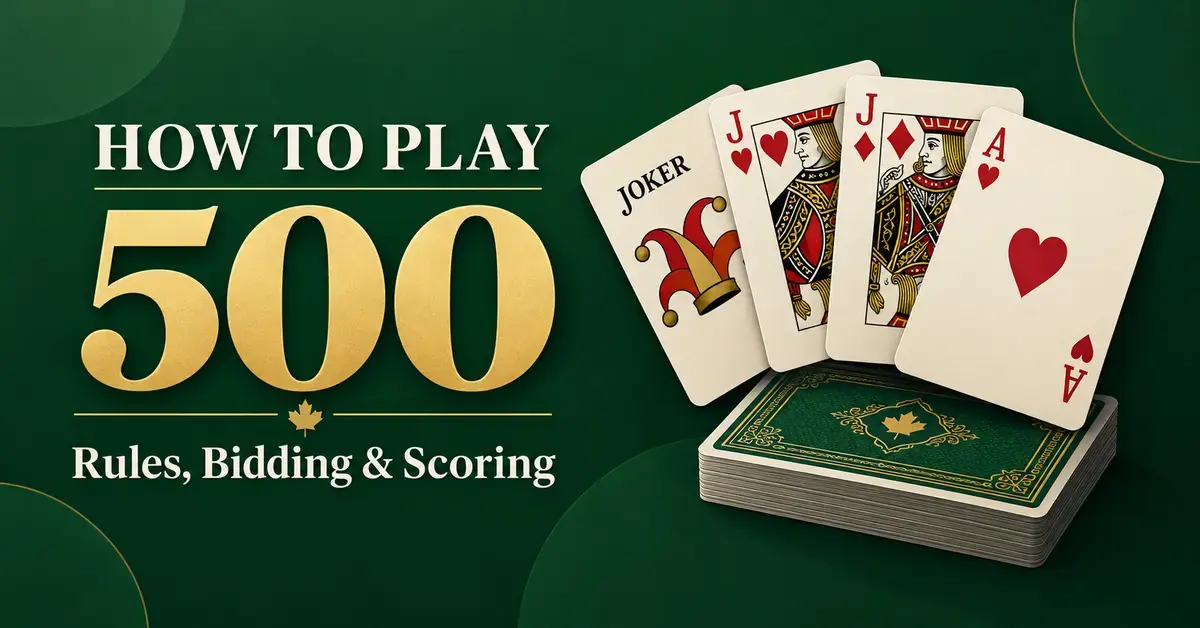
500 is one of the most rewarding trick-taking card games you can learn with a standard deck and a single joker. Invented in the United States around the turn of the twentieth century and refined by the United States Playing Card Company in 1904 (with the famous Avondale scoring schedule following in 1906), it blends the bower mechanic of Euchre with the auction and partnership play of Bridge. The game is a long-standing favourite in Canada, parts of the United States such as Ohio and Pennsylvania, and above all Australia, where it is often called the national card game.
This guide explains everything a beginner needs: the deck, the deal, how the cards rank, how the bidding auction works, how tricks are played and, crucially, how the scoring adds up to the magic number of 500. Every rule and figure below follows the widely used four-player partnership game with the standard Avondale scoring schedule.
Key Facts at a Glance
- Players: 4 in two fixed partnerships (variants for 3, 5 and 6)
- Deck: 43 cards (A-4 in red suits, A-5 in black suits) plus one joker
- Cards dealt: 10 each, with a 3-card kitty for the winning bidder
- Goal: Win an auction, make your trick contract and be first to 500 points
- Key feature: The joker, right bower and left bower are the top three trumps
- Game length: About 30-60 minutes; skill level easy to learn, hard to master
What Is 500?
500 is a point-based, trick-taking card game for four players in two fixed partnerships, with partners sitting opposite one another. The name comes from the target score: the first partnership to reach 500 points wins the game. Each hand begins with an auction in which players bid how many tricks they think they can win and which suit (if any) will be trump. The winning bidder and their partner then try to fulfil that contract, while the opponents try to stop them.
Because it evolved directly from how to play Euchre, 500 shares Euchre’s signature feature: the two jacks of the trump colour become the two most powerful ordinary cards, known as the bowers. Players who already enjoy bidding trick-takers like Kaiser on the Canadian prairies will find the rhythm of 500 immediately familiar.
What You Need: Players, Deck and Setup
The standard game is played by four people in two partnerships. You need one deck of cards prepared specifically for 500, a flat surface and a way to keep score (pen and paper is traditional). A hand usually takes a few minutes, and a full game to 500 points typically lasts 30 to 60 minutes.
The 43-Card Deck
500 uses a trimmed 43-card deck rather than a full 52-card pack. Starting from a standard French-suited deck you keep the following cards and add one joker:
- Hearts and Diamonds (red suits): Ace, King, Queen, Jack, 10, 9, 8, 7, 6, 5, 4
- Clubs and Spades (black suits): Ace, King, Queen, Jack, 10, 9, 8, 7, 6, 5
- One joker (often nicknamed “the bird”)
That gives 11 red cards in each red suit, 10 black cards in each black suit, plus the joker, for 43 cards in total. The 2s and 3s are removed from every suit, and the two black 4s are also removed. Some households instead play with a 45-card deck that keeps all four 4s; either version works as long as everyone agrees before the deal.
Dealing and the Kitty
The dealer shuffles and deals ten cards to each player and sets three cards aside, face down, to form the kitty (sometimes called the widow). A common dealing pattern is a packet of three to each player, three to the kitty, then four and three more to each player, but the exact pattern does not matter so long as everyone ends with ten cards and the kitty has three.
The kitty is the prize for winning the auction. Whoever wins the bid picks up the three kitty cards, adds them to their hand, and then discards any three cards face down, returning to a ten-card hand. This lets the contractor improve their hand and discard weak suits before play begins.
Card Rankings and the Bowers
Card strength in 500 depends entirely on whether a suit is trump. Getting the bower order right is the single most important thing a new player must memorise.
Trump Suit Order
When a suit is named as trump, its cards rank from highest to lowest as follows:
- The joker — the highest card in the game
- Right bower — the Jack of the trump suit
- Left bower — the other Jack of the same colour as trump
- Ace, King, Queen, 10, 9, 8, 7, 6, 5, 4 of the trump suit (descending)
For example, if Hearts are trump, the order is joker, Jack of Hearts (right bower), Jack of Diamonds (left bower), then Ace of Hearts down to 4 of Hearts. The important twist is that the left bower counts as a trump card for the whole hand, so the Jack of Diamonds is no longer a diamond — it is effectively the second-highest heart. The ordinary suits (the three that are not trump) simply rank Ace high down to their lowest card, with their Jack missing if it has become a bower.
No-Trump Rankings
A player can also bid “no trumps,” meaning no suit is trump at all. In a no-trump hand the joker is the only trump: it beats every other card and can be played on any trick. The holder may play it whenever they like, but if they lead with the joker they must name a suit that the other players then have to follow. With no trump suit, both bowers behave as ordinary jacks and all four suits rank Ace high down to their lowest card.
How Bidding Works
After the deal, players bid in a clockwise auction starting with the player to the dealer’s left. Each bid states a number of tricks (from 6 to 10) and a trump suit, or no trumps. A bid promises that your partnership will win at least that many of the ten tricks. On your turn you must either make a higher-scoring bid than the current one or pass; in the common game, once you pass you are out of the auction. Bidding ends when three players have passed, and the last and highest bidder becomes the contractor.
The Order of Bids
Bids are ranked first by the number of tricks and then by suit value. From lowest to highest, the suits rank Spades, Clubs, Diamonds, Hearts, then No Trumps. So “six spades” is the lowest possible bid and “ten no trumps” is the highest. A bid of “seven hearts” means you intend to win at least seven tricks with Hearts as trump, while “seven no trumps” means seven tricks with only the joker as trump. Because higher suits and higher trick counts are worth more points, the auction naturally pushes players toward their strongest realistic contract.
Misère and Open Misère
500 also allows reverse bids where you try to win no tricks at all. A plain misère (called nullo in some American rule sets) is a promise to lose every trick, played with no trump; it is worth 250 points and conventionally can only be bid after someone has already bid at the seven level. An open misère is the same promise, but the bidder lays their hand face up on the table after the first trick so opponents can see every card; it is a bolder bid, usually valued at 500 points. Successfully taking zero tricks when everyone can see your hand is one of the most satisfying plays in the game. If you enjoy contracts built on avoiding tricks, the idea will feel related to Oh Hell, where bidding the exact number of tricks is everything.
Avondale Bidding and Scoring Table
| Tricks bid | Spades | Clubs | Diamonds | Hearts | No Trumps |
|---|---|---|---|---|---|
| 6 | 40 | 60 | 80 | 100 | 120 |
| 7 | 140 | 160 | 180 | 200 | 220 |
| 8 | 240 | 260 | 280 | 300 | 320 |
| 9 | 340 | 360 | 380 | 400 | 420 |
| 10 | 440 | 460 | 480 | 500 | 520 |
| Misère | 250 points | ||||
| Open Misère | 500 points | ||||
Make the contract to score the value shown; fail and you lose it. Opponents score 10 points for each trick they win (except on misère hands).
Playing the Hand
Once the contract is set and the contractor has used the kitty and discarded, play begins. The contractor leads the first trick by playing any card face up. Play continues clockwise, and each player must follow the led suit if they can. If you cannot follow suit, you may play any card, including a trump. Remember that the left bower counts as a trump, not as a card of its printed suit, so you cannot use it to follow a plain-suit lead of its original colour.
A trick is won by the highest trump played, or, if no trump was played, by the highest card of the suit that was led. The winner of each trick gathers the four cards, sets them aside face down, and leads the next trick. After all ten tricks are played, the partnership counts how many tricks each side won and the hand is scored. This core trick-taking flow is shared with classics such as Spades, so skills transfer easily between the games.
How Scoring Works
Scoring in 500 is where the game earns its name. Only the contract value matters for the bidding side; the opponents score small trick bonuses. The standard point values come from the Avondale schedule, shown in the scoring element above.
Making and Failing a Contract
If the contracting partnership wins at least as many tricks as they bid, they score the full value of their contract from the Avondale table — for instance, 300 points for making eight hearts. If they win all ten tricks (a slam) on a contract worth less than 250, they instead score 250. Whether or not the contractors succeed, the opposing partnership scores 10 points for each trick they manage to win during the hand.
If the contractors fall short of their bid, they are “set”: they lose the full contract value, recorded as a negative number, while the opponents still collect their 10 points per trick won. A failed ten no-trumps, for example, costs the bidding side 520 points, which is why high bids are a genuine gamble. Misère and open misère are scored on their own: success earns 250 or 500 points and failure loses the same amount, with no trick bonus to the opponents in either case.
Winning and Losing the Game
The first partnership to reach 500 points or more wins the game — but there is a catch. A team can only win by making a successful contract; you cannot win purely on the 10-points-per-trick bonuses collected as an opponent. At the same time, a partnership that drops to minus 500 or worse loses the game outright, a fate colourfully known as “going out the back door.” This two-sided target keeps every hand tense: bold bids can win the game in a single deal, but a string of failed contracts can lose it just as fast.
500 Compared to Other Trick-Taking Games
If you already know a related game, the table below shows how 500 lines up against other popular trick-takers and where it fits in difficulty and style. Despite sharing a number in its name with Rummy 500, the two are entirely different — you can read our separate guide on Rummy 500 to see the melding game that sometimes causes confusion.
| Game | Players | Deck | Trump / bidding | Target |
|---|---|---|---|---|
| 500 | 4 (2 teams) | 43 cards + joker | Auction with bowers | First to 500 points |
| Euchre | 4 (2 teams) | 24 or 25 cards | Trump named, bowers | First to 10 points |
| Kaiser | 4 (2 teams) | 32 cards | Bidding, special cards | First to 52 points |
| Spades | 4 (2 teams) | 52 cards | Spades always trump | First to 500 points |
| Oh Hell | 3-7 | 52 cards | Rotating trump, exact bids | Most points after set rounds |
Tips and Strategy for Beginners
A few habits will raise your game quickly. First, count your likely tricks before bidding: the joker and both bowers are near-certain winners, and a long trump suit usually produces extra tricks. Second, do not overbid early — a failed contract hands momentum straight to your opponents through the negative score. Third, use the kitty wisely by discarding an entire weak side suit so you can trump it later. Fourth, communicate with your partner through your bids rather than table talk; a higher bid tells your partner you have strength. Finally, pay attention to which bowers have been played, because mistaking the left bower for a plain jack is the most common beginner error.
Common Variations
500 scales to different numbers of players with small deck changes. A three-handed game drops the partnerships and uses a 33-card deck so each player competes alone. A five-handed game uses a larger deck and lets the winning bidder call a card to choose a temporary partner, while a six-handed game uses a special expanded pack with extra ranks (elevens, twelves and red thirteens). House rules also vary on whether open misère outranks a ten bid, and on the exact placement of misère in the auction, so confirm the local rules before you start. Trick-taking fans who enjoy these partnership mechanics will also recognise them in Whist, one of the older ancestors of the whole family.
Reference Sources
Frequently Asked Questions
How many cards are in a 500 deck?
The standard four-player game uses a 43-card deck: the Ace down to the 4 in Hearts and Diamonds, the Ace down to the 5 in Clubs and Spades, plus one joker. That removes all the 2s and 3s and the two black 4s from a normal pack. Some players prefer a 45-card version that keeps all four 4s.
What are the bowers in 500?
The bowers are the two most powerful trump cards after the joker. The right bower is the Jack of the trump suit, and the left bower is the other Jack of the same colour. The left bower counts as a trump card for the whole hand, so it is no longer treated as a member of its printed suit.
What does a bid of “seven hearts” mean?
It means you are promising that your partnership will win at least seven of the ten tricks with Hearts as the trump suit. If you succeed you score the contract’s value from the Avondale table; if you win fewer than seven tricks you are set and lose that value instead.
What is a misère bid?
A misère is a bid to lose every single trick, played with no trump suit, and it is worth 250 points. An open misère is the same promise but you reveal your whole hand after the first trick, and it is usually worth 500 points. Both are scored on their own, with no trick bonus going to the opponents.
How do you win a game of 500?
The first partnership to reach 500 points or more by making a successful contract wins the game. You cannot win on the 10-points-per-trick bonuses you earn as an opponent. A partnership that falls to minus 500 or worse loses the game outright.