

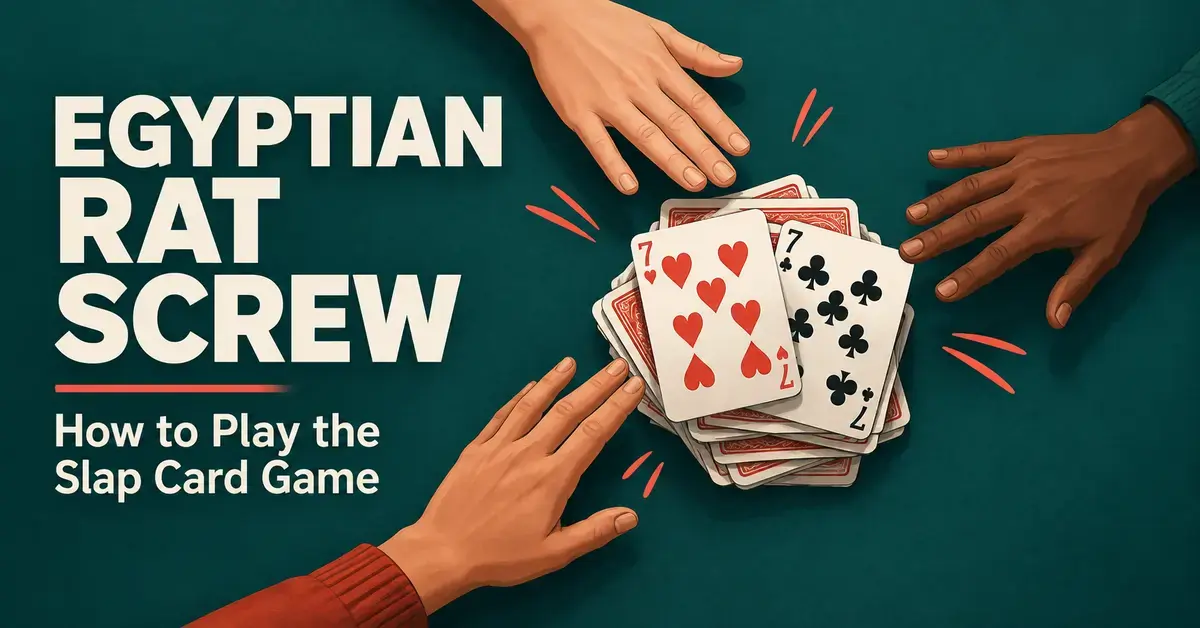
Egyptian Rat Screw is a fast, noisy, luck-and-reflexes card game where the whole deck ends up in one central pile and players race to slap it before anyone else. It is easy enough for children to pick up in a single round, yet chaotic enough to keep a table of adults laughing. If you already enjoy the thrill of smacking the pile in Slapjack, Egyptian Rat Screw takes that same instinct and layers on face-card duels and a growing list of slappable combinations.
This guide walks through the complete Egyptian Rat Screw rules: the deal, normal play, the all-important face-card payments, every way to legally slap the pile, the penalties for slapping wrongly, and the house rules that keep the game fresh. By the end you will be able to teach it to a full table in about two minutes.
Key Points
- Players: 2-5+ (add a second deck for 6 or more)
- Deck: One standard 52-card deck; jokers optional
- Goal: Win every card in the deck
- How you win cards: Win a face-card challenge or be first to slap a valid combination
- Key slaps: Double, sandwich, top-bottom and marriage
- Wrong slap: Burn 1-2 cards to the bottom of the pile
- Skill type: Luck plus fast reactions – no betting involved
What Is Egyptian Rat Screw?
Egyptian Rat Screw (often shortened to ERS, and also known as Egyptian War, Ratslap, Slap or Bloodystump) is an American card game that blends two older traditions. The core of laying one card at a time onto a shared pile comes from the 19th-century British game Beggar-My-Neighbour and from the familiar schoolyard favourite War. The slapping mechanic is borrowed straight from Slapjack.
The result is a game that rewards two very different skills at once: a little bit of luck in how the cards fall, and a lot of hand-eye speed when a slappable pattern appears. There is no bluffing, no hidden strategy and no money involved, which makes it a reliable family and party game rather than a gambling game.
What You Need to Play
Egyptian Rat Screw needs almost nothing beyond a deck of cards and a flat surface everyone can reach.
- Players: 2 to 5 is the sweet spot. With two players the game is quick and punishing; three or four players create the most fun and the most slapping chaos. Six or more can play if you shuffle in a second deck.
- Cards: One standard 52-card deck. Jokers are removed by default but can be added as a house rule (see below).
- Table: A surface where every player can comfortably reach the centre, because reaching the pile first is the whole point.
Because speed matters, it helps to agree on the exact slapping rules before the first card is dealt. Disputes almost always come from players using slightly different combinations.
Setting Up and Dealing
Choose a dealer any way you like. The dealer shuffles and then deals the entire deck out one card at a time, face down, going clockwise until every card is gone. With a 52-card deck and four players, each person ends up with 13 cards.
Two rules make the deal fair:
- It does not matter if players receive slightly uneven amounts when the deck does not divide evenly. The cards balance out in play.
- Players must not look at their cards. Each person squares their hand into a neat, face-down stack in front of them and leaves it there.
Nobody ever holds a hand the way you would in most card games. Your pile is simply a stack you draw from blindly, which is why Egyptian Rat Screw is a game of reaction rather than planning.
How a Turn Works
Play begins with the person to the dealer’s left and moves clockwise. On your turn you take the top card from your own stack and flip it face up onto the central pile in the middle of the table. You play one card and then it is the next player’s turn.
If the card you flip is a plain number card (2 through 10), nothing special happens and play simply passes to the next player. The pile keeps growing, one card at a time, until either a face card or Ace appears or a slappable combination is created. Those two events are the engine of the whole game.
Face Cards and Aces: The Challenge Rule
Face cards (Jack, Queen, King) and Aces are special. When you flip one onto the pile, you issue a challenge to the next player. They now owe you a set number of attempts to flip their own face card or Ace, and the number depends on the card you played:
Face Card Payments
| Card Played | Attempts the Next Player Gets |
|---|---|
| Jack | 1 attempt |
| Queen | 2 attempts |
| King | 3 attempts |
| Ace | 4 attempts |
Here is how it resolves, step by step:
- You play a face card or Ace. The next player must now try to “pay” it by flipping their own face card or Ace within the allotted number of attempts.
- If the challenged player flips a plain number card, that counts as a used attempt. They keep flipping until they either succeed or run out of attempts.
- If they fail to produce a face card or Ace within their attempts, the challenge ends. The last person who played a face card or Ace wins the entire pile, adds it face down to the bottom of their stack, and starts a fresh pile.
- If they succeed and flip a face card or Ace, the challenge immediately passes to the player after them, who now owes the new number of attempts for that card.
This back-and-forth is where big piles build up, and a fat pile is exactly when players are most eager to slap it away from everyone else.
The Slap Rule: How to Win the Pile Instantly
The slap rule overrides everything else. At any moment, if a slappable pattern appears on top of the pile, the first player to slap the pile wins all the cards in it, no matter whose turn it is or who was in the middle of a face-card challenge. This is why you keep one hand free and your eyes locked on the centre.
When you win by slapping, you collect the whole pile, shuffle it into the bottom of your stack, and the player to your left starts a new pile. Even players who have run out of cards can usually “slap back in” to rejoin the game, which is a popular rule worth agreeing on up front.
The Core Slappable Combinations
Most groups play with these four combinations, which almost everyone agrees are standard:
- Double: Two cards of the same rank played back to back, such as 7 then 7.
- Sandwich: Two cards of the same rank with exactly one different card between them, such as 9, 4, 9.
- Top-Bottom: The card just played matches the bottom card of the pile. Because the bottom card can be hard to see, many casual games skip this one.
- Marriage: A King and a Queen played one directly after the other, in either order.
Popular Optional Combinations
Many tables add extra triggers to make the game faster and funnier. Agree on these before you start:
- Tens (Addition): Two cards in a row that add up to exactly ten, counting Ace as one, such as a 6 and a 4.
- Four in a Row: Four consecutive cards in ascending or descending order, such as 5, 6, 7, 8.
- Jokers: If jokers are left in the deck, any joker can be slapped the instant it appears.
The more combinations you allow, the more frantic and mistake-prone the game becomes, which is usually a good thing. New players often start with doubles and sandwiches only, then add the rest once everyone is comfortable.
Penalties: Slapping When You Should Not
Because slapping is so tempting, there has to be a cost for getting it wrong. If you slap the pile when there is no valid combination, you pay a penalty known as a “burn”: you take one or two cards from the top of your own stack and place them face down on the bottom of the central pile. (Agree on one card or two before you start; two is the more common, more punishing version.)
This penalty does two useful things. It discourages wild, hopeful slapping, and it feeds extra cards into the pile so the eventual winner is rewarded even more. When several players slap at once, the player whose hand is lowest, touching the actual pile, wins the cards. A common tie-breaker is simply whoever has the most fingers on the pile.
How the Game Ends
Players are knocked out when they run out of cards, whether through losing challenges or burning cards on bad slaps. In most house rules an eliminated player gets one last chance: they stay at the table and may jump back in by slapping a valid combination, winning the pile and rejoining the game. If they miss their chance, they are out for good.
The game continues until a single player has collected all 52 cards. That player is the winner. Because the lead can swing wildly on a single lucky slap, games can be short and brutal or stretch on for a surprisingly long time.
Egyptian Rat Screw vs Other Slap and Speed Games
Egyptian Rat Screw belongs to a family of quick, reaction-based card games. If you enjoy it, the games below scratch a similar itch, and each has its own full rules guide on this site.
| Game | Players | How You Win Cards | Main Skill | Best For |
|---|---|---|---|---|
| Egyptian Rat Screw | 2-5+ | Win challenges or slap combinations | Reaction speed and pattern spotting | Families and lively parties |
| Slapjack | 2-8 | Slap the pile when a Jack appears | Pure reaction speed | Young kids and beginners |
| Snap | 2-4 | Call “Snap” on matching cards | Attention and reflexes | Very young children |
| War | 2 | Higher card takes the trick | None (pure luck) | Simple, passive play |
| Spoons | 3-13 | Grab a spoon when you collect four of a kind | Dealing speed and bluffing | Big, rowdy groups |
If this is your first slapping game, learning Snap or Spoons first is a gentle way to build the reflexes Egyptian Rat Screw rewards.
Strategy and Etiquette Tips
Egyptian Rat Screw is mostly luck, but a few habits give you a real edge and keep the table friendly.
- Flip cards away from yourself. Turn each card over so it lands face up toward the centre, not toward you. Doing it the other way gives you a split-second early look, which most groups consider cheating.
- Keep a slapping hand ready. Draw and flip with one hand and hover the other near the pile so you are never caught flat-footed.
- Watch the pile, not your stack. You draw blindly anyway, so there is no reason to look at your own cards. All the action is in the middle.
- Slap flat and light. A controlled tap is faster and safer than a wind-up smash. Protect fingers and the table, especially when kids are playing.
- Agree on the rules first. Decide on your slappable combinations, the burn size, and whether players can slap back in before anyone touches a card.
For another fast, no-pressure warm-up before an Egyptian Rat Screw session, the Spit card game builds the same quick reactions in a two-player speed race.
Reference Sources
Frequently Asked Questions
How many players do you need for Egyptian Rat Screw?
You can play with as few as two people, but three to five players make the game far livelier because there are more hands racing to slap the pile. If you want to include six or more players, simply shuffle in a second 52-card deck so everyone starts with a reasonable number of cards.
What can you slap in Egyptian Rat Screw?
The four standard slappable combinations are a double (two matching cards in a row), a sandwich (two matching cards with one card between them), a top-bottom (a played card that matches the bottom card of the pile), and a marriage (a King and a Queen played back to back). Many groups also add optional triggers such as two cards adding up to ten, four cards in a sequence, or any joker.
What happens if you slap the pile by mistake?
Slapping when there is no valid combination costs you a penalty called a burn. You take one or two cards from the top of your own stack and place them face down on the bottom of the central pile. Agree on whether the burn is one card or two before the game begins, since two cards is the harsher and more common version.
How do face cards and Aces work?
When you play a face card or an Ace, the next player must answer with their own face card or Ace within a set number of attempts: one for a Jack, two for a Queen, three for a King and four for an Ace. If they succeed, the challenge passes on to the following player. If they fail, the last person who played a face card or Ace wins the entire pile.
Is Egyptian Rat Screw the same as Slapjack?
They are closely related but not the same. Slapjack is simpler: you only ever slap when a Jack appears. Egyptian Rat Screw keeps the slapping idea but adds face-card challenges and several extra slappable combinations such as doubles, sandwiches and marriages, which makes it faster, trickier and better suited to older children and adults.