

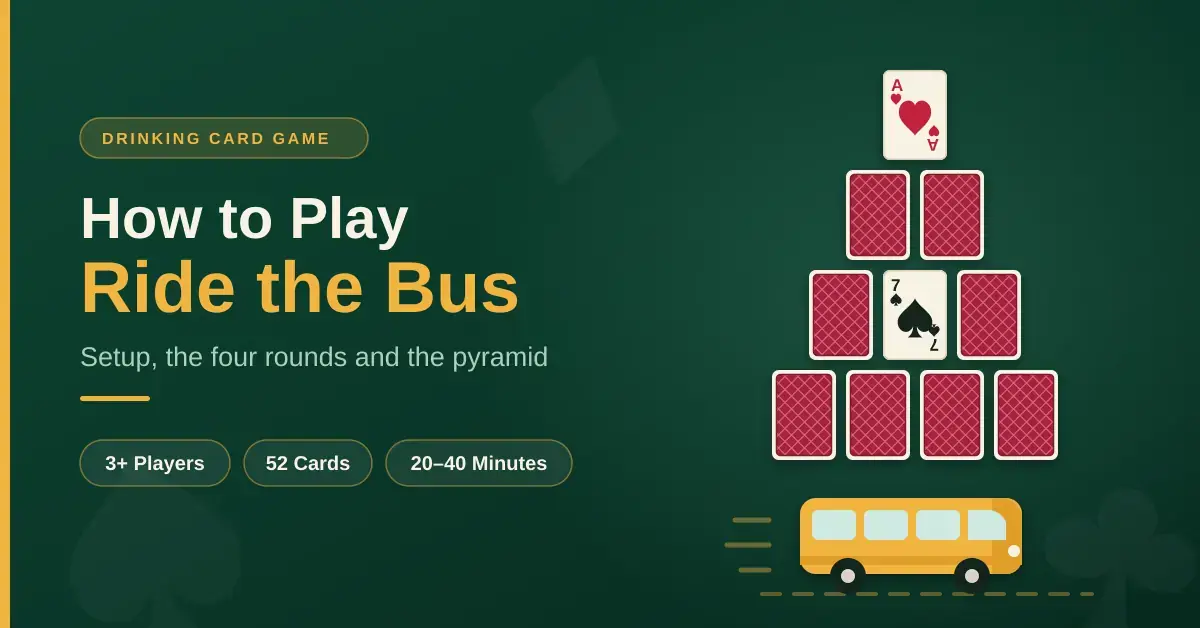
Ride the Bus is one of the most popular drinking card games at house parties, pre-games and cottage weekends across Canada. It needs nothing more than a standard deck of playing cards, a group of friends and a few drinks, yet it packs guessing, memory, a bit of strategy and plenty of laughs into a single session. The game is built around four quick guessing rounds, a card pyramid and one unlucky player who has to “ride the bus” at the end. This guide explains every phase in plain language, covers the most common house rules, and shows beginners exactly how to set up and play.
Key Takeaways
Ride the Bus at a glance
- Players: 3+ (best with 4-8)
- Equipment: One standard 52-card deck (no jokers) and drinks
- Type: Luck-based social drinking game
- Three stages: Four guessing rounds → the pyramid → riding the bus
- Goal: Avoid collecting cards, so you are not the one stuck riding the bus
- Time: Around 20-40 minutes per game
What Is Ride the Bus?
Ride the Bus (sometimes written “Ride the Buzz”) is a social drinking game for a standard 52-card deck. It is a game of luck first and light strategy second: players make simple predictions about cards they are about to be dealt, and wrong guesses lead to sips while correct guesses let you hand out drinks to others. There is no official rulebook and no single governing body, so the exact drink amounts and small details vary from group to group. What stays consistent everywhere is the structure: four guessing rounds, a pyramid, and a final solo challenge for the biggest loser of the pyramid phase.
Because it is quick to learn and scales well to a group, it sits comfortably alongside other social favourites you will find in our roundup of top party card games for adults in Canada, and it is a staple of the wider world of party and drinking card games.
What You Need to Play
- Players: 3 or more; 4 to 8 works best.
- Deck: One standard 52-card deck with the jokers removed.
- Drinks: A beverage for each player (alcoholic or non-alcoholic — the game works either way).
- A dealer: One person to run the rounds and build the pyramid. Many groups pick the dealer at random or with a quick draw of the high card.
- A flat surface: A table or floor with room to lay out cards face up and build the pyramid.
Card values run from 2 (low) up to Ace (high) for the guessing rounds, which matters when you predict higher, lower, inside or outside.
How to Play Ride the Bus: The Three Stages
A full game moves through three stages in order. First, every player goes through the four guessing rounds and collects cards for wrong answers. Second, the dealer builds a pyramid that lets players fight back by matching cards and dishing out drinks. Third, whoever ends the pyramid with the most cards has to ride the bus — a solo gauntlet of guesses that can go on for a while. Below, each stage is broken down step by step.
Stage 1: The Four Guessing Rounds
Going around the table one player at a time, the dealer asks each player a question, then deals them a card face up to reveal the answer. Every player answers all four questions before play moves on, building a small face-up row of up to four cards in front of them. A wrong guess means you drink (a common amount is one sip per wrong answer); many groups also let a correct guess pass with no penalty, while house variants let correct guessers assign drinks to someone else.
Round 1 – Red or Black
Guess the colour of your first card: red (hearts or diamonds) or black (spades or clubs). It is a straight 50/50. Guess wrong and you drink; guess right and you are safe.
Round 2 – Higher or Lower
Looking at your first card, predict whether your second card will be higher or lower in value. Aces are high and 2s are low. If the second card ties your first card exactly, that usually counts as a wrong guess and you drink. Simple card sense helps here — if your first card is a 3, “higher” is the smart call.
Round 3 – Inside or Outside
Now you have two cards showing. Predict whether your third card’s value will fall inside (between) those two cards or outside them. For example, with a 5 and a 10 already down, “inside” wins on any 6 through 9. A card matching either of your two values is normally treated as a loss. The wider the gap between your first two cards, the safer “inside” becomes.
Round 4 – Guess the Suit
Name the exact suit of your fourth card: hearts, diamonds, spades or clubs. This is a 1-in-4 long shot, so it is the hardest round to win — and many groups reward a correct suit call with a big payout, letting you hand out several drinks. Guess wrong and you take a drink yourself.
Round Cheat Sheet
| Round | The question | Your odds | Wrong guess |
|---|---|---|---|
| 1. Red or Black | Colour of your 1st card | 1 in 2 | Drink |
| 2. Higher or Lower | Is card 2 higher or lower than card 1? | Roughly 1 in 2 | Drink |
| 3. Inside or Outside | Is card 3 between cards 1 and 2, or outside them? | Depends on the gap | Drink |
| 4. Guess the Suit | Exact suit of your 4th card | 1 in 4 | Drink (correct often pays out big) |
Stage 2: The Pyramid
Once everyone has been through the four rounds, players keep their four cards in hand. The dealer then builds a pyramid from the remaining deck, laid out face down in five rows: five cards on the bottom row, then four, then three, then two, then one card at the top. A common build uses 15 cards (5-4-3-2-1).
The dealer flips the pyramid cards one row at a time, usually starting from the bottom row and working up. When a card is flipped, any player holding a card of the same rank (for example, any 7 when a 7 is flipped) may play it from their hand and assign drinks to another player. The row determines how many drinks are on the line. A widely used scale gives more drinks to the higher, scarcer rows:
- Bottom row (5 cards): 1 drink each
- Second row (4 cards): 2 drinks each
- Third row (3 cards): 3 drinks each
- Fourth row (2 cards): 4 drinks each
- Top card (1 card): 5 drinks or a shot
Some groups reverse this and make the bottom row worth the most; either way, agree on the scale before you start. Matching a card lets you discard it from your hand, which is the whole point: the fewer cards you are holding when the pyramid ends, the safer you are. A popular “bluffing” variant lets you claim a match you do not actually hold; if another player calls your bluff and you cannot show the card, you drink double, but if they are wrong, they drink double.
Stage 3: Riding the Bus
When the pyramid is finished, the player left holding the most cards is the loser and must ride the bus. If there is a tie, those players can play a quick tiebreaker (such as a single high-card draw) to decide who rides.
The dealer reshuffles and lays out a line of cards face down in front of the rider — commonly four cards, though some groups use a longer row. The rider then works along the line, making the same style of guesses as the opening rounds (colour, higher or lower, inside or outside, and suit), one card at a time. Every correct guess advances them along the bus. The catch: a single wrong guess sends them back to the start, they take a drink, the row is reshuffled, and they begin again. The rider keeps going until they clear the whole line without a mistake. Because it is pure luck, the bus can be a quick trip or a long, unlucky ride — which is exactly where the game gets its name.
Popular Variations and House Rules
Ride the Bus is endlessly customizable, and half the fun is agreeing on your table’s rules up front. Common variations include:
- Give-and-take rounds: A correct guess lets you give drinks, while a wrong guess makes you take them, instead of “correct = safe.”
- Doubling stakes: Drinks stack across the four rounds, so a wrong guess in Round 4 is worth far more than one in Round 1.
- Bigger bus: Use a longer face-down row (up to 10 cards) to make riding the bus a real endurance test.
- Pyramid bluffing: Allow calling matches you do not hold, with a call-out penalty of double drinks either way.
- Dry play: Swap alcohol for water, soda or a points system so everyone can join, including designated drivers.
If you enjoy putting a party spin on classic decks, you will find more in the same spirit in our guide to Drunk Uno and other hilarious card game variations.
Tips, Strategy and Etiquette
Ride the Bus is mostly luck, but a few habits keep it fun and fair:
- Play the odds: In Higher or Lower, call “higher” on low cards and “lower” on high cards. In Inside or Outside, judge the gap between your two cards before deciding.
- Hold your matches: Track which ranks you hold so you can dump cards fast during the pyramid and avoid riding the bus.
- Agree on amounts first: Settle the drink scale, the bus length and whether bluffing is allowed before dealing the first card.
- Pace the group: A “sip” should be small. Long buses can add up quickly, so keep water on the table and let anyone tap out.
- Keep it friendly: Spread assigned drinks around rather than targeting one person all night.
How Ride the Bus Compares to Other Party Card Games
Ride the Bus is a luck-driven guessing game, which sets it apart from prompt-and-answer party games. If your group prefers reading cards and reacting to funny prompts, a game like Cards Against Humanity leans on humour and creativity instead of chance. And if you want a lighter, all-ages evening with the same familiar deck, a classic round of how to play Uno keeps everyone involved without any drinking at all. Ride the Bus sits in between: fast, social and deck-only, but built specifically around drinks and dares.
Responsible Play Disclaimer
Play responsibly. Ride the Bus is intended for adults of legal drinking age (18 or 19+ depending on your province or territory) and for entertainment only. Drinking games can encourage rapid or excessive alcohol consumption, so pace yourselves, keep water on hand, never drink and drive, and stop any time. The game is just as fun with non-alcoholic drinks.
If you or someone you know needs support with alcohol use in Canada, help is available and confidential:
- ConnexOntario — free, 24/7 addiction and mental-health support in Ontario, 1-866-531-2600
- Government of Canada — Get help with substance use (national and provincial resources)
- Canada’s Guidance on Alcohol and Health (Canadian Centre on Substance Use and Addiction)
Reference Sources
- GameRules.com — Ride the Bus Drinking Game Rules
- Dronk — Ride the Bus: The Complete Drinking Game Rules
- Boom It Party — How to Play Ride the Bus: Rules and Tips
- CollegeWares — Ride the Bus Drinking Game
- The Game Farm — Ride the Bus: Rules, Examples and Tips
- CCSA — Canada’s Guidance on Alcohol and Health
Frequently Asked Questions
How many players do you need for Ride the Bus?
You can play with as few as three people, but the game is at its best with four to eight players. A mid-sized group keeps the guessing rounds moving quickly and gives the pyramid phase enough hands on the table for lots of matches and drink-passing. Very large groups can still play, but rounds take longer and you may want to use a second deck.
What cards are high and low in Ride the Bus?
For the guessing rounds, cards rank from 2 as the lowest up to Ace as the highest, with the number cards and face cards in their usual order in between (Jack, Queen, King, then Ace). This ranking matters most in the Higher or Lower and Inside or Outside rounds. Suit colour only matters in the Red or Black round, where hearts and diamonds are red and spades and clubs are black.
Why is it called “riding the bus”?
The name comes from the final phase, where the losing player must guess their way along a row of face-down cards and start over from the beginning on every wrong guess. Because a run of bad luck can send them back again and again, they can feel stuck “riding the bus” for a long time before they finally get off. It is the game’s signature moment and the reason it is so memorable at parties.
Can you play Ride the Bus without alcohol?
Yes. The rules work exactly the same whether players drink water, soda, juice or nothing at all. Many groups run a “dry” version using a points or forfeit system so everyone can join, including designated drivers and anyone who prefers not to drink. Keeping a non-alcoholic option on the table is also a simple way to help everyone pace themselves.
Is Ride the Bus a game of skill or luck?
It is mostly luck. Every guess — colour, higher or lower, inside or outside, and suit — depends on cards you cannot see, so no amount of skill guarantees a safe round. There is a small element of strategy: playing the odds on higher/lower and inside/outside guesses, and tracking which ranks you hold so you can shed cards during the pyramid and avoid riding the bus. Beyond that, the deck decides the winner.