

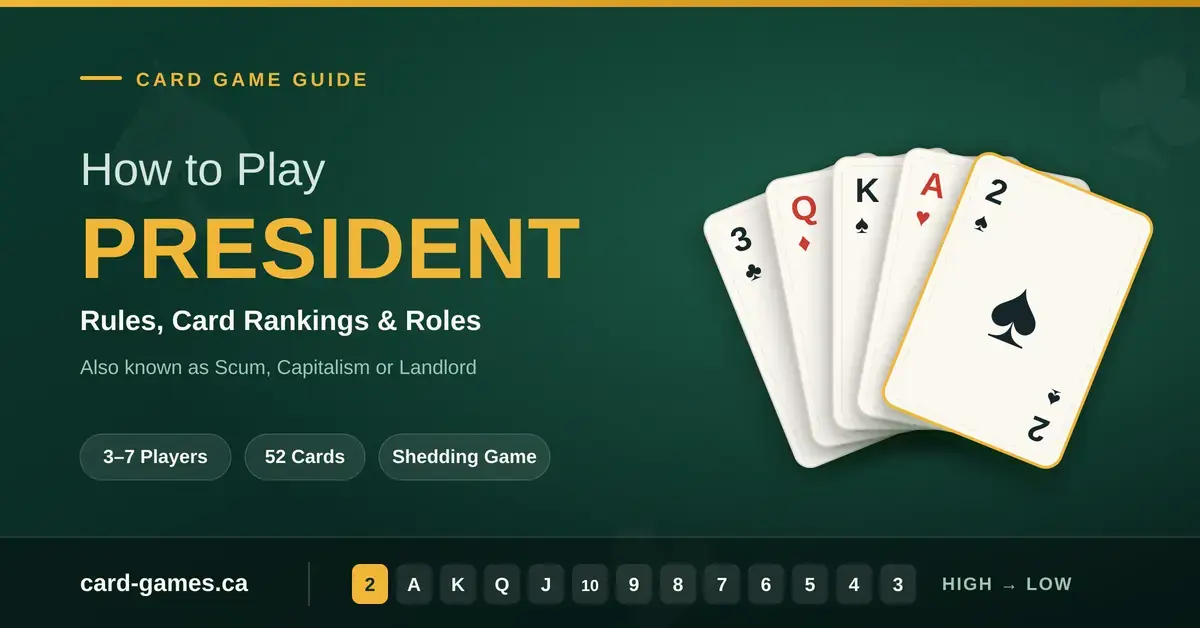
President is one of the world’s most popular social card games — a fast, noisy “shedding” game where the goal is refreshingly simple: be the first to get rid of every card in your hand. Depending on where and with whom you play, you might know it as Asshole, Scum, Capitalism, Landlord, or President and Vice-President, but the core is always the same: players finish in order, and where you finish decides your rank — and your privileges — in the next round. This guide covers the standard rules, the all-important card rankings, the roles from President down to Scum, the between-round card exchange, and the most common house-rule variations, including the party-drinking version.
Quick Facts
| Detail | President (Asshole) |
|---|---|
| Players | 3–7 (best with 4–7; use 2 decks for 8+) |
| Deck | Standard 52 cards, suits irrelevant (optional jokers) |
| Card rank (high → low) | 2, A, K, Q, J, 10, 9, 8, 7, 6, 5, 4, 3 |
| Game type | Shedding / climbing card game |
| Objective | Be the first to get rid of all your cards |
| Also known as | Scum, Capitalism, Landlord, President and Vice-President |
| Difficulty | Easy to learn, quick to play |
What Is President (Asshole)?
President belongs to a family of games known as climbing or shedding games, in which each play must be higher than the last until nobody can (or wants to) beat it. The table is then cleared and a new sub-round begins. Because suits do not matter and there is no complicated scoring, President is easy to learn in a single deal, yet it rewards timing, memory and a little social cunning — which is why it has spread across dorm rooms, pubs and family tables worldwide under dozens of names.
The name changes with the crowd. In polite company it is “President” or “Scum”; at student parties it is more often “Asshole.” The mechanics are identical — only the tone and the optional drinking rules differ. If you enjoy other lay-and-beat games such as Crazy Eights or how to play UNO, President will feel instantly familiar, just with a competitive social twist.
What You Need to Play
Players and Equipment
President works best with four to seven players using a single standard 52-card pack, though it can be played with as few as three. Suits are ignored entirely, so no suit ranks above another. For larger groups of eight or more, simply shuffle two decks together; some groups also add one or two jokers as the highest cards (an optional rule covered below). All you truly need is a full deck, a flat surface and a way to keep track of who finished where.
Card Rankings in President
Getting the rankings right is the single most important thing for new players. In the standard game the cards rank, from high to low:
2 (highest) – A – K – Q – J – 10 – 9 – 8 – 7 – 6 – 5 – 4 – 3 (lowest)
The 2 is the top card and is normally almost unbeatable, while the humble 3 is the weakest. This inverted feel — where the lowest pip cards are the worst and the 2 is king — catches many beginners out. Aces sit just below the 2, and the picture cards fall in the usual order beneath them.
How to Deal and Start
Choose a dealer for the very first hand — any fair method works. Starting with the player to the dealer’s left and going clockwise, deal the entire deck out one card at a time until all cards are distributed. With most player counts the hands will be uneven; that is perfectly normal and does not affect play. Players pick up their cards and sort them mentally from high to low.
In the opening round nobody has a rank yet, so the player to the dealer’s left simply leads first. In every round after that, the seating and the starting player are shaped by the ranks earned in the previous round, and the card exchange happens before play begins (both explained below).
How a Round Is Played
Leading a Hand
The player who leads may play a single card or a set of equal-ranked cards — for example one 7, a pair of 7s, or three 7s. Whatever they lead sets the size of the set for that hand: if the lead is a pair, everyone must respond with pairs; if it is three of a kind, everyone must respond with triples of a higher rank.
Following and Beating the Play
Going clockwise, each player must either beat the previous play or pass. To beat it, you must match the number of cards and play a higher rank. A single King beats a single 10; a pair of Queens beats a pair of 9s; but a pair can never be beaten by a single card, and three 7s cannot be beaten by a pair of Kings — the count has to match. Because suits are irrelevant, ties are impossible; every legal play is strictly higher than the one before it.
Passing and Clearing the Table
If you cannot or do not wish to beat the current play, you pass. Passing is always allowed and — in the standard rules — it does not lock you out; you may re-enter on a later hand within the same round if the play comes back around. The current hand continues until a play is made that everyone else passes on. Those cards are then swept aside into a discard pile, and the player who made that unbeatable play leads the next hand with anything they like. This lead-beat-pass-clear cycle repeats until players run out of cards.
Player Ranks and Card Exchange
| Rank | Finishing position | Card exchange before next round |
|---|---|---|
| President | 1st to empty hand | Receives Scum’s 2 best cards; gives back any 2 cards |
| Vice-President | 2nd out | Receives 1 best card from 2nd-last; gives back 1 card |
| Citizen(s) | Middle finishers | No exchange |
| 2nd-to-last | Second-last with cards | Gives 1 best card to Vice-President |
| Scum / Asshole | Last with cards | Gives 2 best cards to President; shuffles and deals next round |
Player Ranks: President to Scum
The order in which players empty their hands sets their social rank for the next round. The first player to shed every card wins and becomes the President. The second player out is the Vice-President. The middle finishers are neutral Citizens. The very last player still holding cards is the Scum (or, in the party version, the Asshole).
These ranks are not just for bragging rights — they carry real in-game advantages. Many groups also rearrange seating so the President takes the best seat and the Scum sits to the President’s right, ready to deal. Crucially, the Scum takes over the dealing and shuffling duties for the next round, a small penalty that keeps the game running smoothly.
The Card Exchange Between Rounds
Before each new round begins, the top and bottom players swap cards — the mechanic that gives President its addictive, ladder-climbing feel. In the most common version:
- The Scum gives their two highest cards to the President, and the President returns any two cards they do not want.
- The Vice-President and the second-to-last player exchange one card the same way — the lower-ranked player gives their best card, and the Vice-President hands back one unwanted card.
Some groups play a lighter one-card exchange between only the President and Scum, while stricter tables use a two-and-three exchange. Whatever you choose, agree on it before dealing. The effect is the same: the President starts each round with a stronger hand, and the Scum is dragged further down — unless clever play flips the table.
Winning the Game
President is usually played over an agreed number of rounds or for a set time rather than to a fixed score, because the fun lies in the shifting hierarchy. A common way to “win” is to be President for a set number of consecutive rounds, or simply to hold the President seat when the session ends. Some groups keep a running tally, awarding points for finishing as President or Vice-President. Because the card exchange constantly rewards the leaders and punishes the losers, staying on top is a genuine challenge — which is exactly the point.
Popular Variations and House Rules
Few games have as many regional house rules as President. Always confirm which ones are in play before you deal. Here are the most widespread.
The Two Clears the Table
In many groups a single 2 — the highest card — can be played on almost anything to instantly clear the table, letting the player who dropped it lead again. This turns 2s into powerful “reset” cards you save for the right moment.
Revolution
If four cards of the same rank are played (either all at once or completing a set of four in succession), a “Revolution” occurs: the card rankings temporarily flip so that low cards become high. It is a dramatic swing that can rescue a losing hand, and some groups also reverse the direction of play.
Jokers and Bombs
Adding one or two jokers gives you cards that outrank even the 2 — the ultimate table-clearers. Related “bomb” rules let a set of four of a kind beat any play regardless of size, adding another layer of strategy for experienced groups.
Transparent Threes
Under this rule a 3 — normally the weakest card — can be played on any single card and takes on the rank of the card it beat for the rest of that hand. It is a creative way to make the lowest card useful and is popular in more advanced circles.
The “Asshole” Drinking Game Variant
The party version keeps every rule above and layers social drinking penalties on top of the social hierarchy — which is where the blunt “Asshole” name comes from. Groups agree on their own penalties, but common ones include: the President can order any player to drink at any time; the Vice-President can order anyone except the President; Citizens can order each other; and the Asshole cannot order anyone and often drinks whenever told to. Some tables add a sip for every pass. It is essentially President with the loser doing the dealing and the drinking.
If drinking games are your scene, you’ll find plenty more in our roundup of the best party card games for adults in Canada, in the broader party and drinking card games section, and in our guide to Drunk UNO and other hilarious variations. As always, the alcohol is optional — President is just as entertaining played dry.
Tips and Strategy for Beginners
President rewards patience as much as good cards. A few principles will quickly lift your finishes:
- Hold your 2s and high cards for the right moment — they are best used to clear the table so you can lead into your weaker cards.
- Shed your low cards early, especially 3s, 4s and 5s, ideally as pairs or triples while others still have cards to force out.
- Watch what has been played. Knowing that both other 2s are gone means your Ace is suddenly the strongest card at the table.
- Lead sets you can support. Leading a pair when you hold a matching third card lets you regain the lead when it comes back around.
- As President, spend the exchange wisely — the cards you pass down should be genuinely useless, not just middling.
If you enjoy games that blend luck with reading the table, you may also like the trick-taking classic how to play Kaiser, a prairie Canadian favourite with a very different rhythm.
Responsible play notice: The “Asshole” version of this game involves alcohol and is intended only for adults of legal drinking age in their province or territory. Please play responsibly, never pressure anyone to drink, and always arrange a safe way home. For evidence-based information on alcohol and health in Canada, see Canada’s Guidance on Alcohol and Health from the Canadian Centre on Substance Use and Addiction. This article is for general informational and entertainment purposes only.
Reference Sources
Frequently Asked Questions
What is the highest card in President?
In the standard game the 2 is the highest-ranking card and is normally almost unbeatable, followed by the Ace and then the King down to the 3, which is the lowest. Some groups add jokers that rank even higher than the 2, and a single 2 is often used to instantly clear the table.
How many players do you need to play President?
President works best with four to seven players using one standard 52-card deck, but it can be played with as few as three. For eight or more players, shuffle two decks together so everyone still receives a reasonable hand.
What is the difference between President and Asshole?
They are the same card game. “President” (also called Scum or Capitalism) is the neutral name, while “Asshole” usually refers to the party version that adds drinking penalties for the lower-ranked players. The card rules are identical; only the optional social rules and the tone differ.
How do the card exchanges between rounds work?
After each round, the last-place Scum gives their two highest cards to the President, who returns any two unwanted cards. The Vice-President and the second-to-last player usually swap one card the same way. This helps the winners and hinders the losers, so climbing back up the ranks takes real skill.
Can you pass even if you are able to play in President?
Yes. In the standard rules passing is always allowed, whether or not you can beat the current play, and it does not lock you out of the round. Skilled players often pass strategically to save high cards for a moment when they can clear the table and take the lead.