

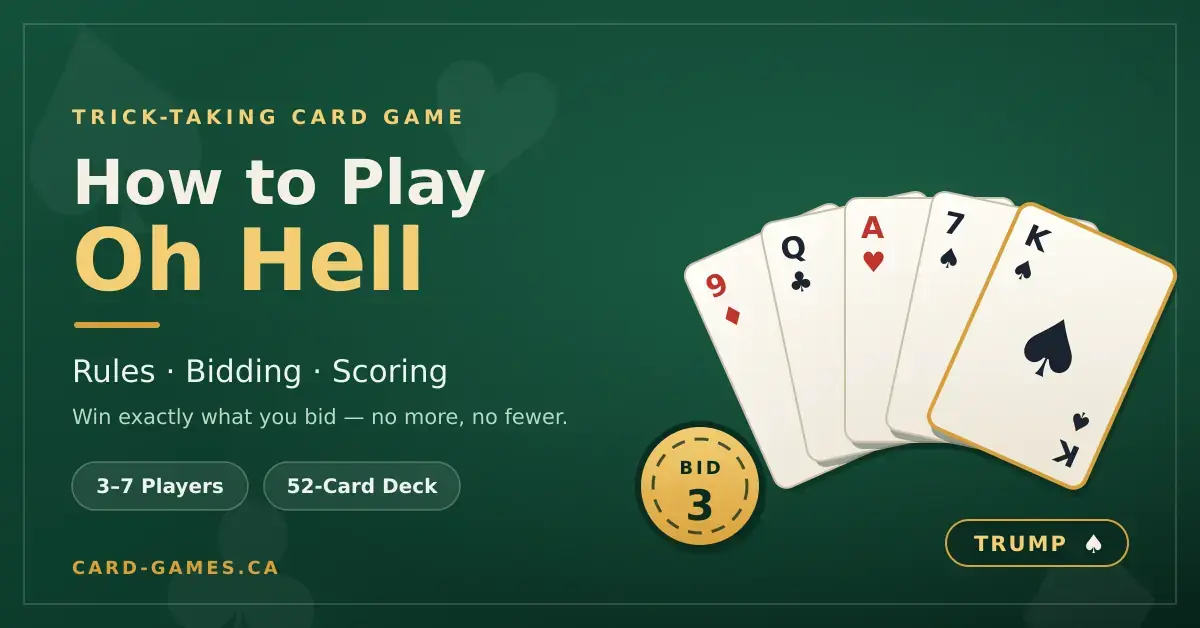
Oh Hell is a fast, tense trick-taking card game built around one deceptively simple idea: you must win exactly the number of tricks you predict — no more, no fewer. Take one too many and you score nothing. That single twist turns an ordinary deck of cards into a game of nerve, arithmetic and bluff that plays well with families, friends and serious card players alike. This guide explains everything you need to know about how to play Oh Hell, from dealing and choosing trump to bidding, the famous dealer “hook” rule, scoring and strategy.
What Is Oh Hell?
Oh Hell is an individual (non-partnership) trick-taking game for three to seven players, played with a standard 52-card deck. Unlike many classics where the aim is to win as many tricks as possible, in Oh Hell the goal is precision: before each hand every player bids how many tricks they think they will win, and points are awarded chiefly for hitting that number on the nose.
Because the number of cards dealt changes from hand to hand — shrinking down to a single card and then growing again — the game constantly rebalances between skill and chance. A one-card hand is almost pure luck; a ten-card hand rewards careful counting and planning. That mix is why the game appeals to beginners and experts at the same table, and it sits comfortably alongside other strategy and skill-based card games that reward reading the table.
A Brief History of Oh Hell
Oh Hell is of British origin. It was first described by B. C. Westall around 1930 under the gentler name “Oh! Well”, and it was reportedly introduced to America through the New York clubs in 1931. Early writers praised it as one of the best “round games” precisely because its rules are simple enough for a novice yet deep enough to keep experts honest.
Over the decades the game spread widely and picked up a long list of aliases, including Oh Pshaw, Blackout, Blob, Bust, Elevator, Up and Down the River, Contract Whist, Nomination Whist and German Bridge. The rules vary slightly from region to region, but the exact-bid heart of the game stays the same. If you enjoy the wider story of how these games reached this country, our overview of the history of playing cards in Canada puts trick-taking traditions in context.
Quick Facts
| Detail | Oh Hell |
|---|---|
| Type | Trick-taking, exact-bid |
| Players | 3–7 (best 4–6) |
| Deck | Standard 52 cards, aces high |
| Origin | Britain; first described by B. C. Westall c. 1930 |
| Also known as | Oh Pshaw, Blackout, Blob, Up and Down the River, Nomination Whist |
| Trump | Suit of the turned-up card (or a fixed rotation) |
| Aim | Win exactly the tricks you bid each hand |
What You Need to Play
Getting started is easy. You need only the following:
- Players: 3 to 7. The game is generally considered best with 4 to 6.
- Cards: One standard 52-card deck. No jokers in the basic game.
- Ranking: Cards rank in the usual order, with the ace high: A, K, Q, J, 10, 9, 8, 7, 6, 5, 4, 3, 2.
- Scorepad: Paper and a pen, since scores are tallied hand by hand.
A “trick” is one round of play in which each player contributes a single card; the winning card takes the trick. If that idea is new to you, it works the same way here as it does in Hearts and other trick-based games.
The Deal: A Shrinking and Growing Hand
The signature feature of Oh Hell is that the number of cards dealt changes every hand. One player is chosen as the first dealer; the deal then rotates clockwise after each hand. Cards are dealt one at a time, face down, until each player has the correct number for that hand.
The most common patterns count down to a single card and then climb back up. Two popular sequences are:
- 10–1–10: Start with 10 cards each, drop by one card per hand to a single card, then build back up to 10. This is typical for three to five players.
- 7–1–7: A shorter game often used with more players, where seven players start with seven cards each.
The starting size is limited by how many cards the deck can supply. With six players many groups begin at eight cards each, and with seven players at seven cards each, so that a full round can always be dealt. Some groups play only the descending half, or only the ascending half, to shorten or lengthen the session. The maximum number of tricks in any hand always equals the number of cards each player holds.
Choosing the Trump Suit
Trumps are cards of a nominated suit that beat any card of another suit. In most versions of Oh Hell, after the hands are dealt the next card from the deck is turned face up, and its suit becomes trump for that hand. In the final hand of a 10–1–10 game, where all the cards may be dealt out, that hand is often played with no trump at all.
A common variation dispenses with turning a card and instead rotates the trump suit in a fixed order — for example hearts, then clubs, then diamonds, then spades — so players know the trump in advance. Fixed-suit trump is the same principle used in Spades, where spades are always trump.
Bidding: Predicting Your Tricks
Once trump is set, bidding begins with the player to the dealer’s left and proceeds clockwise, with the dealer bidding last. Each player states the exact number of tricks they expect to win that hand, from zero up to the number of cards in their hand. Passing is not allowed — a bid of zero is a legitimate and often valuable call, since making zero earns the same bonus as any other correct bid.
Bidding zero (sometimes called going “nil”) is especially tempting in small hands, but it is a gamble: if you are forced to win even one trick, your bid fails. The running total of all bids is usually announced so everyone can see whether the hand is collectively over-bid or under-bid.
The “Hook” Rule (Screw the Dealer)
Oh Hell has one famous restriction, known as the hook or “screw the dealer” rule. The dealer, bidding last, may not name a number that would make the total of all bids exactly equal the number of tricks available. In other words, the hand can never be perfectly balanced — it is always over-bid or under-bid, which guarantees that at least one player will miss their target. This keeps the game competitive and is the reason accurate bidding matters so much.
Key Takeaways
- Goal: win the exact number of tricks you bid — not more, not fewer.
- Players: 3–7 (best with 4–6), using one standard 52-card deck, aces high.
- The deal changes every hand, counting down to one card and back up (e.g. 10–1–10 or 7–1–7).
- Trump is usually the suit of the next card turned up after the deal.
- The hook rule stops the dealer from balancing the bids, so someone always misses.
- Scoring pays a 10-point bonus for an exact bid; miss and you lose the bonus (or score zero in Blackout).
Playing the Tricks
The player to the dealer’s left leads the first trick and may play any card. Play then continues clockwise, and the basic trick rules are the same ones used across most trick-taking games:
- Follow suit if you can. You must play a card of the same suit as the card that was led.
- If you cannot follow suit, you may play any card, including a trump.
- Winning the trick: the highest trump played wins; if no trump is played, the highest card of the suit that was led wins.
- The winner of each trick leads the next one, and play continues until all cards are exhausted.
Every trick you win is counted against the number you bid. The tension builds as the hand goes on: sometimes you are desperately trying to win one more trick, and sometimes you are just as desperately trying to avoid winning, because an extra trick can wreck a perfect bid.
Scoring Oh Hell
Scoring rewards accuracy above greed. Several systems are in use, but they all pay a bonus for hitting your bid exactly.
The Standard Scoring System
The most widely used method works like this:
- If you take exactly the number of tricks you bid, you score 10 points plus 1 point for each trick you won. So a correct bid of 3 scores 13, and a correct bid of 0 scores 10.
- If you miss your bid — too many or too few — you score nothing that hand in the strict “Blackout” version, or in a gentler version you still score 1 point per trick taken but lose the 10-point bonus.
Popular Scoring Variations
Different groups use different formulas, so agree on the system before you deal. Here are the most common alternatives:
| Scoring system | If you make your bid | If you miss your bid |
|---|---|---|
| Standard (most common) | 10 + 1 per trick won | 1 per trick won (no bonus) |
| Strict Blackout | 10 + tricks bid | 0 points |
| Squared bonus | 10 + (tricks bid squared) | Subtract the square of the difference |
| Per-trick penalty | 10 per trick bid and won | Lose 10 per trick over or under |
Winning the Game
Oh Hell is played over a fixed number of hands — the full up-and-down sequence you agreed on at the start. Once the final hand is scored, the player with the highest cumulative total wins. Because the last hands of a 10–1–10 game are the largest and can swing the most points, the outcome often stays in doubt until the very end.
Oh Hell vs. Other Trick-Taking Games
If you already know a trick-taking game, Oh Hell will feel familiar — but its exact-bid goal sets it apart. This table shows how it compares with popular relatives covered elsewhere on the site.
| Game | Players | Bidding | Trump | Objective |
|---|---|---|---|---|
| Oh Hell | 3–7 | Bid exact tricks each hand | Turned card (varies) | Win exactly your bid |
| Spades | 4 (partners) | Bid total tricks per team | Spades always trump | Meet your team’s bid |
| Hearts | 3–6 | No bidding | No trump | Avoid penalty cards |
| Euchre | 4 (partners) | Choose/accept trump | Nominated suit | Win the most tricks |
| Bridge | 4 (partners) | Full auction for a contract | Suit or no-trump | Fulfil the contract |
If the partnership and auction elements appeal to you, the natural next step up in complexity is Bridge, while Euchre offers a quicker, trump-driven partnership game.
Strategy Tips for Better Bidding
Oh Hell is won at the moment you bid, so disciplined estimation matters more than flashy card play. Keep these principles in mind:
- Count your winners. Aces and high trumps are near-certain tricks; low off-suit cards rarely win. Bid what your hand can realistically deliver.
- Read the table. If the players before you have bid high, the remaining tricks are scarce, so trim your own bid — and raise it if others are bidding low.
- Respect the hook. As dealer, you cannot balance the hand, so plan a bid that you can protect even when someone is guaranteed to miss.
- Learn to lose on purpose. Once you have your tricks, deliberately dumping high cards or ducking a trick is often the smartest play to avoid overshooting.
- Track the trumps. Keep a running count of trumps and aces that have appeared; knowing what is left tells you whether your marginal card is a winner or a loser.
- Play it safe early. Missing a bid by a single trick usually scores zero, so a conservative, achievable bid beats an ambitious one.
Popular Variations and Other Names
Because Oh Hell has travelled so widely, you will meet many house rules and names. Some groups add one or two jokers as the highest trumps; others fix the trump rotation instead of turning a card, or play a “no trump” hand when the deck runs out. The game is known as Oh Pshaw, Blackout and Blob in some circles, as Up and Down the River or Bust in Australia and New Zealand, and as Contract Whist or Nomination Whist in Britain. Whatever the label, always confirm the deal pattern, the trump method and the scoring system before the first hand so everyone is playing the same game.
Reference sources
Frequently Asked Questions
How many players do you need for Oh Hell?
Oh Hell works with three to seven players and is generally considered best with four to six. The number of players determines how many cards can be dealt in the largest hand, since a single 52-card deck has to supply every player plus, in most versions, one card to turn up for trump.
Why can’t the total of all bids equal the number of tricks?
This is the “hook” or “screw the dealer” rule. The dealer bids last and is forbidden from choosing a number that would make the bids add up exactly to the tricks available. It guarantees the hand is always over-bid or under-bid, so at least one player is certain to miss their target — which keeps the game sharp and competitive.
Is bidding zero a good idea in Oh Hell?
Bidding zero can be very effective, because making it correctly earns the full bonus just like any other bid. It is safest when your hand is full of low cards and short on trumps. The risk is that if you are forced to win even one trick — for example when you must follow suit with your only high card — the bid fails and you score nothing.
What happens if I win more tricks than I bid?
Winning too many tricks counts as a missed bid, exactly like winning too few. In the strict Blackout scoring system you score zero for that hand; in the common alternative you keep 1 point per trick but lose the 10-point bonus. That is why experienced players will deliberately lose tricks once they have already reached their bid.
How long does a game of Oh Hell take?
A full game is a fixed number of hands set by the deal pattern. A 7–1–7 sequence runs about 13 hands and takes roughly 45 minutes, while a longer 10–1–10 game takes more time. You can shorten the game by playing only the descending or only the ascending half of the sequence.