

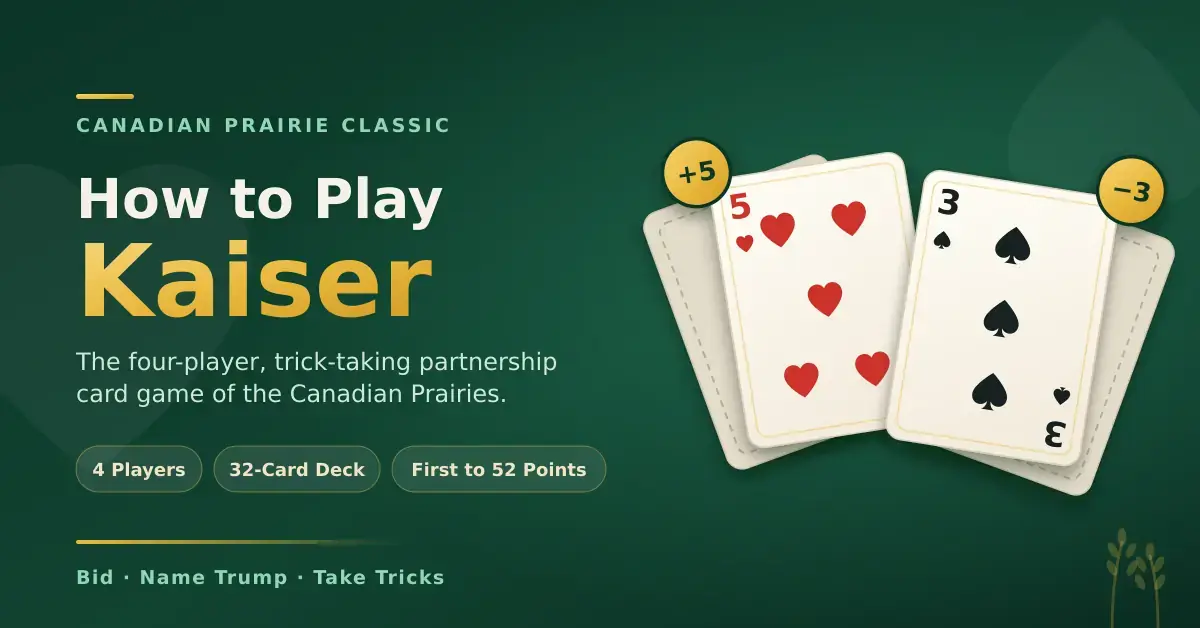
Few card games are as closely tied to one corner of Canada as Kaiser. Born on the kitchen tables and in the community halls of the Prairies, this four-player, trick-taking partnership game is a Saskatchewan institution that has been passed down through generations of families. If you have ever played Euchre or Bridge, Kaiser will feel familiar — you bid for the right to name trump, then work with your partner to win tricks — but its two special scoring cards, the 5 of hearts and the 3 of spades, give it a personality all its own.
This guide explains exactly how to play Kaiser from scratch: the deck, the deal, the bidding, the play of the cards, and how the scoring works its way to the winning total of 52 points. Whether you are learning for a family reunion on the Prairies or simply expanding your card-game repertoire, everything you need is below.
Kaiser at a Glance
| Feature | Details |
|---|---|
| Players | 4, in two partnerships (partners sit opposite) |
| Deck | 32 cards (standard) or 34 cards (Saskatchewan kitty version) |
| Cards dealt | 8 per player |
| Game type | Trick-taking, bidding, partnership |
| Special cards | 5 of hearts (+5 points), 3 of spades (−3 points) |
| Typical bids | 6 to 12 (minimum 7 with a kitty or in no-trump) |
| Goal | First partnership to reach 52 points |
| Region | Prairie provinces, especially Saskatchewan |
What Is Kaiser?
Kaiser is a point-trick game for four players divided into two partnerships, with partners sitting opposite each other at the table. Like many classic trick-taking games, each hand is a small contest in two stages: first an auction, in which players bid the number of points they believe their side can win, and then the play, in which cards are led and won trick by trick.
What sets Kaiser apart from most trick-takers is that not every trick is equal. Two individual cards carry a huge weight in the final score — the 5 of hearts is worth a bonus of five points to whoever wins it, and the 3 of spades costs its capturer three points. Suddenly a single trick can swing a whole hand, and much of the skill lies in hunting down the 5 while dodging the 3. For readers who enjoy that kind of tension, it is the same instinct that drives penalty-card play in Hearts.
The History and Canadian Roots of Kaiser
Kaiser’s precise origins are not well documented, but the game is firmly established in the Prairie provinces, and especially in Saskatchewan and its neighbouring regions. It is strongly associated with the province’s rural communities, including its Ukrainian and German-Canadian settler families, where it became a staple of long winter evenings, curling rinks, and Legion halls.
The name itself points to the game’s twentieth-century roots. “Kaiser” is the German word for emperor, and the highest possible bid — a bid of 12 in no-trump — came to be known as the “kaiser bid,” a name that eventually attached itself to the whole game. Today Kaiser remains something of a regional treasure: rarely seen outside the Prairies, but fiercely loved within them. It sits comfortably alongside the other traditional imports and inventions covered in our look at the history of playing cards in Canada.
What You Need to Play
Players and Partnerships
Kaiser is designed for exactly four players in two fixed partnerships. Partners sit across the table from one another so that play alternates between the two teams as it moves clockwise. As in Spades, all scoring is done by partnership rather than by individual, so communication through legal play — not table talk — is central to winning.
The Kaiser Deck
Kaiser uses a specially reduced deck, and there are two common versions. Getting the deck right is the single most important setup step, because the whole scoring system depends on the 5 of hearts and the 3 of spades being present.
In the standard 32-card version, each suit runs A-K-Q-J-10-9-8 down to a low card, ranking from the Ace high. Clubs and diamonds keep their 7s, but in hearts the 5 replaces the 7, and in spades the 3 replaces the 7. That gives 32 cards in total, and it guarantees that the two special cards are always in play.
In the popular 34-card Saskatchewan version, the pack is A-K-Q-J-10-9-8-7 in all four suits, plus the 5 of hearts and the 3 of spades added as extras. That makes 34 cards: 8 are dealt to each of the four players and the remaining two form a face-down “kitty” in the middle of the table. This kitty version is the one most Prairie players learn first, and it is the one used in organised events such as the Saskatchewan Senior Fitness 55+ Games.
Setting Up the Game: The Deal and the Kitty
Choose a first dealer at random; the deal then passes clockwise after every hand. The dealer shuffles and deals the cards clockwise, one at a time, until every player holds eight cards. In the 32-card game that uses the whole pack; in the 34-card game the last two cards are placed face down as the kitty.
Some groups allow a player to call a misdeal — a re-deal by the same dealer — if they are dealt a hopeless hand with no Aces, no picture cards, and neither the 5 of hearts nor the 3 of spades. If a card is accidentally exposed during the deal, the standard fix is simply to re-deal.
How the Bidding Works
Bidding Order and Minimum Bids
Once the cards are dealt, the auction begins with the player to the dealer’s left and proceeds clockwise. Each player gets one turn to either pass or make a bid higher than the current highest bid. A bid is a number from 6 to 12 that represents how many points your partnership promises to win in the play of that hand.
The minimum bid is usually 6. When bidding no-trump — and in the 34-card kitty version generally — the minimum is raised to 7, because the bidder gains an advantage from picking up the kitty. If the first three players all pass, the dealer is forced to bid at least the minimum rather than let the hand be thrown in. The dealer also has a small privilege: they may take the contract by matching (equalling) the previous high bid instead of having to outbid it.
No-Trump Bids and the Kaiser Bid
A player may bid in a suit (naming that suit as trump later) or in no-trump. A no-trump bid outranks an equal-numbered suit bid, so a bid of “7 no-trump” beats “7 hearts.” No-trump contracts are riskier because there is no trump suit to rescue you, so in most house rules a made or failed no-trump bid scores or loses double. The very top of the ladder — 12 in no-trump — is the celebrated “kaiser bid” that gives the game its name.
The highest bidder wins the auction and names the trump suit (or declares no-trump). In the 34-card version, the winning bidder then picks up the two kitty cards without showing them, and discards any two cards face down — with one crucial restriction: you may never discard the 5 of hearts or the 3 of spades. Those cards must stay in play.
Card Values and Scoring
How points are won and lost in each hand:
- Each trick won: +1 point
- Trick containing the 5 of hearts: +5 bonus points
- Trick containing the 3 of spades: −3 penalty points
- Bidding team makes its bid: scores the points it actually won
- Bidding team misses its bid: loses the full amount it bid
- No-trump contracts: commonly score or lose double
- Maximum for one hand: a net of about +10 points
Playing the Tricks
The player who won the bid leads the first card to the first trick. Play proceeds clockwise, and each player must follow the suit that was led if they can. If you cannot follow suit, you may play any card, including a trump.
A trick is won by the highest trump played; if no trump was played, it is won by the highest card of the suit that was led. The winner of each trick gathers the cards, sets them face down in front of their partnership, and leads to the next trick. Play continues until all eight tricks have been won. If the contract was no-trump, there is no trump suit at all, and every trick is simply won by the highest card of the led suit.
Because the 5 of hearts and 3 of spades live inside ordinary tricks, timing matters enormously. Leading a suit to flush out the 5 of hearts, or forcing an opponent to win the trick that holds the 3 of spades, is where Kaiser rewards teamwork and card-reading — the same trick-management instincts you build in how to play Euchre.
How Scoring Works in Kaiser
At the end of each hand, both partnerships count their points from the tricks they won. The scoring rules are refreshingly simple once you know the two special cards:
- Each trick a partnership wins is worth 1 point.
- The partnership that wins the trick containing the 5 of hearts adds 5 points.
- The partnership that wins the trick containing the 3 of spades subtracts 3 points.
Because there are eight tricks plus the plus-five and minus-three cards, the total points available in a single hand net out to a maximum of 10 for one side.
Making and Missing Your Bid
The two teams are scored differently. The bidding team must reach at least the number it bid. If it does, it scores exactly the points it actually won that hand. If it falls short — even by one — it does not just miss out; it loses the amount of its bid, which is subtracted from its running total. Overbidding is therefore genuinely dangerous. The non-bidding team simply scores whatever points it managed to win in the play, no promises required. Remember that no-trump contracts typically count double in both directions.
The Race to 52
Scores accumulate from hand to hand, and the first partnership to reach a cumulative total of 52 points or more wins the game. A widely used “end-game” rule adds tension near the finish: once a team reaches a high threshold (commonly 45), it can no longer score points simply for tricks won as the non-bidding side — it must win the auction and make its bid to advance. This stops a team from coasting to victory on the back of its opponents’ contracts and forces a decisive final bid.
Common Rule Variations
Like most folk card games, Kaiser is played slightly differently from town to town and family to family. Confirm the house rules before your first hand. The most common variations include:
| Variation | How it changes the game |
|---|---|
| Minimum bid | Some groups set the floor as low as 5 or as high as 8 rather than the usual 6 (7 with a kitty). |
| Kitty (widow) | The 34-card version deals a two-card kitty that the winning bidder takes and then discards down to eight, never discarding the 5 or 3. |
| Low No-Trump | An alternative no-trump contract in which card rank is reversed — the 7 becomes the highest card — except for the 5 and 3. |
| Card passing | Some circles let partners pass a card to add a layer of strategy before play. |
| Target score | Regional forms such as the Québec variant known as “Les Rois” change the winning total (for example, to 40). |
Kaiser vs. Other Trick-Taking Games
If you are choosing which partnership game to bring to the table, it helps to see where Kaiser sits among the classics. Each of the games below is a bidding, trick-taking game, but they differ in deck, players and what makes scoring interesting.
| Game | Players | Deck | Scoring twist |
|---|---|---|---|
| Kaiser | 4 (2 teams) | 32 or 34 cards | 5 of hearts (+5), 3 of spades (−3); first to 52 |
| Euchre | 4 (2 teams) | 24 cards | Bowers (Jacks) are the top trumps; first to 10 |
| Spades | 4 (2 teams) | 52 cards | Spades are always trump; bid your exact tricks |
| Bridge | 4 (2 teams) | 52 cards | Complex contract auction; tricks above six count |
| Hearts | 3–6 | 52 cards | Avoid penalty hearts and the Queen of spades |
Kaiser is often described as the Prairie cousin of Euchre, sharing its fast, four-player rhythm. Players who enjoy the deeper auction of Kaiser frequently graduate to the full contract auction of bridge, and you can explore the whole family of these games on our traditional card games hub.
Strategy Tips for Beginners
Kaiser rewards patience and partnership more than raw luck. A few principles will improve your game quickly:
- Count the special cards first. Before you bid, weigh your chances of capturing the 5 of hearts and avoiding the 3 of spades. Those eight points of swing matter more than any single trick.
- Bid your hand, not your hopes. Because a failed contract subtracts your entire bid, a conservative made bid usually beats an ambitious broken one.
- Read your partner’s leads. A high lead often signals strength; a low lead can be an invitation to take control. Legal signalling through card choice is the heart of good partnership play.
- Use trump to hunt the 5. If you are void in hearts, a well-timed trump can steal the trick that holds the 5 of hearts.
- Steer the 3 of spades onto the opponents. Forcing the other team to win the trick with the 3 of spades is one of the most satisfying plays in the game.
Reference Sources
Frequently Asked Questions
Is Kaiser only played in Saskatchewan?
Kaiser is most strongly associated with Saskatchewan and the surrounding Prairie provinces, where it has been a community favourite for generations. It is rarely seen elsewhere in Canada, but it is not exclusive to any one place, and anyone with the right reduced deck can learn and enjoy it.
What deck do I need to play Kaiser?
You need a reduced pack rather than a full 52-card deck. The standard version uses 32 cards, with the 5 of hearts and 3 of spades replacing the 7s in those two suits. The popular Saskatchewan version uses 34 cards: a full A-through-7 in each suit plus the 5 of hearts and 3 of spades, which allows for a two-card kitty.
Why are the 5 of hearts and 3 of spades so important?
These two cards carry the game’s biggest scoring swings. Winning the trick that contains the 5 of hearts adds five points to your side, while winning the trick with the 3 of spades subtracts three. Because they can decide a hand on their own, chasing the 5 and dumping the 3 is central to Kaiser strategy.
How many points do you need to win at Kaiser?
The first partnership to reach a cumulative total of 52 points wins the game. Many groups add a rule that once a team passes a high threshold (often 45), it can only advance by winning the auction and making its bid, which forces a decisive final hand.
Is Kaiser hard to learn for beginners?
Not at all. If you can follow suit and understand that the highest trump wins a trick, you already know most of Kaiser. The bidding and the two special cards add depth, but the basics can be picked up in a single evening — especially if you have played Euchre, Spades or Hearts before.