

Solitaire is the card game most people picture when they imagine playing cards alone at a kitchen table or on a phone screen. In Canada and the United States, the word “Solitaire” on its own almost always means one specific game: Klondike. In the United Kingdom the same family of single-player games is usually called “Patience,” and Klondike itself is sometimes labelled “American Patience.” This guide explains how to play Solitaire (Klondike) from scratch, using plain language and beginner-friendly steps so you can deal your first game with confidence.
Klondike became a household name largely because Microsoft bundled it as Microsoft Solitaire with Windows in the early 1990s, introducing the game to hundreds of millions of computer users. Today you can play it with a physical deck or in countless free apps, but the rules are exactly the same. Once you understand the four areas of the table and a handful of building rules, the whole game clicks into place.
What Is Klondike Solitaire?
Klondike Solitaire is a single-player card game played with one standard 52-card deck (no jokers). Your goal is to sort the entire deck into four ordered piles — one for each suit — running from Ace up to King. You do this by uncovering hidden cards and arranging them in descending, alternating-colour sequences until every card can be moved home.
The name’s exact origin is uncertain, though it is often linked to the 1890s Klondike Gold Rush in Canada’s Yukon. The earliest documented rules appear in the 1907 edition of Hoyle’s Games as “Seven-Card Klondike,” and the one-card-at-a-time draw that most beginners use today was recorded by 1913. If you enjoy tracing how these games reached North America, our overview of the history of playing cards in Canada adds useful background.
Key Facts
- Players: 1
- Deck: One standard 52-card deck, no jokers
- Also known as: Solitaire (Canada/US), Patience (UK), American Patience
- Goal: Build four foundation piles by suit, Ace to King
- Setup: 7 tableau columns (28 cards) + 24-card stock + 4 empty foundations
- Beginner mode: Draw 1 (flip one stock card at a time)
- Typical game length: 5–15 minutes
What You Need to Play
You need only one thing: a single, complete standard deck of 52 cards. Remove the jokers before you start. A flat surface with enough room for seven columns of cards is ideal, because Klondike spreads out as you play. If you are using an app, everything is laid out automatically and illegal moves are simply refused, which makes digital play a forgiving way to learn.
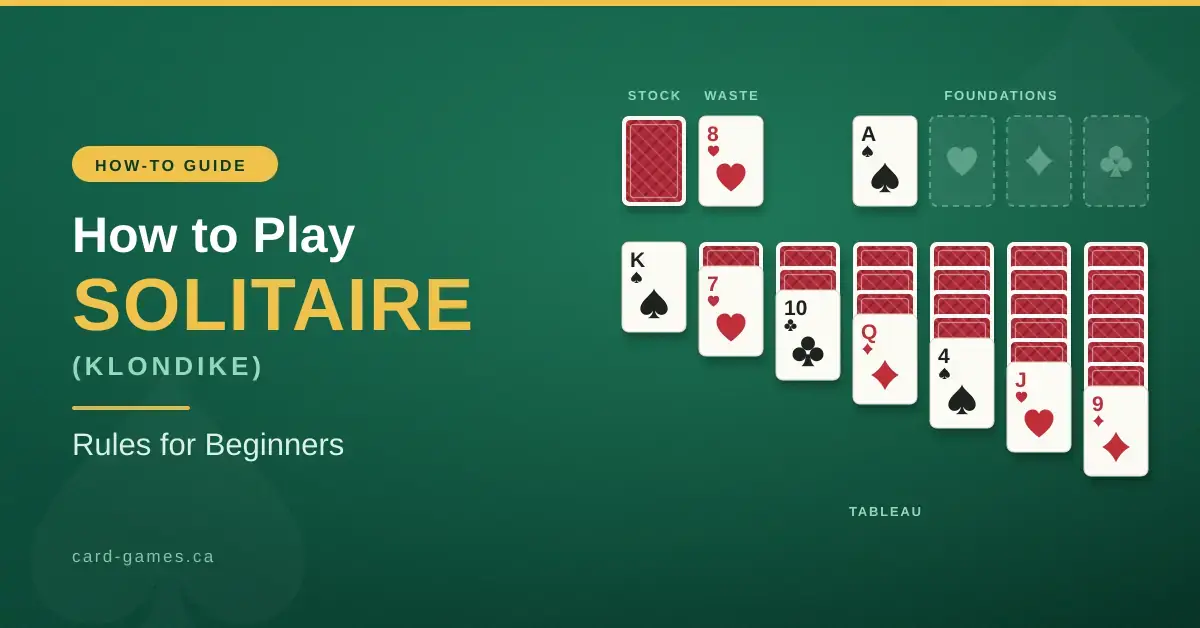
Before dealing, it helps to know the four zones you will be working with:
- Tableau — the seven main columns where most of the play happens.
- Stock — the face-down pile of leftover cards you draw from.
- Waste (or talon) — the face-up pile beside the stock holding cards you have drawn but not yet played.
- Foundations — the four target piles, one per suit, that you build from Ace to King to win.
How to Set Up Klondike Solitaire
Shuffle the deck thoroughly, then deal the tableau from left to right across seven columns. The first column gets 1 card, the second gets 2, the third gets 3, and so on up to 7 cards in the seventh column. That uses 28 cards in total. In each column, only the top card is turned face-up; every card beneath it stays face-down for now.
The 24 cards you did not deal become the stock, placed face-down to one side. Leave space above the tableau for the four foundation piles — they start empty and you fill them as the game goes on. The setup below summarizes the layout at a glance.
Setup at a Glance
| Area | Cards | How it starts |
|---|---|---|
| Tableau (7 columns) | 28 | 1, 2, 3, 4, 5, 6, 7 cards per column; only the top card face-up |
| Stock | 24 | Face-down draw pile |
| Waste (talon) | 0 | Empty; holds cards drawn from the stock |
| Foundations | 0 | Four empty piles, one per suit |
The Tableau
The tableau is your workspace. Its seven columns hold the cards you rearrange to expose the face-down cards hiding underneath. Every time you clear the face-up card off a pile, you turn the next hidden card face-up, which is how you gradually reveal the whole deck.
The Stock and Waste
When you run out of moves in the tableau, you draw from the stock. Each draw sends one or three cards (depending on the mode) to the face-up waste pile, and only the top card of the waste is available to play. When the stock is empty, you can turn the waste back over to form a fresh stock and go through it again, subject to the pass limits your chosen variation sets.
The Foundations
The four foundations are where you win the game. Each one holds a single suit and must be built strictly upward in order: Ace first, then 2, 3, 4, and so on through to the King. You cannot place a card on a foundation out of sequence, so an Ace of hearts must appear before the 2 of hearts, and so on for all four suits.
The Objective: How to Win
You win Klondike when all 52 cards have been moved onto the foundations — every suit stacked neatly from Ace to King. In practice that means uncovering every face-down tableau card, working the stock efficiently, and feeding cards to the foundations in the right order. If you reach a point where no legal move remains and the foundations are incomplete, the game is lost and you redeal.
How to Play: Step by Step
Play is a loop of small decisions: move cards in the tableau to expose new ones, send Aces and low cards to the foundations, and draw from the stock when you stall. Here is how each type of move works.
Building in the Tableau
Within the tableau you build columns downward in alternating colours. A card can be placed on another tableau card that is one rank higher and the opposite colour. For example, a red 7 (hearts or diamonds) can go on a black 8 (spades or clubs), and a black Queen can go on a red King. You may also move an entire ordered run of face-up cards as a single unit, based on its highest card, onto a legal target. Every time a move clears the last face-up card from a pile, flip the newly exposed face-down card.
Moving Cards to the Foundations
Whenever an Ace becomes available — in the tableau or on top of the waste — move it straight to a foundation. From there, add cards of the same suit in ascending order as they become available. You can also pull a card back off a foundation into the tableau if it helps you make another move, which is sometimes necessary to keep alternating-colour sequences going.
Using the Stock and Waste
When the tableau offers no useful move, draw from the stock. Play the top card of the waste if it fits either a tableau column or a foundation; otherwise draw again. Managing the waste well is one of the biggest skill differences between winning and losing, especially in the harder three-card draw.
Working with Empty Columns
If you manage to clear an entire tableau column, the empty space is valuable — but it comes with a rule. Only a King, or a sequence headed by a King, may be moved into an empty column. This is why holding back a King to open up space, rather than burying it, is a classic beginner lesson.
Draw 1 vs Draw 3: Which Should Beginners Choose?
The single biggest rule choice in Klondike is how many cards you flip from the stock at a time. In Draw 1, one card moves to the waste per draw, so every card in the stock is reachable on each pass. In Draw 3, three cards flip at once and only the top one is playable, meaning two of every three cards are temporarily locked behind the card above them.
That difference has a big impact on how often you can win. Mathematical study of “thoughtful” Klondike — played as if every card were visible — puts the solvable fraction of draw-1 deals at roughly 82%. Real players win far less often because cards stay hidden: tracked data from large samples of ordinary games shows draw-1 winning around 30% of the time and draw-3 closer to 10%. Skilled play pushes both numbers higher, but the takeaway for newcomers is clear.
Beginner recommendation: start with Draw 1. It is the most forgiving mode, lets you focus on learning the building rules, and gives you a realistic chance of finishing a game. Once you are comfortable, Draw 3 is the natural next challenge.
Klondike Solitaire Rules Recap
Here is the whole game in a nutshell so you can refer back quickly:
- Deal 28 cards into 7 columns (1 to 7); only the top card of each is face-up.
- The remaining 24 cards form the face-down stock.
- Build the four foundations up by suit, Ace to King.
- Build tableau columns down in alternating colours.
- Move ordered runs as a unit based on their highest card.
- Fill empty columns only with a King (or a King-led run).
- Draw from the stock when stuck; play the top waste card if it fits.
- Win when all 52 cards reach the foundations.
Beginner Strategy Tips
Klondike rewards planning a move or two ahead. These habits will noticeably improve your results:
- Play Aces and 2s immediately, but do not rush every low card to the foundations — you may need a card in the tableau to catch an opposite colour.
- Uncover face-down cards first. Prioritize moves that flip hidden cards over moves that just shuffle visible ones around.
- Empty a column when you can, and try to have a King ready to fill the gap.
- Turn the stock over early. Cycling through it helps you plan which cards are coming, especially in Draw 3.
- Think before you deal from the stock, because a card you skip may be hard to reach again.
Common Mistakes to Avoid
New players tend to lose winnable games for a few predictable reasons. Emptying a column with no King to fill it wastes a valuable space. Sending every low card straight to the foundations too early can strand higher cards that needed those low cards as landing spots. And ignoring the stock — or drawing from it randomly without a plan — buries useful cards in the waste. Slowing down and reading the whole table before each move fixes most of these errors.
Klondike vs Other Solitaire Games
Klondike is the most famous member of a large solitaire family. If you enjoy it, the variants below offer different challenges. Several relatives are also playable head-to-head: Spite and Malice turns Patience-style building into a competitive two-player duel, and the Golf card game has both a solitaire form and a lively group version. You can browse the full range of related titles among our classic card games.
| Solitaire game | Decks used | Beginner difficulty | What makes it different |
|---|---|---|---|
| Klondike | 1 (52 cards) | Easy–Moderate | The classic “Solitaire”; build 4 foundations Ace to King. |
| Spider | 2 (104 cards) | Moderate–Hard | Build descending same-suit runs; clear full King-to-Ace sequences. |
| FreeCell | 1 (52 cards) | Moderate | All cards dealt face-up with four free cells; almost every deal is solvable. |
| Pyramid | 1 (52 cards) | Easy–Moderate | Remove pairs of cards that add up to 13. |
| TriPeaks | 1 (52 cards) | Easy | Clear three peaks by playing cards one rank above or below the waste. |
| Golf | 1 (52 cards) | Easy | Clear seven columns onto a single foundation by rank, up or down. |
| Canfield | 1 (52 cards) | Hard | Casino-style relative of Klondike with a reserve pile; low win rate. |
If you would rather try a shared-deck classic next, our guide to how to play Hearts is a friendly step up into multiplayer card games.
Reference Sources
Frequently Asked Questions
Is Solitaire the same as Klondike?
In Canada and the United States, “Solitaire” used on its own almost always refers to Klondike, which is the version bundled with Windows and found in most apps. Strictly speaking, “solitaire” (or “patience” in British English) is the broad category of single-player card games, and Klondike is the best-known game within it.
How many cards do you deal in Klondike Solitaire?
You deal 28 cards into seven tableau columns, with 1 card in the first column and increasing by one up to 7 cards in the seventh. Only the top card of each column starts face-up. The remaining 24 cards form the face-down stock, and the four foundations begin empty.
What is the difference between Draw 1 and Draw 3?
Draw 1 flips a single card from the stock each time, so every card is reachable on each pass through the deck. Draw 3 flips three cards at once and lets you play only the top one, which makes the game noticeably harder. Beginners are usually advised to start with Draw 1.
Can every game of Solitaire be won?
No. Some deals are simply not solvable no matter how well you play. Studies of draw-1 Klondike suggest roughly 80% of deals are winnable with perfect information, but real win rates are lower because cards stay hidden and mistakes happen. A losing deal is normal, so redeal and try again.
What happens when the stock pile runs out?
When the stock is empty, you turn the waste pile face-down to form a new stock and continue drawing. How many times you may do this depends on the variation you are playing — some allow unlimited passes, while stricter rules limit you to one or three passes through the deck.