

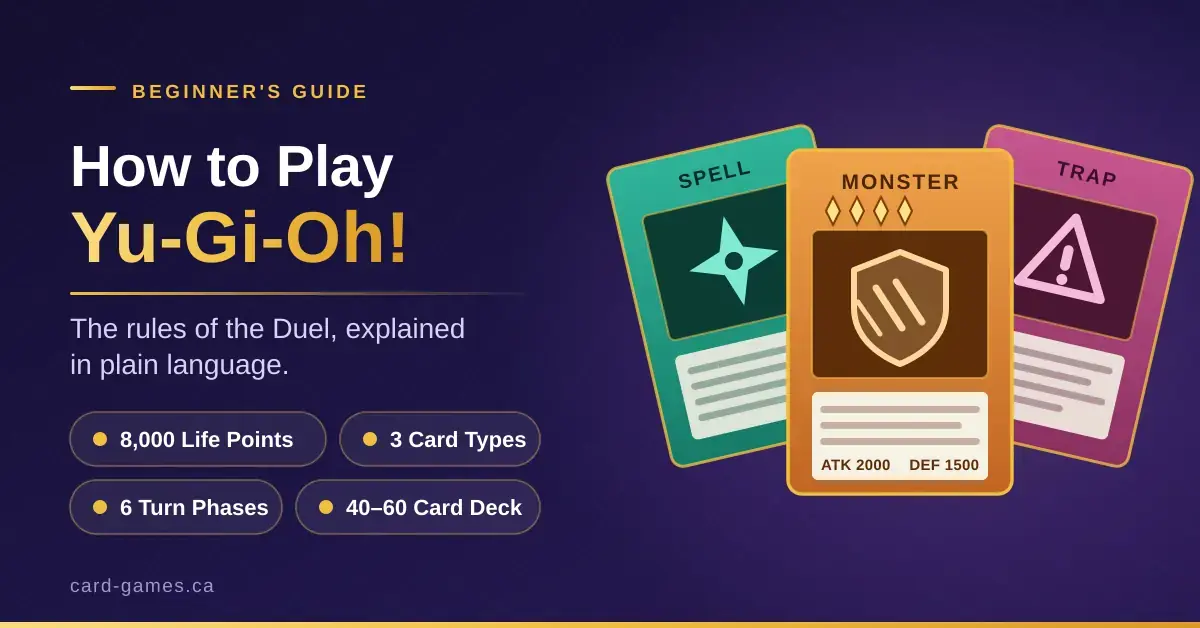
Yu-Gi-Oh! is one of the most popular collectible card games in the world, but its reputation for complex combos can make it look intimidating to newcomers. The good news is that the core of the game is simple: two players, or Duelists, use a customised deck of cards to reduce each other’s Life Points from 8,000 to zero. Once you understand a handful of foundational concepts — the card types, the layout of the field, and the order of a turn — the rest starts to click. This beginner’s guide breaks the official Yu-Gi-Oh! TRADING CARD GAME rules down into plain language so you can sit down and start Duelling with confidence.
Key Points
- Goal: reduce your opponent’s Life Points from 8,000 to 0.
- Card types: Monster, Spell and Trap Cards.
- Turn order: Draw → Standby → Main Phase 1 → Battle → Main Phase 2 → End.
- Deck: a Main Deck of 40–60 cards, plus optional Extra and Side Decks of up to 15 each.
- Easy start: try a pre-built Starter Deck or the simplified Speed Duel format.
What Is Yu-Gi-Oh!?
Yu-Gi-Oh! is a trading card game published by Konami. It grew out of a Japanese manga series and was first launched as a physical card game in Japan in 1999, arriving in North America in March 2002. Since then it has become a global hobby with organised tournaments, regular new card sets, and a thriving collector’s market. In 2009, Guinness World Records named it the top-selling trading card game in the world, a title that reflects just how many cards have been printed over the decades.
Like other trading card games, Yu-Gi-Oh! rewards both deck-building creativity and in-game decision-making. You collect cards, assemble them into a deck that reflects your strategy, and then test that deck against other players. Every match is called a Duel, and the two people playing are Duelists.
What You Need to Start Playing
To play a standard game of Yu-Gi-Oh!, each player brings their own deck. The rules define a few different deck types, and knowing the difference early on will save you a lot of confusion:
- Main Deck: This is your primary deck and must contain between 40 and 60 cards. It holds most of your Monster, Spell and Trap Cards.
- Extra Deck: An optional deck of up to 15 cards that holds special monsters (such as Fusion, Synchro, Xyz and Link monsters) which are summoned through specific mechanics rather than drawn into your hand.
- Side Deck: An optional set of up to 15 cards used in multi-game matches to swap cards in and out between games and adjust your strategy against a particular opponent.
You will also need a way to track Life Points — many players use a notepad, dice, or a phone app — and both players usually start each Duel with 8,000 Life Points. At the beginning of a Duel, each player shuffles their deck and draws an opening hand of five cards.
Building or Buying Your First Deck
You do not need to build a deck from scratch to begin. Konami sells pre-constructed Starter Decks and Structure Decks that are ready to play straight out of the box and are designed with beginners in mind. These are the easiest on-ramp: they come with a balanced mix of cards and a small rulebook. Once you understand how the cards interact, you can start buying booster packs and customising your deck to suit your playstyle.
Quick Facts
| Detail | Standard game | Speed Duel |
|---|---|---|
| Publisher | Konami | Konami |
| Starting Life Points | 8,000 | 4,000 |
| Opening hand | 5 cards | 4 cards |
| Main Deck size | 40–60 cards | 20–30 cards |
| First launched | Japan 1999 / N. America 2002 | January 2019 |
The Card Types Explained
Every card in Yu-Gi-Oh! falls into one of three broad categories: Monster Cards, Spell Cards and Trap Cards. Learning to recognise them at a glance is the single most useful skill for a new player.
Monster Cards
Monster Cards are the heart of the game and are used to attack your opponent and defend yourself. Each monster has an Attribute, a Type, a Level (shown as stars), and two key numbers: ATK (Attack) and DEF (Defense). The most common monsters you will meet as a beginner are:
- Normal Monsters (yellow cards): straightforward monsters with no special abilities, valued purely for their ATK and DEF.
- Effect Monsters (orange cards): monsters that carry a special ability described in their text box.
Beyond these, more advanced monsters live in the Extra Deck and are summoned using special methods. These include Ritual, Fusion, Synchro, Xyz, Pendulum and Link monsters. You do not need to master them on day one — most beginner decks focus on Normal and Effect monsters first.
Spell Cards
Spell Cards (green) provide a wide range of effects, from boosting your monsters and destroying your opponent’s cards to letting you draw more cards. Most Spell Cards can be activated from your hand during your Main Phase. Some, such as Continuous, Equip and Field Spells, stay on the field to provide ongoing benefits.
Trap Cards
Trap Cards (purple) are your reactive tools. Unlike Spells, a Trap Card must first be Set face-down on the field and cannot be activated during the same turn it is Set. From the following turn onward it can be triggered in response to your opponent’s actions — for example, to stop an attack or negate an effect. This delayed timing is what makes Traps a powerful surprise.
Understanding the Playing Field
Each player has their own side of the field with clearly defined zones. Knowing where cards go keeps the game orderly and helps you plan your turns:
- Main Monster Zones: five zones where you place your monsters.
- Spell & Trap Zones: five zones for your Spell and Trap Cards.
- Field Zone: a single zone reserved for Field Spell Cards.
- Graveyard: the discard pile where destroyed or used cards are sent.
- Extra Deck Zone: where your face-down Extra Deck sits.
- Extra Monster Zone: shared middle zones used for certain Extra Deck monsters under current rules.
How You Win a Duel
There are three main ways to win a Duel in Yu-Gi-Oh!:
- Reduce your opponent’s Life Points to 0. This is the most common path to victory, achieved by attacking with monsters and using card effects that inflict damage.
- Deck out your opponent. If a player has to draw a card during their Draw Phase but their deck is empty, they lose the Duel. This is called “decking out.”
- Win by a specific card effect. A small number of cards state that you win the Duel outright when their conditions are met.
The Phases of a Turn
A Yu-Gi-Oh! turn always follows the same fixed order. Every turn is divided into six phases, and understanding this sequence is the key to knowing when you can play cards and attack.
- Draw Phase: the turn player draws one card from the top of their deck. Note that the player who goes first does not draw during their very first Draw Phase.
- Standby Phase: a brief window before the main action, used to resolve any effects or maintenance costs that happen here.
- Main Phase 1: your main working phase. You can Normal Summon or Set a monster, activate Spell Cards, Set Spell and Trap Cards, and change monster positions.
- Battle Phase: when you declare attacks with your monsters. The player going first cannot conduct a Battle Phase on the opening turn.
- Main Phase 2: a second main phase after battle, useful for summoning or setting cards you held back during Main Phase 1.
- End Phase: the turn ends. If you are holding more than six cards, you must discard down to six, and play passes to your opponent.
How to Summon Monsters
Getting monsters onto the field is how you build a board and apply pressure. The basic method is the Normal Summon, and you may Normal Summon or Set only one monster per turn unless a card effect says otherwise.
Normal Summon and Tribute Summon
Lower-Level monsters are the easiest to play. The number of stars on a monster (its Level) determines what it takes to summon it:
- Level 1 to 4: summoned directly with no cost.
- Level 5 to 6: require you to Tribute (send to the Graveyard) one monster you already control.
- Level 7 or higher: require you to Tribute two monsters.
This process of offering monsters to summon a stronger one is called a Tribute Summon, and it counts as your one Normal Summon for the turn. When you play a monster, you can place it face-up in Attack Position (standing up) or face-down in Defense Position (Set, lying sideways).
Special Summons and the Extra Deck
Many cards allow a Special Summon, which does not use up your once-per-turn Normal Summon. Special Summons include the advanced Extra Deck monsters — Fusion, Synchro, Xyz and Link — each brought out by its own mechanic. Beginners are best served leaving these until they are comfortable with the basics, but they are the gateway to the powerful combos Yu-Gi-Oh! is famous for.
Battling: Attacking and Defending
During your Battle Phase, each of your Attack Position monsters may declare one attack. How the battle resolves depends on the target:
- Attacking directly: if your opponent has no monsters, your monster attacks their Life Points directly, dealing damage equal to its ATK.
- Attack vs. Attack Position monster: compare the two ATK values. The monster with lower ATK is destroyed, and its controller loses Life Points equal to the difference. If the values are equal, both monsters are destroyed.
- Attack vs. Defense Position monster: compare your attacker’s ATK with the defender’s DEF. If ATK is higher, the defending monster is destroyed but no Life Points are lost. If DEF is higher, your attacker is not destroyed, but you lose the difference in Life Points.
Remember that a monster you summon can usually attack the same turn, with one important exception: the player going first cannot attack on the opening turn because there is no Battle Phase available to them.
Speed Duel: The Easiest Way to Start
If the full game still feels like a lot, Konami created a streamlined format called Speed Duel, launched in January 2019 and designed specifically for newcomers and casual play. Speed Duel trims the game down: players start with 4,000 Life Points instead of 8,000, use a smaller Main Deck of 20 to 30 cards, and open with a hand of four cards. It also removes some of the more advanced zones and card interactions, making it a friendly first step before graduating to the standard Advanced format.
How Yu-Gi-Oh! Compares to Other Trading Card Games
Yu-Gi-Oh! is one of several major trading card games competing for players’ attention. If you are deciding where to start — or you already play one game and are curious about the others — the table below compares the essentials. You can also explore our beginner guides to Magic: The Gathering for beginners, the Pokémon Trading Card Game, and the newer Disney Lorcana.
| Game | Publisher | Starting life/health | Deck size | Official site |
|---|---|---|---|---|
| Yu-Gi-Oh! TCG | Konami | 8,000 Life Points | 40–60 (Main Deck) | yugioh-card.com |
| Magic: The Gathering | Wizards of the Coast | 20 life | 60 minimum | magic.wizards.com |
| Pokémon TCG | The Pokémon Company | Prize-card based (6 prizes) | 60 (exactly) | pokemon.com |
| Disney Lorcana | Ravensburger | Lore-based (20 to win) | 60 minimum | disneylorcana.com |
Beginner Tips for Your First Duels
A few practical habits will make learning Yu-Gi-Oh! far smoother:
- Start with a pre-made deck. Structure and Starter Decks are balanced and cheap, and they teach you a coherent strategy.
- Read your cards carefully. Yu-Gi-Oh! plays exactly as the card text says. When in doubt, read the box again.
- Learn the turn order by heart. Knowing the six phases prevents most rules mistakes.
- Play with others. The fastest way to improve is to Duel real people. Local game stores and community events are great places to learn, and you can find more organised play through card game clubs and tournaments in Canada.
Yu-Gi-Oh! has depth that can keep you engaged for years, but it starts with the simple loop of summon, attack and defend. Master that, and every new mechanic you learn afterwards will feel like a natural extension of a game you already understand.
Reference Sources
Frequently Asked Questions
Is Yu-Gi-Oh! hard to learn for beginners?
The core rules are straightforward once you learn the three card types, the six turn phases, and how to summon and battle. Advanced summoning mechanics add complexity later, but you can play a full, satisfying game using only Normal and Effect monsters. Starting with a pre-made Starter or Structure Deck, or with the simplified Speed Duel format, makes the learning curve much gentler.
How many Life Points do you start with in Yu-Gi-Oh!?
In the standard game, each player begins with 8,000 Life Points, and you win by reducing your opponent’s total to zero. In the beginner-friendly Speed Duel format, each player starts with 4,000 Life Points instead, which makes games shorter and quicker to learn.
How big does my Yu-Gi-Oh! deck need to be?
Your Main Deck must contain between 40 and 60 cards. You may also use an optional Extra Deck of up to 15 cards for special summon monsters and an optional Side Deck of up to 15 cards for swapping cards between games in a match. Speed Duel uses a smaller Main Deck of 20 to 30 cards.
Can you attack on the first turn in Yu-Gi-Oh!?
No. The player who takes the first turn of the Duel does not draw a card during their opening Draw Phase and cannot conduct a Battle Phase, so they cannot attack. This rule helps balance the advantage of going first and prevents extremely fast one-turn victories.
What is the difference between a Spell and a Trap Card?
Spell Cards (green) are usually played on your own turn during your Main Phase to create an immediate or ongoing effect. Trap Cards (purple) must first be Set face-down and cannot be used the same turn they are Set; from your next turn onward they can be triggered in response to your opponent, which makes them ideal for defensive surprises.