

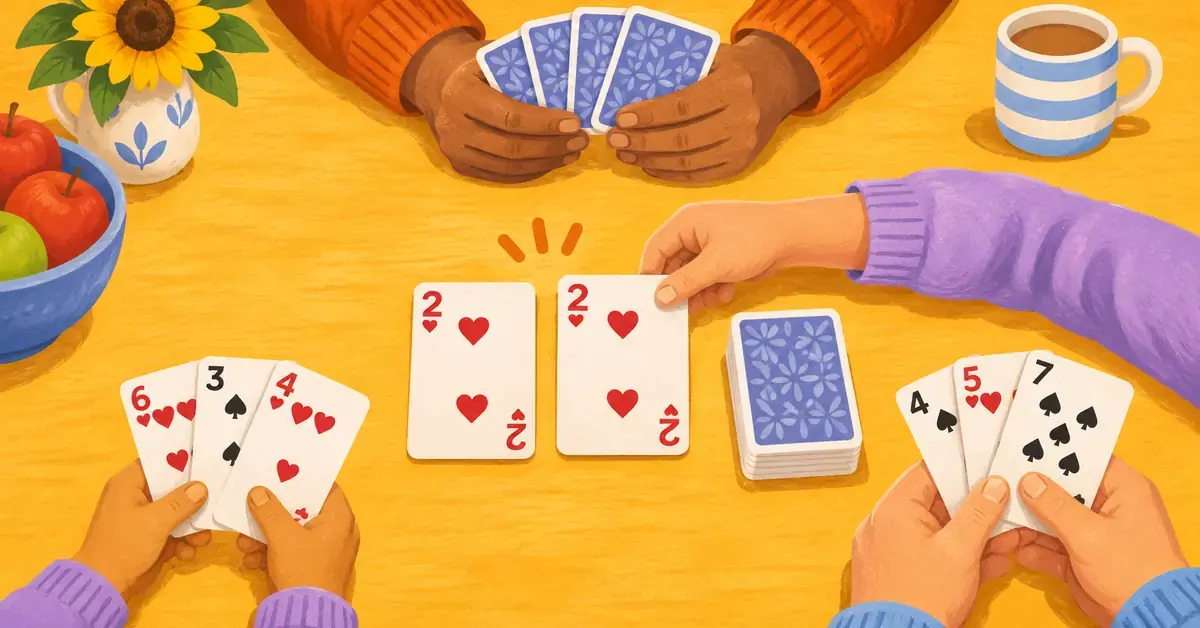
Few things bring a Canadian family together like a deck of cards on the kitchen table. Whether it is a rainy afternoon at the cottage, a long drive’s rest stop, or a weeknight after homework, the best card games for kids are the ones everyone can learn in a couple of minutes and still want to play again before bed. The good news is that most of them cost only a few dollars, and many need nothing more than a standard 52-card deck you already own.
This guide rounds up 12 easy card games the whole family can play, grouped by the age that usually clicks with each one. You will find a quick comparison of players, timing and skills for all 12, short how-to-play summaries, and a simple buying guide for the handful of boxed games worth adding to the shelf. For the wider list of titles, including a few trickier picks, you can also browse our family and kids card games section.
How we picked these kids’ card games
Not every card game suits a six-year-old, and not every six-year-old is ready for the same game. To keep this list genuinely family-friendly, every game below had to tick most of these boxes:
- Fast to learn. A child should grasp the basic idea in one or two rounds, with little or no reading required.
- Short rounds. Games that finish in 10 to 20 minutes hold young attention spans and let you squeeze in a rematch.
- Light on equipment. Most use a standard deck; the boxed ones are cheap and widely sold in Canada.
- Builds a useful skill. Matching, counting, memory, taking turns and a little friendly strategy all count.
- Fun for grown-ups too. The point of family card night is that nobody is just being polite.
The table below lets you compare all 12 at a glance so you can match a game to the ages at your table, the number of players, and how much time you have.
At a Glance Comparison
| Game | Best for ages | Players | What you need | Round time | Skills built |
|---|---|---|---|---|---|
| Go Fish | 4+ | 2-6 | Standard deck | 5-10 min | Matching, memory, turn-taking |
| Snap | 4+ | 2-4 | Standard deck | 5-10 min | Fast reactions, rank recognition |
| War | 4+ | 2 | Standard deck | 10-20 min | Card ranking, patience |
| Slapjack | 4+ | 2-8 | Standard deck | 5-15 min | Reflexes, focus |
| Old Maid | 4+ | 3-8 | Deck with one Queen removed | 10 min | Pairing, keeping a poker face |
| Happy Families | 4+ | 3-6 | Happy Families or standard deck | 15 min | Memory, polite asking, sets |
| Crazy Eights | 6+ | 2-7 | Standard deck | 10-15 min | Matching, planning |
| Spoons | 6+ | 3-8 | Standard deck + spoons | 10-15 min | Speed, observation |
| Garbage (Trash) | 6+ | 2-4 | Standard deck | 10-20 min | Number order, memory |
| Uno | 7+ | 2-10 | Uno deck (108 cards) | 15-30 min | Colour/number matching, tactics |
| Sleeping Queens | 8+ | 2-5 | Sleeping Queens deck | 15-20 min | Memory, simple addition |
| Spot It! (Dobble) | 6+ | 2-8 | Spot It! / Dobble deck | 15-20 min | Visual speed, concentration |
Easy card games for younger kids (roughly ages 4 to 6)
These six games ask almost nothing of a new player. There is no scorekeeping to speak of, no reading, and the rules fit in a single sentence. They are the perfect first step before a child moves on to matching and strategy games.
Go Fish
Go Fish is the classic set-collecting game and a brilliant first card game for ages four and up. Deal five to seven cards each (fewer for more players) and spread the rest face down as the “pool.” On your turn you ask one opponent for a rank you already hold – “Do you have any sevens?” If they do, they hand the cards over and you ask again; if they do not, they say “Go fish” and you draw from the pool. Collect all four cards of a rank to make a “book,” and whoever has the most books when the cards run out wins. It teaches matching, polite turn-taking and a surprising amount of memory. Once your child has the basics, our guide to how to win Go Fish shows the small tricks that tip the odds in their favour.
Snap
Snap is pure speed and giggles. Deal the whole deck out evenly, face down, and players take turns flipping their top card onto their own face-up pile. The instant two players’ top cards match in rank, the first to shout “Snap!” wins both piles. Keep going until one player has captured every card. There is nothing to memorise and nothing to score, which makes it ideal for ages four and up – just be ready for a loud table.
War
War needs exactly two players and zero setup, so it is a go-to for keeping one child busy. Split the deck into two face-down piles of 26. Both players flip their top card at the same time, and the higher rank wins both cards. If the two cards tie, you go to “war”: each player lays one card face down and turns one card face up, and the higher face-up card scoops the whole pile. You win by collecting all 52 cards. Rounds can run long, but the suspense of each flip keeps little ones hooked.
Slapjack
Slapjack takes the flipping action of War and adds a slap. Deal the entire deck out face down and, in turn, each player flips one card onto a central pile. Nobody looks at their cards first. The moment a Jack lands on the pile, everyone races to slap it – the first hand down wins the whole pile. Lose all your cards and you are out, until one sharp-eyed player holds the lot. It is a fantastic reflex game for ages four and up and works with a big, noisy group.
Old Maid
Old Maid is a gentle game of pairs and suspense. Use a standard deck with one Queen removed (51 cards) or a dedicated Old Maid deck. Deal all the cards out – it is fine if players have uneven hands – and everyone discards any pairs they are dealt. Then, in turn, you fan your hand face down to the player on your left, who draws one card; if it pairs with a card in their hand, they discard the pair. Play continues until every card is matched except the lone, unpaired Queen. Whoever is left holding her is the Old Maid and loses the round. It quietly builds matching skills and a first taste of a poker face.
Happy Families
A Victorian parlour favourite that still charms today, Happy Families is traditionally played with a special 44-card deck made up of 11 families of four, though you can play the same way by grouping a standard deck into sets of four. The goal is to collect complete families by politely asking other players for the cards you need. Remembering who asked for what rewards attention, and the asking-and-answering rhythm makes it a lovely game for ages four and up. Our full guide to Happy Families walks through the deck, the deal and the house rules families tweak most often.
Fun card games for older kids and family game night (ages 6 and up)
Once children can count, match and hold a small hand of cards, a new tier of games opens up. These six add a dash of strategy, speed or memory while staying easy enough for a mixed-age table.
Crazy Eights
Crazy Eights is the standard-deck ancestor of every “match and discard” game. Deal five cards each (seven for two players), turn one card face up to start the discard pile, and take turns playing a card that matches the top card’s rank or suit. Can’t match? Draw until you can. The magic is in the eights: an 8 is wild, playable at any time, and lets you name the suit the next player must follow. The first to empty their hand wins. It suits ages six and up and is the perfect bridge toward boxed matching games.
Spoons
Spoons is controlled chaos for three to eight players, and all you need beyond a deck is a handful of spoons – always one fewer than the number of players – placed in the centre of the table. Using sets of four matching ranks, everyone passes cards around the table as fast as they can, trying to collect four of a kind. The instant someone does, they quietly grab a spoon, which triggers a mad scramble for the rest. The player left without a spoon earns a letter, S-P-O-O-N, and is out once they spell the whole word. It is a riotous family-reunion game that rewards sharp eyes.
Garbage (Trash)
Garbage, also called Trash, is a brilliant way to help kids lock in the numbers one through ten. Each player lays ten cards face down in a row. You draw a card and, if it matches a position (an Ace goes in spot one, a two in spot two, and so on), you place it face up there and keep drawing; Jacks are wild, while Queens and Kings are “garbage” that end your turn. The first player to fill all ten positions wins the round. It plays best with two to four and gently drills number order and memory. See the full Garbage (Trash) card game rules for the complete sequence and scoring.
Uno
Uno is the boxed game almost every Canadian household recognises. Its classic 108-card deck of four colours works for 2 to 10 players, and the maker recommends it for ages seven and up. You match the top card by colour, number or symbol, then unleash action cards – Skip, Reverse, Draw Two, Wild and Wild Draw Four – to slow down the leader. Don’t forget to call “Uno!” when you are down to one card, or you risk drawing a penalty. First to shed every card wins. It is endlessly re-playable and the easiest boxed game to recommend for a crowd.
Sleeping Queens
Invented by a six-year-old and published by Gamewright in 2005, Sleeping Queens is a charming boxed game for 2 to 5 players, recommended for ages eight and up and playing in about 20 minutes. Players wake slumbering queens by playing Kings, defend them with Dragons, steal them with Knights and send them back to sleep with Potions. Along the way, discarding number cards sneaks in a little addition practice. The first player to collect enough queens – or reach the point target – wins. It is a lovely step up for kids who have outgrown pure luck.
Spot It! (Dobble)
Spot It!, sold as Dobble in much of the world, is a lightning-fast matching game of 55 round cards. Each card shows eight symbols, and – thanks to some clever maths – any two cards share exactly one matching symbol. Players race to be the first to spot and name the match between two cards. It supports 2 to 8 players, the box is usually marked for about ages six and up, and a game runs about 15 to 20 minutes, made up of quick individual rounds that suit restaurants, waiting rooms and short attention spans. Several mini-games share the same deck, which keeps it fresh.
Standard deck or boxed game: what to buy
One of the best things about teaching kids card games is how little it costs. A standard 52-card deck – a few dollars at any Canadian corner store or dollar store – plays Go Fish, Snap, War, Slapjack, Old Maid, Crazy Eights, Spoons and Garbage, which is most of this list. Keep two decks on hand so a bent or missing card never ends a game.
The boxed games are worth the small outlay when you want something self-contained. Uno, Spot It! and Sleeping Queens usually cost under $20 at Canadian toy shops, book stores and major retailers, and each brings something a plain deck cannot: Uno’s action cards, Spot It!’s visual speed, or the light strategy of Sleeping Queens. If you buy just one boxed game for a mixed-age family, Uno is the safe crowd-pleaser; add Spot It! for younger kids who love a fast, visual game.
When choosing, match the game to the youngest player at the table, not the oldest. A game that is too complex frustrates a four-year-old, while an older sibling will happily play a “baby” game if the rounds are quick and the stakes are silly. Use the quick picks below to zero in fast.
Quick Picks
- Fastest to learn: War or Snap – flip, react, no reading needed.
- Best for just two players: War, Garbage (Trash) or Go Fish.
- Best for a big, loud group: Slapjack, Spoons or Uno.
- Best for learning numbers and matching: Go Fish, Garbage (Trash) and Crazy Eights.
- Best for quick, no-reading fun: War, Snap and Spot It!.
- Best single boxed game to buy: Uno for a crowd, or Sleeping Queens for a little strategy.
Tips for playing card games with kids
A few small habits turn a card game from a meltdown into a memory. First, teach by playing an open-handed practice round where everyone shows their cards and you talk through each move. Second, loosen the rules for the youngest players – let them take back an obviously bad play while they learn, then tighten up over time. Third, keep rounds short and quit while it is still fun; a child who leaves the table wanting one more game is a child who will ask to play tomorrow.
Finally, agree on the house rules before you deal. Almost every classic has regional variations – how many cards Go Fish starts with, whether Crazy Eights stacks penalties, how Spoons handles a tie – so deciding up front saves arguments later. When the kids are in bed, the same deck powers a very different evening; our round-up of party card games for adults is a good place to start. And if your child is ready for a scoring game with real strategy, the Golf card game is a great next step.
Reference Sources
- Bicycle Cards – How to Play Go Fish
- Bicycle Cards – How to Play Old Maid
- Bicycle Cards – How to Play War
- Bicycle Cards – Snap Rules
- Bicycle Cards – Slapjack Rules
- Bicycle Cards – Spoons Rules
- Bicycle Cards – Trash (Garbage) Rules
- Wikipedia – Crazy Eights
- Wikipedia – Uno (card game)
- Wikipedia – Sleeping Queens
- Target – Spot It! (ages 6 and up, 2-8 players)
- Jaques of London – The History of Happy Families
Frequently asked questions
What is the best card game for a 6-year-old?
For most six-year-olds, Go Fish, Crazy Eights and Uno hit the sweet spot: they reward matching and a little planning without demanding long attention or reading. If your child is at the younger end, start with War, Snap or Slapjack, which need no strategy at all – just quick reactions and a love of flipping cards.
What are the best classic card games for kids using a standard deck?
You can play most of this list with a single 52-card deck. The timeless classics are Go Fish, War, Snap, Slapjack, Old Maid, Crazy Eights, Spoons and Garbage (Trash). Together they cover matching, memory, speed and a first taste of strategy, so a cheap deck of cards keeps a family entertained for years.
What is the most popular card game for kids?
Uno is probably the single most recognised kids’ card game in Canada, thanks to its simple colour-and-number matching and its unpredictable action cards. Among standard-deck games, Go Fish and Crazy Eights are the most widely taught, because almost every adult already knows how to play and can pass them on in minutes.
How many players do kids’ card games need?
It depends on the game. War and Garbage (Trash) are built for two, which makes them handy for one child and one grown-up. Go Fish, Crazy Eights and Old Maid shine with three to six, while Slapjack, Spoons, Uno and Spot It! happily stretch to a big, loud group – Uno and Spot It! both go up to eight to ten players.
At what age can children start playing card games?
Many children can enjoy a simple game like War, Snap or Go Fish from around age four, once they can recognise numbers and take turns. Matching games such as Crazy Eights and Uno usually click at six or seven, and light-strategy boxed games like Sleeping Queens are aimed at eight and up. As always, the youngest player at the table is the best guide to which game to choose.