

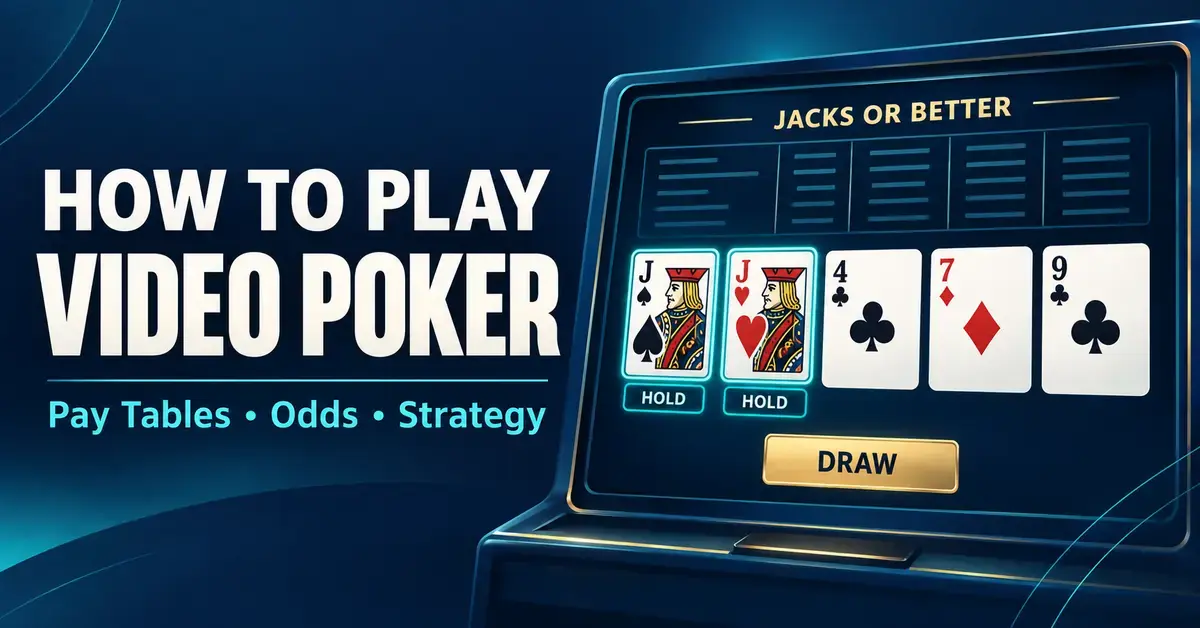
Video poker is one of the most approachable games on any casino floor or online lobby, and it is a natural next step for anyone who already enjoys card games. It blends the familiar hand rankings of five-card draw poker with the solo, machine-based pace of a slot. Crucially, unlike a slot machine, video poker rewards skill: the decisions you make about which cards to keep directly change your long-term results. This guide explains how to play video poker from the first coin to the final draw, how to read pay tables, what the odds and return-to-player figures really mean, and the Jacks or Better strategy that beginners should learn first.
Throughout, we focus on Jacks or Better, the classic variant that serves as the template for nearly every other version of the game. Master it and you will understand the rest.
Key Facts
- Game type: single-player draw poker played on a machine or online — no dealer or opponents.
- Deck: one standard 52-card deck, randomly shuffled every hand.
- Core move: you are dealt five cards, hold the ones you want, and draw once to replace the rest.
- Most popular variant: Jacks or Better, where a pair of jacks or higher is the minimum paying hand.
- Best odds: full-pay 9/6 Jacks or Better returns about 99.54% with optimal strategy (0.46% house edge).
- Golden rule: always bet five coins and always check the pay table before you play.
What Is Video Poker?
Video poker is a single-player game played on a computerized terminal or in a browser. You are dealt a five-card hand from a standard 52-card deck, you choose which cards to keep, and the machine replaces the rest with a single draw. You are not playing against other players or a live dealer — you are simply trying to build one of the paying poker hands listed on the machine’s pay table.
The game first appeared in the 1970s when affordable video technology met the solitaire-style appeal of draw poker. It became a casino staple in the 1980s and remains popular today because it combines quick, private play with a genuinely low house edge when you play correctly.
Because the deck is standard and the shuffle is random, the odds of each hand are fixed and known. That transparency is what allows mathematicians to calculate the exact long-term return of every pay table — something that is impossible with a traditional slot machine.
How a Round of Video Poker Works
A single round is short and always follows the same sequence. Here is the step-by-step flow:
- Choose your bet. You select a coin denomination (for example $0.25) and how many coins to wager per hand, from one to five. Betting the maximum of five coins is important — more on that below.
- Deal. Press “Deal” and the machine gives you five cards face up.
- Hold. Decide which cards to keep. You tap “Hold” under each card you want to save. You may keep anywhere from zero to all five.
- Draw. Press “Draw” and every card you did not hold is discarded and replaced with a new one from the same deck.
- Payout. The final five-card hand is compared to the pay table. If it ranks as a paying hand, you are paid automatically; if not, the round ends and you start again.
That single hold-and-draw decision is the entire game, yet it is where all of your skill is applied. The order you tap the cards does not matter, and there is no bluffing, no betting rounds, and no opponents to read.
Video Poker Hand Rankings
Video poker uses the same hand hierarchy as traditional poker, so if you already know those rankings you are most of the way there. From strongest to weakest, the paying hands in Jacks or Better are: royal flush, straight flush, four of a kind, full house, flush, straight, three of a kind, two pair, and a high pair of jacks, queens, kings or aces.
The name “Jacks or Better” comes from the minimum paying hand: a single pair only pays if it is a pair of jacks or higher. A pair of tens or lower returns nothing. If you want a deeper refresher on how each combination beats another, our full guide to poker hand rankings breaks down every hand with examples and tie-breaker rules.
Understanding these rankings matters because strategy is all about weighing a guaranteed small win against the chance of drawing into a larger one.
Understanding Pay Tables
The pay table is the single most important thing to check before you play, because two machines running the same game can return very different amounts. Pay tables are usually named after the payouts for a full house and a flush. The gold-standard Jacks or Better table pays 9 coins for a full house and 6 for a flush, which is why it is called “9/6” or full-pay.
Here is the full-pay 9/6 Jacks or Better pay table. Payouts are shown per coin bet, with the five-coin (maximum bet) column included because the royal flush jumps to a bonus rate at max bet:
Jacks or Better Pay Table
| Hand | Per coin bet | 5-coin (max) payout |
|---|---|---|
| Royal flush | 250 | 4,000 |
| Straight flush | 50 | 250 |
| Four of a kind | 25 | 125 |
| Full house | 9 | 45 |
| Flush | 6 | 30 |
| Straight | 4 | 20 |
| Three of a kind | 3 | 15 |
| Two pair | 2 | 10 |
| Jacks or better | 1 | 5 |
Notice how the royal flush pays 250 coins each for the first four coins but leaps to 4,000 (800 per coin) when you bet all five. That jump is why experienced players almost always bet the maximum of five coins — betting fewer coins lowers the overall return of the game. If five coins at a given denomination is beyond your budget, drop to a smaller coin size rather than betting fewer coins.
If a machine pays less for the full house or flush — such as 8/5 or 6/5 — the return drops noticeably even though everything else looks identical. Always read the pay table, not just the game’s name.
Video Poker Odds, RTP and House Edge
Return to player (RTP) is the percentage of all wagered money a game pays back over the very long run, assuming perfect play. The house edge is simply 100% minus the RTP. Full-pay 9/6 Jacks or Better returns 99.54% with optimal strategy, leaving a house edge of just 0.46% — one of the best odds in any casino.
Two points are essential to understand. First, RTP is a long-run average across hundreds of thousands of hands; any single session can swing far above or below it. Second, those figures only hold if you play the mathematically correct strategy. Careless play can easily cost several percent, turning a great game into a mediocre one.
It is also worth remembering that a published RTP assumes the specific pay table it was calculated for. The same optimal strategy on an 8/5 Jacks or Better machine returns only about 97.3%, because the weaker payouts — not your decisions — drag the number down.
Jacks or Better Strategy for Beginners
Optimal video poker strategy is a ranked list of what to hold. For any dealt hand, you scan the list from top to bottom and keep the first (highest) pattern that appears in your cards. Below is a simplified priority order for 9/6 Jacks or Better that captures the vast majority of situations correctly:
- A made four of a kind, straight flush or royal flush — keep all five.
- Four cards to a royal flush — break up a flush or straight to chase it.
- A made three of a kind, straight, flush or full house.
- Four cards to a straight flush.
- Two pair.
- A high pair (jacks or better).
- Three cards to a royal flush.
- Four cards to a flush.
- A low pair (tens or lower).
- Four cards to an open-ended straight.
- Two suited high cards.
- Three cards to a straight flush.
- One high card (jack, queen, king or ace).
- Nothing of value — discard all five and draw a fresh hand.
A few rules of thumb flow from this list. Always keep a paying high pair rather than chasing a flush or straight draw. Never hold a “kicker” alongside a pair — keep only the pair and draw three. Favour a low pair over a single high card, but favour four to a flush over a low pair. And never break a made straight or flush unless you are one card away from a royal.
Keeping a printed or on-screen strategy chart beside you is perfectly legal and common; video poker is a game of mathematics, not memory, so there is no shame in using a reference while you learn.
Popular Video Poker Variants
Once you are comfortable with Jacks or Better, you will see dozens of related games. They share the deal-and-draw mechanic but tweak the pay table or add wild cards, which changes both the strategy and the return. The table below compares the most common variants and their best widely available pay tables:
| Variant | Best common pay table | Max RTP (optimal play) | Strategy difficulty |
|---|---|---|---|
| Jacks or Better | 9/6 | 99.54% | Low |
| Bonus Poker | 8/5 | 99.17% | Medium |
| Double Bonus Poker | 10/7 | 100.17% | High |
| Double Double Bonus | 9/6 | 98.98% | High |
| Deuces Wild | Full-pay (“NSUD”) | 100.76% | High |
A handful of these tables return more than 100% in theory, meaning a flawless player has a tiny mathematical edge. In practice those pay tables are rare, demand near-perfect play, and require large volume before the edge appears — so treat them as a curiosity rather than a reliable income. Bonus-style games also overpay certain four-of-a-kind hands (like four aces), which raises volatility: expect longer dry spells punctuated by bigger wins.
If you enjoy the machine format, you may also like table-based casino poker games such as Three Card Poker, or the community-card classic Texas Hold’em. You can browse the full lineup on our casino and gambling card games hub.
Common Mistakes to Avoid
New players lose value in a few predictable ways. Avoid these and your results will track the game’s advertised return far more closely:
- Betting fewer than five coins. This forfeits the royal-flush bonus and lowers your overall RTP. Lower the denomination instead.
- Ignoring the pay table. An 8/5 or 6/5 machine looks identical to a 9/6 one but pays far less. Always check before you sit down.
- Breaking a winning hand to chase. Holding four to a flush when you already have a paying high pair is a classic error.
- Keeping kickers. An extra high card held with a pair reduces your chance of improving to trips or better.
- Playing without a strategy chart. Guesswork can cost several percent in return. Use a reference until the decisions become automatic.
Skill-based casino games reward discipline. The same logic that makes advantage techniques like card counting in blackjack effective — playing the mathematics rather than hunches — applies here, minus the risk of being asked to leave.
Tips for Playing Video Poker in Canada
Video poker is available in licensed land-based casinos across Canada and through provincially regulated online platforms, such as Ontario’s regulated iGaming market. Wherever you play, stick to a few habits: set a budget before you start and treat it as the cost of entertainment, choose the best pay table available, bet five coins at a denomination you can comfortably afford, and always apply a strategy chart.
Remember that video poker is a game of entertainment with a built-in house edge. Even the best players lose over time on most pay tables, so never chase losses and never wager money you cannot afford to lose.
Responsible Gambling Notice
Responsible gambling: This article is for informational and educational purposes only and is not gambling or financial advice. Video poker involves real financial risk, and outcomes are determined by chance. You must be of legal gambling age in your province and should only wager money you can afford to lose. If gambling is affecting you or someone you know, free, confidential help is available in Canada 24/7 from ConnexOntario (1-866-531-2600) and the Responsible Gambling Council. In Ontario, gaming is regulated by the Alcohol and Gaming Commission of Ontario (AGCO); check your own provincial regulator for local rules.
Reference Sources
Frequently Asked Questions
Is video poker a game of skill or luck?
It is both. The cards you are dealt are random, which is the luck element, but your hold-and-draw decisions determine how much value you extract from those cards over time. Because the odds are fixed and known, correct strategy measurably improves your long-term return, which makes video poker far more skill-dependent than a slot machine.
What does “9/6 Jacks or Better” mean?
The numbers refer to the payout for a full house and a flush: nine coins per coin bet for a full house and six for a flush. This is the full-pay version and returns about 99.54% with optimal play. Tables that pay less for those hands, such as 8/5, return noticeably less, so the 9/6 label is a quick way to spot a good machine.
Why should I always bet the maximum of five coins?
On almost every machine the royal flush pays a disproportionate bonus at five coins — 4,000 coins instead of the 1,250 you would expect from scaling up the single-coin payout. Betting fewer coins sacrifices that bonus and lowers your overall return. If five coins is too much for your budget, move to a smaller coin denomination rather than reducing the number of coins.
Can you actually win money at video poker?
You can win in any given session, and a rare few pay tables return slightly over 100% to a flawless player. However, the vast majority of machines carry a small house edge, so over the long run most players lose a little. Treat video poker as entertainment with good odds, not as a way to make money.
Do I need to memorize a strategy chart to play?
No. You can start playing immediately, and using a printed or on-screen strategy chart while you play is completely acceptable and legal. Memorizing the hold priorities simply speeds up your play; it is not required to achieve the correct decisions, since the chart tells you exactly what to keep in every situation.