

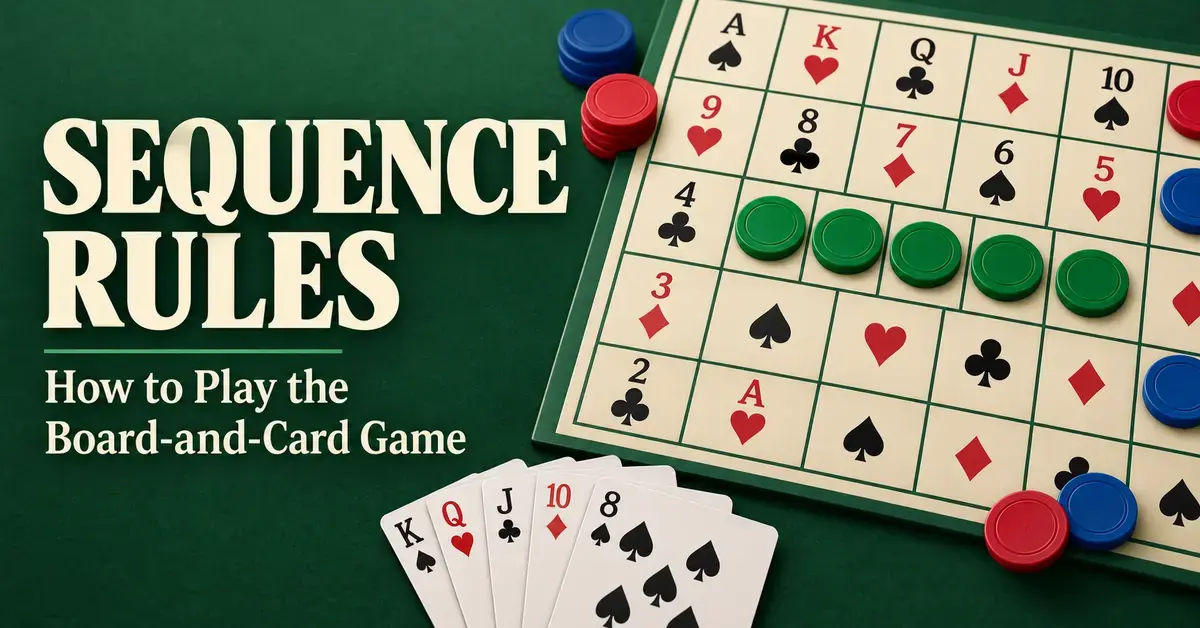
Sequence is one of those rare games that works for a quiet evening with one other person or a loud table of twelve, and it does it with nothing more than a board, a handful of playing cards and a pile of coloured chips. It is a board-and-card hybrid: you play cards from your hand, but you win by claiming spaces on a shared board. If you have ever wanted a game that is simple enough for a seven-year-old yet tense enough to keep adults scheming, the Sequence rules below will have you playing in about ten minutes.
This guide walks through everything you need: the equipment, how to set up and deal, how a turn works, what the Jacks do, and exactly how to win. Along the way we explain every term in plain language so that total beginners can follow along.
Key Facts
- Players: 2–12 (teams of 2 or 3 for 4+ players)
- Recommended age: 7 and up
- You need: the Sequence board, 104 cards (two decks, no jokers) and coloured chips
- Playing time: roughly 10–30 minutes
- Goal: build 2 sequences (2 players/teams) or 1 sequence (3 players/teams) of five chips in a row
- Designed by: Douglas Reuter; first sold in 1982
What Is Sequence?
Sequence is a strategy game for two to twelve players, invented by American designer Douglas Reuter and first sold in stores in 1982. The goal is to place your coloured chips on the board to form rows of five, called “sequences,” running horizontally, vertically or diagonally. You do this by playing cards from your hand that match the cards printed on the board.
Because it blends the luck of the cards you are dealt with the tactics of where to build and block, Sequence sits comfortably between pure luck games and heavier brain-burners. It is often shelved alongside other accessible family card games, but the blocking and sequence-building give it real bite for anyone who enjoys strategy card games.
What You Need to Play
A standard Sequence set contains three things:
- The game board. It shows a 10 x 10 grid of 100 spaces. Ninety-six of those spaces picture the cards from two standard decks; the four corners are printed as “Free” spaces. Every card appears on the board exactly twice.
- The cards. Sequence uses 104 cards, which is two standard 52-card decks shuffled together with the jokers removed. Note that while Jacks are in your hand, no Jack is printed anywhere on the board.
- The chips. Poker-style marker chips in up to three colours. Blue and green are always used; red is added only for a three-player or three-team game. Everyone on the same team uses the same colour.
Because only the 48 non-Jack cards of a deck are printed on the board, and each is shown twice, you get 96 card spaces plus the 4 free corners for a total of 100. Keeping that math in mind helps the rest of the rules click into place.
Setting Up the Game
Lay the board flat where everyone can reach it and give each player (or team) its colour of chips. Choose a dealer, shuffle the 104 cards and deal each player a hand according to the number of players at the table. The more players, the fewer cards each person holds.
Cards Dealt by Player Count
| Number of players | Cards dealt to each player |
|---|---|
| 2 players | 7 cards |
| 3 players | 6 cards |
| 4 players | 6 cards |
| 6 players | 5 cards |
| 8 players | 4 cards |
| 9 players | 4 cards |
| 10 players | 3 cards |
| 12 players | 3 cards |
Place the rest of the deck face down beside the board as the draw pile. Each player also keeps a personal, face-up discard pile in front of them as the game goes on.
Playing in Teams
Any game with four or more players is played in teams, and the players must split evenly into two or three teams. The one firm seating rule is that teammates may never sit next to one another: seats must alternate around the table so that an opponent always sits between you and your partner. Teammates share a chip colour and work toward the team’s sequences together, but they are not allowed to talk strategy or signal about the contents of their hands.
How to Play Sequence: Turn by Turn
Play moves clockwise, starting with the player to the dealer’s left. A single turn is short and always follows the same four steps:
- Choose one card from your hand and play it face up onto your own discard pile.
- Place one of your chips on an open board space that matches the card you just played (remember, each card appears in two places).
- If you played a Jack, follow the special Jack rules below instead.
- Draw one new card from the draw pile to return your hand to its full size. Your turn is now over.
One detail trips up new players: you must draw your replacement card before the next person acts. If you forget to draw and the next player begins their turn, you lose the right to draw and must finish the game with a smaller hand, so get into the habit early.
Using the Free Corner Spaces
The four printed “Free” corners belong to everyone at once. Each corner counts as if it already holds a chip of your colour, so it can serve as one of the five spaces in any player’s or team’s sequence. Because a corner is shared, two different teams can both use the same corner as part of their own separate sequences.
The Dead Card Rule
A card is “dead” when both of its matching board spaces are already covered by chips, which means you can no longer place a chip for it. When you hold a dead card, you may trade it in: on your turn, announce that you are turning in a dead card, place it on your discard pile, and draw one replacement card from the deck. You may only exchange one dead card per turn, and doing so uses up your turn’s draw rather than letting you place a chip.
The Jacks: Wild and Anti-Wild Cards
Jacks are the engine of Sequence strategy, and they come in two kinds. In a standard deck, two of the four Jacks are drawn facing forward so you can see two eyes, and two are drawn in profile showing only one eye. The artwork is your cheat sheet for which Jack does what.
Jacks at a Glance
| Card | Nickname | What it does |
|---|---|---|
| Two-eyed Jacks (Diamonds & Clubs) | Wild card | Place a chip on any open space anywhere on the board. |
| One-eyed Jacks (Hearts & Spades) | Anti-wild card | Remove one opponent’s chip, but never a chip in a completed sequence. |
Two-Eyed Jacks: the Wild Cards
The two-eyed Jacks are the Jack of Diamonds and the Jack of Clubs. They are wild: play one and you may place a chip on any open space anywhere on the board, exactly as if you held that card. Two-eyed Jacks are precious for completing a sequence or grabbing a space no ordinary card can reach.
One-Eyed Jacks: the Anti-Wild Cards
The one-eyed Jacks are the Jack of Hearts and the Jack of Spades. They do the opposite of placing a chip: play a one-eyed Jack to remove a single opponent’s chip from the board, returning that space to open. The one unbreakable limit is that you can never remove a chip that is already part of a completed sequence. Once five chips lock into a sequence, they are safe for the rest of the game.
How to Win: Building Sequences
A sequence is a connected line of five chips of your colour, placed horizontally, vertically or diagonally. A completed sequence can include a corner free space in place of one chip, so a four-chip line that touches a corner also counts as a full sequence of five.
How Many Sequences You Need
The number of sequences required to win depends on how the table is divided:
- With two players or two teams, you must complete two sequences.
- With three players or three teams, you only need one sequence.
As soon as a player or team meets its target, they call it out and the game ends immediately in their favour.
Sharing a Chip Between Two Sequences
When you need two sequences, there is an important rule about where they can touch. One chip from a completed sequence may also count toward a second sequence, but only one shared chip is allowed. In practice, that means your second sequence must contain at least four brand-new chips. You cannot simply extend one long line and call it two sequences; the lines may cross or meet at a single point, and no more.
Sequence Strategy Tips for Beginners
Once the rules are second nature, a few habits will sharpen your play:
- Hold your Jacks. Resist spending a wild two-eyed Jack early. Saved for the right moment, it can finish a sequence your opponents thought they had blocked.
- Watch both copies. Every card matches two board spaces, so think about which of the two placements does more to build your own line or block an opponent.
- Block as much as you build. A chip dropped into the gap of an opponent’s growing row can be worth more than advancing your own. Good players defend and attack on the same turn.
- Use the corners. Because the free corners count for everyone, lines that run through a corner only need four of your own chips, so they are faster to finish.
This mix of planning and blocking is why fans of trick-taking and shedding games enjoy Sequence; if you like it, you may also enjoy the sequence-building tension of Spite and Malice or a lighter family night with how to play Uno.
Sequence Editions Compared
The classic game has spawned several spin-offs for different ages and tastes. They keep the core idea of lining up markers but change the components. The table below compares the most common editions from the publisher, Goliath Games (see the official Goliath Games site for current availability).
| Edition | Players | Ages | How it differs from classic Sequence |
|---|---|---|---|
| Sequence (Classic) | 2–12 | 7+ | The original board, two decks of cards and chips described in this guide. |
| Sequence for Kids | 2–4 | 3–6 | No reading required; animal picture cards, with a Dragon card that removes a chip and a Unicorn card that is wild. One line of four wins. |
| Sequence Numbers | 2–4 | 7+ | Uses number cards and simple addition and subtraction instead of playing cards, so it doubles as math practice. |
| Sequence Dice | 2–12 | 7+ | You roll two dice each turn instead of playing a card, then place a chip on a matching space. |
| Sequence Travel | 2–6 | 7+ | A compact, self-contained board with pegs instead of loose chips, built for playing on the go. |
| Jumbo Sequence | 2–12 | 7+ | The classic game with an oversized board and larger components for big groups. |
Whichever edition you choose, the heart of the game is the same: read the board, line up five, and stop your rivals from doing it first.
A Brief History of Sequence
Douglas Reuter first dreamed up the concept in 1974, originally calling it “Sequence Five.” After years of refining the idea, he granted a licence to Jax Ltd. in 1981, and the game reached store shelves in 1982. It became a steady family favourite across North America, and in the late 2010s Goliath Games acquired full ownership of the brand and continues to publish it today.
Part of its staying power is that it leans on familiar components. Anyone who already knows the standard 52-card deck, or who has learned something like poker hand rankings, can pick up Sequence in minutes, because the cards simply point to spaces on the board rather than forming hands of their own.
Reference Sources
Frequently Asked Questions
How many players do you need for Sequence?
Sequence works with two to twelve players. A one-on-one or two-team game is the most strategic, while four or more players must split evenly into two or three teams, with teammates seated so that an opponent always sits between partners.
What is the difference between a one-eyed Jack and a two-eyed Jack?
A two-eyed Jack (the Jack of Diamonds or Clubs) is wild and lets you place a chip on any open space on the board. A one-eyed Jack (the Jack of Hearts or Spades) does the reverse: it removes one opponent’s chip, though never a chip that is already locked inside a completed sequence.
What happens if I am holding a dead card?
A card is dead when both of its board spaces are already covered. On your turn you may announce the dead card, place it on your discard pile and draw one replacement card instead of placing a chip. You can only swap one dead card per turn.
How many sequences do you need to win?
In a game with two players or two teams you must complete two sequences. In a game with three players or three teams you only need one. A single chip may be shared between two sequences, but each new sequence must still contain at least four fresh chips.
Can you remove a chip that is part of a completed sequence?
No. Once five chips form a completed sequence, those chips are permanently safe and cannot be removed by a one-eyed Jack for the rest of the game. One-eyed Jacks can only take chips that are not yet part of a finished sequence.