

Garbage, also widely known as Trash, is one of the easiest card games to teach and one of the hardest to stop playing. It uses nothing more than an ordinary deck of playing cards, rewards a little luck and a little attention, and works just as well for a five-year-old learning their numbers as it does for adults looking for a quick, low-pressure game. This guide walks through the full Garbage (Trash) card game rules step by step, explains every special card, and shares practical tips for playing with kids.
What Is the Garbage (Trash) Card Game?
Garbage is a sequencing game for two or more players. Each person tries to fill a personal row of face-down cards with the numbers 1 through 10, in order, before their opponents do. The whole game is built around a simple idea: draw a card, and if it fits an open numbered slot, play it there and flip over whatever was hiding in that spot. Because there is almost no reading, counting change, or complex scoring, it is a natural fit for the kind of quick, friendly titles you will find in our family and kids card games collection.
The game goes by several names — Garbage and Trash are the most common in Canada and the United States — but the rules are essentially the same everywhere. It is a game of mostly luck with a dash of decision-making, which is exactly why it levels the playing field between children and adults.
Quick Facts
- Players: 2–5 (more with extra decks)
- Decks: 1 standard deck for 2–3 players; 2 decks for 4–5; 3 for 6+
- Cards dealt: 10 face down per player, in two rows of five (positions 1–10)
- Wild card: Jacks (can fill any position)
- Turn enders: Queens and Kings
- Goal: Fill positions 1–10 in order, then win progressive rounds down to a single card
- Best for: Families, kids and quick, low-pressure play
What You Need to Play
Garbage needs very little equipment, which is part of its appeal for road trips, cottages and rainy afternoons.
- A standard 52-card deck. Jokers are removed in the basic game (some variations add them back — more on that below).
- Two to five players. Use one deck for two or three players, two decks shuffled together for four or five players, and three decks for six or more. More decks keep the draw pile from running out too quickly.
- A flat surface. Each player needs enough room for a layout of up to ten cards in front of them, plus a shared draw pile and discard pile in the middle.
How to Set Up Garbage
Setup takes less than a minute once everyone knows the pattern.
- Shuffle the deck thoroughly and choose a dealer.
- Deal ten cards to each player, one at a time, all face down. Players must not look at them.
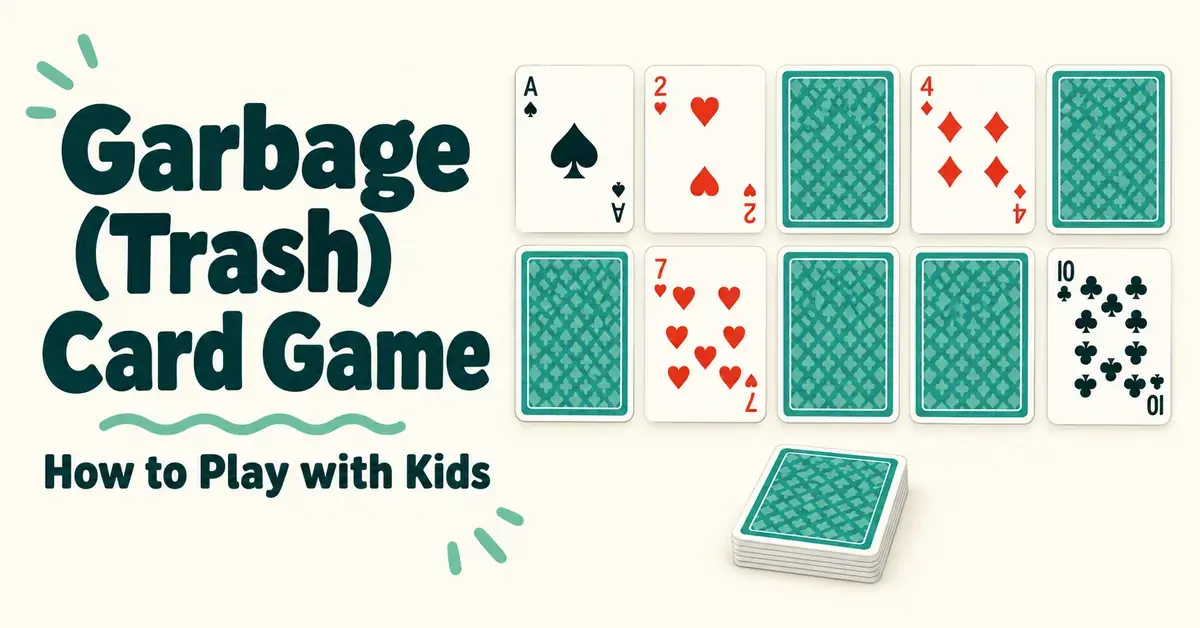
- Arrange each hand in two rows of five. The top row, from left to right, represents positions 1 (Ace), 2, 3, 4 and 5. The bottom row represents positions 6, 7, 8, 9 and 10. This fixed grid never changes, so it is worth pointing out to new players before the first turn.
- Place the rest of the cards face down in the centre as the draw pile (the stock). Leave space beside it for a discard pile, which starts empty.
Every player now has the same secret grid of ten face-down cards. The goal is to turn that grid into a complete, correct run of 1 through 10.
Card Values and Special Cards
Understanding what each card does is the heart of the Garbage rules. There are only three categories to remember.
- Number cards (Ace through 10): These are the cards you want. An Ace always counts as 1, and the numbered cards are worth their face value. Each one belongs in the matching position in your layout.
- Jacks (wild): A Jack is wild and can stand in for any number from 1 to 10. Playing a wild lets you fill any open slot you like, so Jacks are the most valuable cards in the game.
- Queens and Kings (garbage): These are the “trash” that gives the game its name. A Queen or a King cannot be placed anywhere. The moment you draw one, your turn ends and the card goes to the discard pile.
That single rule — face cards other than the wild Jack end your turn — is what creates the game’s tension. A great run can be cut short in an instant by one unlucky King.
Card Values at a Glance
| Card | Role | What it does |
|---|---|---|
| Ace | Number 1 | Fills the position 1 slot |
| 2–10 | Number cards | Fill their matching numbered slot |
| Jack | Wild | Stands in for any number 1–10 |
| Queen | Garbage | Ends your turn; discarded |
| King | Garbage | Ends your turn; discarded |
How to Play Garbage: Turn by Turn
Play moves clockwise, starting with the player to the dealer’s left. A turn is a short loop of draw, place and flip that repeats until you are forced to stop.
1. Draw a card
On your turn, take either the top card of the face-down draw pile or the top card of the discard pile. The discard pile is face up, so you can see exactly what you would be taking — a handy option when the card on top is one you need.
2. Place it and flip what was there
If the card is a number you still need, place it face up in its matching position in your grid and pick up the face-down card that was sitting there. Now look at that new card: if it is also playable, place it in its correct slot and flip the card from that spot too. You keep going — place, flip, place, flip — building your run for as long as your luck holds. A wild Jack can be used to fill any open position you choose.
3. End your turn
Your turn continues until you draw or flip a card you cannot use. That happens in one of three ways: the card is a Queen or King, it is a number whose slot is already filled, or it is a Jack you choose not to use. The unplayable card goes face up on the discard pile and play passes to the next person. Any cards you placed this turn stay put, so you pick up right where you left off next time.
Winning a Round and the Progressive Format
A player wins the round the moment they fill all ten positions with the correct cards (or wilds). As soon as someone completes their layout, the round ends immediately for everyone, even if other players are mid-grid.
Garbage is usually played as a series of progressive rounds rather than a single hand. The reward for winning a round is a head start in the next one: the winner is dealt one fewer card. So a round-one winner plays with nine cards (positions 1 through 9) in round two, then eight, then seven, and so on. Players who did not win keep playing with the same number of cards they had before. This catch-up-proof structure is what keeps the game competitive and gives trailing players a reason to keep fighting.
How to Win the Whole Game
The progression continues until a player is down to a single card. To win the entire game, that player must complete a one-card layout — in other words, draw an Ace (or a wild Jack) to fill their last remaining position. The first player to do this wins. Because that final card must be exactly right, even a big lead does not guarantee victory, and comebacks are common right up to the last draw.
Playing Garbage with Kids
Garbage is a favourite for family game night because it quietly teaches number order and sequencing while feeling like pure fun. A few tips make it even smoother with younger players:
- Say the position out loud. Encourage children to call out “that’s a four, it goes here” as they place cards. It reinforces counting and keeps everyone honest about the grid layout.
- Start with the basic rules. Hold off on variations until kids are comfortable with the core loop of draw, place and flip.
- Keep the discard pile tidy. Because players can draw the top discard, a neat, visible pile helps younger players spot the card they need.
- Play to a smaller target. With very young children you can play a single ten-card round rather than the full progressive game, so nobody waits too long for a winner.
If your family enjoys this style of quick, luck-based play, it pairs well with other classics. Games such as Go Fish and Old Maid use the same gentle, rules-light approach, while faster titles like Snap add a dash of speed and reflexes.
Popular Variations and House Rules
Because Garbage is a folk game passed down by word of mouth, house rules are everywhere. These are the most common variations you will come across:
- Kings wild instead of Jacks. In some households Kings are the wild cards and Jacks join Queens as turn-ending garbage. Agree on which version you are using before you deal.
- Jokers added. Some groups leave the Jokers in the deck and treat them as extra wild cards, while others treat them as additional garbage that ends your turn. Decide up front.
- Draw-only. A stricter version removes the option to take from the discard pile, forcing everyone to draw blind from the stock.
- Reshuffling the discards. If the draw pile runs out, shuffle the discard pile to form a new stock and keep playing.
For players who like the layout-and-flip feel of Garbage, the game shares DNA with other turn-based family favourites such as Crazy Eights, where matching and discarding drive the action.
Simple Strategy Tips
Garbage is mostly a game of chance, but a few small choices can tilt the odds in your favour.
- Take useful discards. Before drawing blind, always check the top of the discard pile. If it fills a slot, grab it.
- Save your wilds wisely. A Jack can rescue a hard-to-fill position. If you are only missing one or two numbers, a wild is often best spent there rather than on an early slot.
- Watch what opponents discard. The cards they throw away hint at what they already have and what they still need.
- Accept the luck. A run can end on a single King. Part of the fun is that no amount of skill removes the gamble — which is exactly why it is such a friendly game for mixed ages.
Looking for more easy games to round out game night? Our guide to Spoons is another fast, laughter-filled option that plays well with the same group.
Reference Sources
Frequently Asked Questions
How many players can play Garbage?
Garbage works with two to five players using one or two decks. Use a single 52-card deck for two or three players, two decks shuffled together for four or five, and three decks for six or more so the draw pile does not run out too quickly.
What do the Jacks, Queens and Kings do in Garbage?
In the standard rules, Jacks are wild and can fill any numbered position. Queens and Kings are “garbage” cards: they cannot be played, so drawing one immediately ends your turn and the card is discarded. Some house rules swap this so that Kings are wild instead of Jacks.
How do you win the Garbage card game?
Each round, the first player to fill all of their positions with the correct cards or wilds wins that round and is dealt one fewer card next time. The progression continues down to a single card, and the first player to complete a one-card layout by drawing an Ace or a wild wins the whole game.
Is Garbage the same game as Trash?
Yes. Garbage and Trash are two names for the same sequencing card game. You may also hear it called by other local nicknames, but the core rules — the 1-to-10 layout, wild Jacks and turn-ending face cards — are the same.
Is Garbage a good card game for young kids?
It is one of the best. The rules are simple, there is no reading or complex scoring, and the game naturally reinforces number order and sequencing. Playing a single ten-card round rather than the full progressive game keeps it short enough for very young children.