
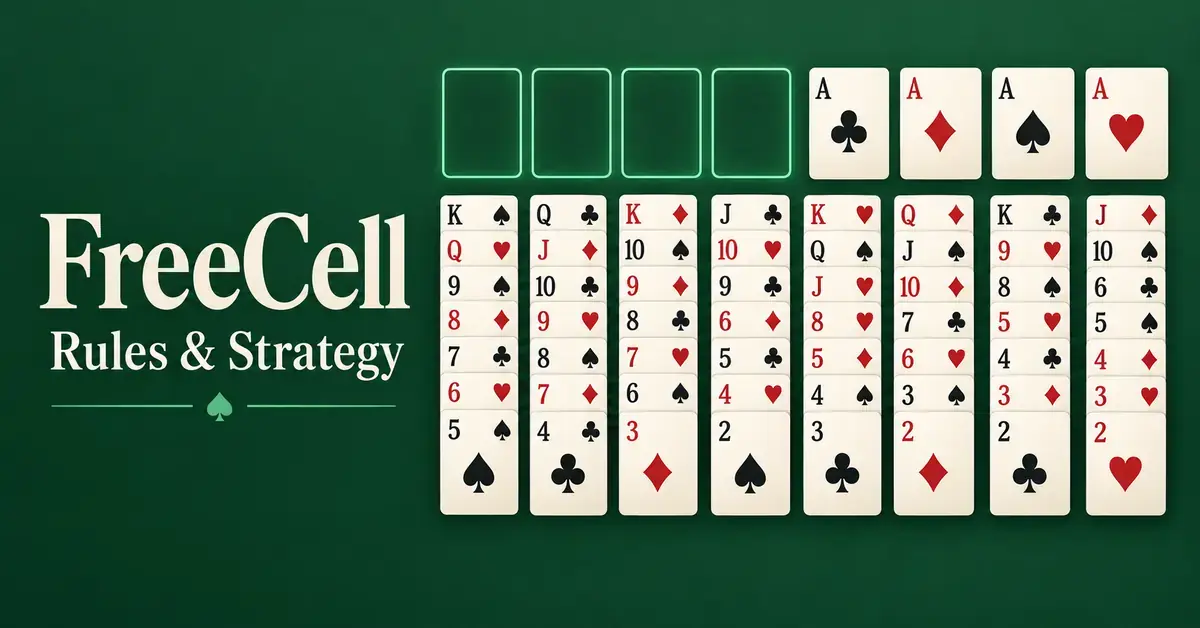
FreeCell is the solitaire game for players who like to win on skill rather than luck. Unlike most patience games, every card is dealt face-up from the start, so there is no hidden information and no stock pile to draw from. The result of a game depends almost entirely on the decisions you make, which is why FreeCell has long been called the “thinking player’s solitaire.”
This guide explains how to play FreeCell from scratch: the layout, the legal moves, the all-important free cells, and the strategy that turns a tricky board into a completed game. It also answers the question nearly every player eventually asks, is every deal really winnable? The short answer is almost, and the detail below explains exactly why.
What Is FreeCell Solitaire?
FreeCell is a single-player card game played with one standard 52-card deck. The aim is to move all 52 cards onto four foundation piles, one for each suit, building each one upward from the Ace to the King. What makes FreeCell distinctive is its four “free cells,” temporary parking spaces that hold one card each and give you room to manoeuvre.
Because the whole deck is visible from the first moment, FreeCell is a game of pure planning. There is no shuffling of a waste pile and no luck of the draw once the deal is set. That open-information design is the reason the overwhelming majority of FreeCell deals can be solved by a careful player, a trait that sets it apart from the classic hidden-card games such as classic Klondike solitaire.
FreeCell Quick Facts
| Feature | Detail |
|---|---|
| Players | 1 (single-player) |
| Deck | One standard 52-card deck |
| Tableau columns | 8 cascades (four of 7 cards, four of 6 cards) |
| Free cells | 4 (hold one card each) |
| Foundations | 4, one per suit |
| Cards face-up | All 52, from the start |
| Tableau building | Down by rank, alternating colours |
| Foundation building | Up by suit, Ace to King |
| Goal | Move all 52 cards to the foundations |
| Deals solvable | About 99.999% |
The FreeCell Table: Setup and Layout
Shuffle a single 52-card deck and deal every card face-up. The table has three distinct areas: the tableau (the main playing columns), the free cells (top-left), and the foundations (top-right).
The eight tableau columns
Deal the deck into eight columns, called cascades. Four of the columns receive seven cards each and the other four receive six cards each, which accounts for all 52 cards (4 x 7 plus 4 x 6). Every card is face-up and fanned so you can read the whole column. Only the bottom card of each column, the one nearest you, is immediately available to move.
The four free cells
Above the tableau sit four empty free cells. Each cell can hold exactly one card of any rank or suit at a time. Think of them as a small amount of temporary storage: you move a card into a cell to get it out of the way, then move it back onto the tableau or up to a foundation when the moment is right. Managing these four spaces well is the heart of FreeCell strategy.
The four foundations
The four foundation piles are where you win the game. Each foundation is built up by suit, starting with the Ace and continuing 2, 3, 4 and so on up to the King. You will have one foundation for spades, one for hearts, one for diamonds and one for clubs. When all four foundations reach the King, the game is complete.
How to Play FreeCell: The Rules Step by Step
The rules are simple to state, but they reward careful thought on every move.
The goal
Build all four suits up from Ace to King on the foundations. Move every one of the 52 cards from the tableau and free cells onto the foundations to win.
Legal moves on the tableau
Within the tableau you build sequences downward in rank and alternating in colour. That means a black card can only be placed on a red card one rank higher, and a red card only on a black card one rank higher. For example, a red six can go onto a black seven, and a black five can then go onto that red six. This alternating-colour rule is exactly the pattern used in Klondike, so players who already know standard solitaire will feel at home.
Using the free cells and foundations
At any time you may move the bottom card of a column, or a card sitting in a free cell, to one of the following: a free cell (if it is empty), the top of another column (if it follows the alternating-colour sequence), an empty column (any card may go there), or its matching foundation (if it is the next rank up). Aces are moved to the foundations as soon as they become available.
Moving more than one card: the supermove
Officially, FreeCell moves only one card at a time. In practice, most computer versions let you drag an ordered run of several cards at once as a convenience, known as a supermove. This is really just a shortcut for a series of single-card moves using your empty cells and columns as stepping stones, so the number of cards you can shift in one go is limited by how much free space you have.
The maximum number of cards you can move as a unit is given by a well-known formula: multiply (1 plus the number of empty free cells) by 2 raised to the power of the number of empty tableau columns. With all four free cells empty and no empty columns, that is (1 + 4) x 2^0 = 5 cards. Empty a single column and the limit doubles.
The Supermove Formula
Maximum cards you can move at once = (1 + empty free cells) × 2 ^ (empty tableau columns)
| Empty free cells | Empty columns | Cards movable |
|---|---|---|
| 4 | 0 | 5 |
| 3 | 0 | 4 |
| 4 | 1 | 10 |
| 4 | 2 | 20 |
| 2 | 1 | 6 |
Every empty free cell adds one more card to the run, while every empty column doubles it. This is why clearing a column is so powerful.
How to Win at FreeCell: Strategy That Works
Because FreeCell is almost always solvable, losing usually comes down to avoidable mistakes rather than a bad deal. These principles will dramatically raise your win rate.
Plan several moves ahead before you touch a card
Every card is visible, so take advantage of that. Before moving anything, scan the board and ask where the low cards are buried and what you need to dig out first. The best FreeCell players think in sequences of moves, not single clicks.
Free the aces and low cards early
Aces and twos must reach the foundations before anything can be built on top of them. Prioritise uncovering buried aces and low cards early, because a deeply trapped ace can stall an entire suit for the rest of the game.
Guard your free cells like gold
Each occupied free cell shrinks the number of cards you can move at once and limits your options. Treat the cells as short-term storage only, and always have a plan to empty a cell soon after you fill it. A game with all four cells clogged and no empty column is often already lost.
Work to empty a whole column
An empty column is the single most powerful resource in FreeCell. It can hold any card, and it multiplies the size of your supermoves. Clearing a short column early gives you enormous flexibility later, so it is often worth a few extra moves to achieve.
Do not rush cards to the foundations
It is tempting to send every eligible card up to its foundation, but a mid-rank card on the tableau is sometimes exactly the landing spot another card needs. Keep a card or two in reserve on the tableau when it helps you build longer alternating-colour runs.
Why (Almost) Every FreeCell Deal Is Winnable
FreeCell’s reputation for being solvable is well earned, and the numbers behind it are specific. The version that Microsoft bundled with Windows used 32,000 numbered deals, and of those, exactly one, deal number 11982, has been proven unsolvable with the standard four free cells. Every other deal in that original set can be won with perfect play.
When later Windows editions expanded the game to a million numbered deals, exhaustive computer analysis found only eight unsolvable deals among the first million: numbers 11982, 146692, 186216, 455889, 495505, 512118, 517776 and 781948. Interestingly, each of those eight becomes solvable if you are given just one extra free cell. Across all possible random deals, researchers estimate that around 99.999% are solvable, roughly one impossible deal in every 84,000.
That near-total solvability is what makes FreeCell feel so fair. If you lose, you can almost always assume a better line of play existed, which is a very different experience from luck-driven games where some deals simply cannot be won.
FreeCell Compared to Other Solitaire Games
FreeCell belongs to a wider family of patience games, each with its own flavour. The table below compares it with other popular single-player card games covered on this site, so you can see where FreeCell’s open-information, high-skill design fits in.
Solitaire Variant Comparison
| Game | Decks | Cards face-up | Tableau build | Winnability | Difficulty |
|---|---|---|---|---|---|
| FreeCell | 1 (52 cards) | All cards | Down, alternating colour | ~99.999% solvable | Skill-based, forgiving |
| Klondike | 1 (52 cards) | Partly hidden | Down, alternating colour | Roughly 80% or less | Luck and skill |
| Yukon | 1 (52 cards) | Mostly face-up | Down, alternating colour | High | Moderate |
| Scorpion | 1 (52 cards) | Partly hidden | Down, same suit | Moderate | Challenging |
| Golf | 1 (52 cards) | All tableau cards | Up or down by rank | Variable | Quick and light |
| Forty Thieves | 2 (104 cards) | Mostly face-up | Down, same suit | Low | Very difficult |
If you enjoy FreeCell’s open layout, you may also like Yukon solitaire, which also deals most cards face-up but keeps a run of hidden cards in each column, and Scorpion solitaire, a spider-style game that builds long same-suit sequences. For a faster, lighter session, Golf solitaire is a good change of pace, while Forty Thieves uses two decks for a much tougher challenge.
A Short History of FreeCell
FreeCell’s design traces back to an older patience game described by C.L. Baker, which Martin Gardner wrote about in Scientific American in 1968. In 1978, Paul Alfille, then a medical student at the University of Illinois, built the first computerised version using the TUTOR language on the PLATO educational computer system. His key change was to make the tableau build by alternating colours rather than by suit, creating FreeCell as we know it.
The game reached a mass audience through Microsoft. Jim Horne, who had seen the PLATO version, wrote a shareware DOS version in the late 1980s and later ported it to Windows after joining Microsoft. FreeCell first shipped as a test program for the 32-bit Win32s add-on, then appeared in the Microsoft Entertainment Pack, and has been included with essentially every release of Windows since 1995. That bundling turned a niche computer-lab curiosity into one of the most-played card games in the world. For more background on how card games spread in this country, see our feature on the history of playing cards in Canada.
Reference Sources
Frequently Asked Questions
Is FreeCell harder than regular solitaire?
In one sense it is easier, because all the cards are visible from the start, so there is no guessing and nearly every deal can be won. In another sense it is harder, because the responsibility for winning is entirely on you. In classic Klondike a bad shuffle can doom a game, but in FreeCell a loss almost always means a better sequence of moves was available.
How many cards can I move at once in FreeCell?
Officially you move one card at a time, but most digital versions let you drag an ordered run as a shortcut. The maximum size of that run equals (1 plus the number of empty free cells) multiplied by 2 to the power of the number of empty tableau columns. With four empty cells and no empty columns you can move five cards; each empty column doubles that number.
Can every FreeCell game be won?
Almost, but not quite. Among the original 32,000 Microsoft deals only deal number 11982 is unsolvable, and among the first million Windows deals just eight are impossible with the standard four free cells. Overall, roughly 99.999% of all possible deals can be solved with perfect play.
What is the difference between a free cell and a foundation?
A free cell is temporary storage that holds a single card of any kind so you can get it out of the way. A foundation is a goal pile that is built up by suit from the Ace to the King. Cards in free cells are still in play and must eventually move onto the tableau or up to a foundation; cards on the foundations are effectively finished.
Why are my moves getting blocked near the end of a game?
This usually happens when all four free cells are occupied and you have no empty columns, which leaves you no room to reorganise. The fix is preventative: keep at least one cell free whenever possible, aim to empty a column early, and avoid burying low cards you will soon need on the foundations.