

Poker hand rankings are the single most important thing to learn before you sit down at any poker table. They are the fixed order that decides which five-card hand beats which, from the almost-unbeatable royal flush right down to a lonely high card. Whether you are playing a friendly kitchen-table game or a real-money table, the same ladder of hands applies, and knowing it by heart is the difference between confident play and costly guesswork.
This guide lists all ten poker hands in order from strongest to weakest, explains each one in plain language with a clear card example, and shows exactly how often each hand appears. You will also learn how ties are broken, how aces behave in straights, and why the rarest hands are always the most powerful. A printable-style ranking chart is included so you can check any hand at a glance.
Key Takeaways
Poker hand rankings at a glance
- There are 10 standard poker hands, ranked from the royal flush (best) down to a high card (worst).
- The rule behind the order is simple: the rarer the hand, the higher it ranks.
- Every hand is built from five cards; suits have no ranking value of their own.
- A flush beats a straight in standard poker, and ties are settled by kickers.
- The same ranking applies across Texas Hold’em, Omaha and most poker games, with a few specialty exceptions.
What Are Poker Hand Rankings?
A poker hand is made up of five cards. Poker hand rankings are the universal system that ranks every possible five-card combination against every other, so that when two or more players reach a showdown, there is always a clear winner. The rankings are built on a simple idea: the harder a hand is to make, the higher it ranks.
A standard 52-card deck has four suits (spades, hearts, diamonds and clubs) and thirteen ranks in each suit. From ace down to two, the ranks are used to form pairs, sequences (called straights) and same-suit groups (called flushes). There are exactly 2,598,960 different five-card hands you can be dealt, and every one of them fits into one of the ten categories below.
Crucially, suits have no ranking value of their own in most poker games. A flush in spades does not beat a flush in hearts; only the card ranks matter. This is different from some other card games, so it is worth remembering from the start.
Poker Hand Rankings in Order (Strongest to Weakest)
Here are all ten hands from best to worst. Each entry includes a beginner-friendly definition, a sample hand, and the odds of being dealt it in a five-card deal. Use the chart below as your quick reference, then read on for the detail behind each hand.
Poker Hand Rankings Chart
| Rank | Hand | Example | Combinations | Odds (5 cards) |
|---|---|---|---|---|
| 1 | Royal Flush | 10-J-Q-K-A, same suit | 4 | 1 in 649,740 |
| 2 | Straight Flush | 5-6-7-8-9, same suit | 36 | 1 in 72,193 |
| 3 | Four of a Kind | K-K-K-K-2 | 624 | 1 in 4,165 |
| 4 | Full House | Q-Q-Q-9-9 | 3,744 | 1 in 694 |
| 5 | Flush | 2-6-9-J-K, same suit | 5,108 | 1 in 509 |
| 6 | Straight | 6-7-8-9-10, mixed suits | 10,200 | 1 in 255 |
| 7 | Three of a Kind | 8-8-8-K-4 | 54,912 | 1 in 47 |
| 8 | Two Pair | J-J-4-4-9 | 123,552 | 1 in 21 |
| 9 | One Pair | 10-10-A-7-3 | 1,098,240 | 1 in 2.4 |
| 10 | High Card | A-J-8-5-2, no match | 1,302,540 | 1 in 2 |
1. Royal Flush
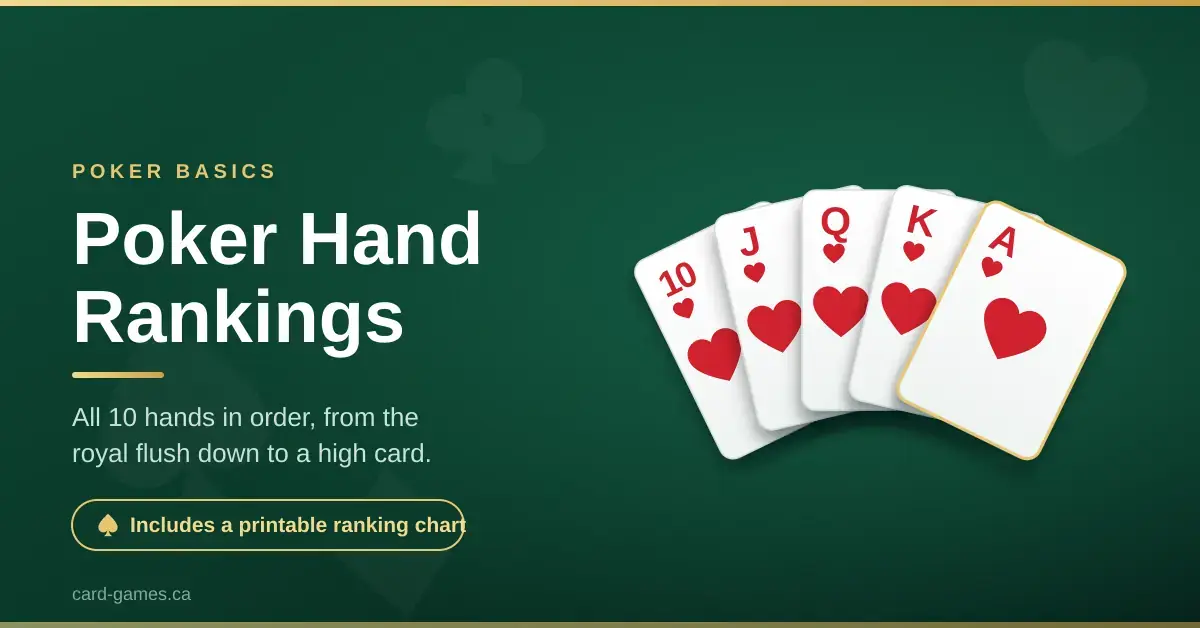
The royal flush is the best possible hand in poker and cannot be beaten. It is an ace-high straight flush: the ten, jack, queen, king and ace all of the same suit, for example 10♥ J♥ Q♥ K♥ A♥. There are only four of them in the entire deck, one for each suit, which makes it the rarest hand of all. The odds of being dealt a royal flush in five cards are roughly 1 in 649,740.
2. Straight Flush
A straight flush is five cards in a row that are all the same suit, such as 5♣ 6♣ 7♣ 8♣ 9♣. It ranks just below the royal flush (which is simply the highest straight flush). When two players both hold a straight flush, the one with the higher top card wins. There are 36 possible straight flushes, giving odds of about 1 in 72,193.
3. Four of a Kind
Also called “quads,” four of a kind is all four cards of the same rank, plus one extra card known as the kicker. An example is K♠ K♥ K♣ K♦ 2♠. If two players somehow hold four of a kind, the higher rank wins. With 624 combinations, the odds are around 1 in 4,165.
4. Full House
A full house, sometimes called a “boat,” is three cards of one rank combined with a pair of another, such as Q♠ Q♥ Q♣ 9♠ 9♦. It is ranked first by the three matching cards, then by the pair, so three queens with a pair of nines beats three jacks with a pair of aces. There are 3,744 full houses, or about 1 in 694.
5. Flush
A flush is any five cards of the same suit that are not in sequence, for example 2♦ 6♦ 9♦ J♦ K♦. When two flushes meet, the winner is decided by comparing the highest card, then the next highest, and so on. There are 5,108 flushes, giving odds of roughly 1 in 509.
6. Straight
A straight is five cards in sequence of mixed suits, such as 6♠ 7♥ 8♣ 9♦ 10♠. The highest card decides which straight wins. A straight beats three of a kind but loses to a flush. There are 10,200 possible straights, or about 1 in 255.
7. Three of a Kind
Three of a kind, also called “trips” or a “set,” is three cards of the same rank plus two unrelated cards, for example 8♠ 8♥ 8♣ K♦ 4♠. Higher matching cards win, and the two side cards act as kickers if needed. With 54,912 combinations, the odds are about 1 in 47.
8. Two Pair
Two pair is exactly what it sounds like: two cards of one rank, two cards of another, and a fifth kicker card, such as J♠ J♥ 4♣ 4♦ 9♠. The higher pair is compared first, then the lower pair, then the kicker. There are 123,552 two-pair hands, giving odds of roughly 1 in 21.
9. One Pair
One pair is a single pair of matching cards with three unrelated cards, for example 10♠ 10♥ A♣ 7♦ 3♠. When two players hold the same pair, the highest kicker decides the winner. This is a common hand: with 1,098,240 combinations it appears roughly once every 2.4 deals, or about 42% of the time.
10. High Card
When a hand contains no pair, no straight and no flush, it is judged only by its highest card, which is why it is called a high card hand. An example is A♠ J♥ 8♣ 5♦ 2♠, described as “ace high.” It is the weakest holding in poker, yet it is also the most likely, appearing just over half the time. If highest cards tie, the next highest cards are compared in turn.
How Poker Hands Are Built: Suits, Ranks and the Five-Card Hand
Every ranked hand is assembled from five cards, but where those cards come from depends on the game. In draw games you form a hand from the five cards in your hand. In community-card games such as Texas Hold’em, you make the best five-card hand from your two private cards plus five shared community cards. In stud games like Seven-Card Stud, you build your best five out of seven dealt cards.
No matter how the cards reach you, the ranking ladder never changes. The three building blocks to watch for are matching ranks (pairs, trips, quads and full houses), sequences of five (straights), and five cards sharing a suit (flushes). The strongest hands, such as the straight flush, combine a sequence and a suit at the same time, which is exactly why they are so rare.
How Ties Are Broken: Kickers and High Cards
Many pots are decided not by the type of hand but by the cards inside it. When two players share the same category, poker uses a tie-break system based on card values.
- Compare the ranked cards first. Two players with one pair compare the pair itself before anything else, so a pair of kings beats a pair of tens.
- Then compare kickers. A kicker is an unmatched side card. If both players hold a pair of kings, the highest side card wins, then the next, and so on down the hand.
- Suits never break ties. If two hands are identical in rank, the pot is split. A club flush and a spade flush of the same values tie exactly.
Kickers are one of the most misunderstood parts of poker for beginners, and they explain why two players with the same pair can still win or lose a hand.
Special Cases: The Wheel, Broadway and How Aces Behave
The ace is the only card that can act as both the highest and the lowest card, which creates two straights worth knowing by name. The highest straight, 10-J-Q-K-A, is nicknamed “Broadway.” The lowest straight, A-2-3-4-5, is called the “wheel” or a “five-high straight,” where the ace plays low. Importantly, the ace cannot wrap around the corner: a hand like Q-K-A-2-3 is not a straight.
These edge cases matter at showdown. In a five-high straight the ace counts as a one, so the wheel loses to every other straight, including 2-3-4-5-6. Understanding this stops beginners from over-valuing a hand that contains an ace.
Why Rarer Hands Always Beat Common Ones
Poker hand rankings are not arbitrary; they follow probability exactly. The rarer a hand is to make from a shuffled deck, the higher it sits on the ladder. That is why a flush beats a straight (flushes are slightly rarer) and why four of a kind beats a full house.
Of all 2,598,960 five-card hands, more than half contain no pair at all, which is why high card is both the weakest and the most frequent result. At the other extreme, only four hands in the entire deck are royal flushes. Seeing the odds side by side makes the whole system click, and it also builds a realistic sense of how often big hands actually appear.
Do Hand Rankings Change Between Poker Games?
For the vast majority of poker games, the ten-hand ranking above is identical. What changes is how valuable a given hand tends to be, because that depends on how many cards you see and how many opponents you face. In Omaha, for instance, players receive four hole cards and must use exactly two of them, so strong hands appear far more often than in Hold’em, and a plain flush wins less frequently.
A few specialty and casino formats add their own twist. Table games such as Three Card Poker use only three cards, which reshuffles the order so that a straight actually beats a flush. Others, like Pai Gow Poker, split your cards into two separate hands. And some “lowball” variants reverse the rankings entirely so the worst hand wins. When you branch out into different casino card games, always confirm which ranking chart applies before you play.
Tips for Memorising the Rankings
Committing the order to memory is easier than it looks once you group the hands. Try these approaches:
- Learn the top and bottom first. Royal flush is unbeatable; high card is the floor. Everything else fits between.
- Group by pattern. The “matching” hands (pair, two pair, trips, full house, quads) and the “sequence and suit” hands (straight, flush, straight flush) each follow their own internal logic.
- Remember the flush-over-straight rule. The most common beginner mistake is thinking a straight beats a flush. It does not, in standard poker.
- Use a chart while you play. Keep the ranking chart nearby until the order is second nature; there is no shame in checking.
With a little practice the ladder becomes automatic, and reading the board at a glance is one of the first real skills every poker player develops.
Disclaimer: This article is educational information about poker hand rankings and card play, not gambling advice or encouragement to wager. Poker can be played for real money and carries financial risk. If you choose to play for stakes, do so responsibly, set limits and only play where it is legal in your province. Players in Canada who want support can contact the Responsible Gambling Council, reach ConnexOntario free at 1-866-531-2600, or consult their provincial regulator such as the Alcohol and Gaming Commission of Ontario (AGCO).
Reference Sources
Frequently Asked Questions
What is the number one hand in poker?
The royal flush is the highest and best hand in poker. It is an ace-high straight flush made of the ten, jack, queen, king and ace all in the same suit. Nothing beats it, and it can only ever be tied by another royal flush, in which case the pot is split.
Does a flush beat a straight in poker?
Yes. In standard poker a flush (five cards of the same suit) beats a straight (five cards in sequence of mixed suits). This is because flushes are slightly rarer than straights. The main exception is three-card games such as Three Card Poker, where the shorter hand length reverses that particular pairing.
What is a kicker in poker?
A kicker is an unmatched side card used to break ties when two players hold the same type of hand. For example, if both players have a pair of aces, the player with the highest additional card wins. Kickers are compared from highest to lowest until the tie is settled or the hands prove identical.
Can an ace be both high and low?
An ace can be high or low, but not both in the same straight. It plays high in the Broadway straight (10-J-Q-K-A) and low in the wheel (A-2-3-4-5). It cannot wrap around the top, so a sequence like K-A-2-3-4 does not count as a straight.
Do poker hand rankings change between different games?
The core ten-hand ranking is the same across most popular poker games, including Texas Hold’em, Omaha and Seven-Card Stud. What changes is how often each hand appears and how much it is worth, which depends on the format. A handful of variants, such as three-card and lowball games, use their own adjusted ranking systems.